


You’ve spent hours filming, editing, and polishing a video you’re genuinely proud of. You hit publish, and then… nothing. A handful of views, mostly from people who already subscribe to your channel.
This is one of the most frustrating parts of being a creator. Good content isn’t enough on its own — YouTube also has to know your video exists before it can show it to anyone. That’s where keyword research and competitor analysis come in, and it’s where a tool like Semrush can genuinely save you time.
This guide walks through how to use Semrush for YouTube SEO, step by step, from finding the right keywords to building a content plan you can actually stick to.
What Is Semrush and How Can It Help With YouTube SEO?
Semrush is an all-in-one SEO and marketing platform originally built for websites. It wasn’t designed exclusively for YouTube, but several of its tools translate surprisingly well to video content — especially since YouTube search behaves a lot like Google search.
For creators, the most useful parts of Semrush are:
- Keyword Overview and Keyword Magic Tool — for finding search terms and understanding demand
- Keyword Gap — for comparing what competing channels rank for versus you
- Topic Research — for generating content ideas around a broad subject
- Position Tracking — for monitoring how your videos perform over time when they’re indexed on Google
One thing worth setting expectations on early: Semrush pulls most of its keyword data from Google search, not directly from YouTube’s own search algorithm. It’s still genuinely useful, because a lot of search intent overlaps between the two, but it works best when you pair it with YouTube’s own signals, like autocomplete and YouTube Analytics, which we’ll cover later.
Step 1: Find YouTube Keywords With Semrush
Every video idea starts with a question: are people actually searching for this? Semrush helps answer that.
Start With a Seed Keyword
Open the Keyword Magic Tool and type in a broad topic related to your channel — something like “home workout” or “sourdough bread.” Semrush will generate a large list of related keywords and questions people are searching for.
From there, look at four things for each keyword:
- Search volume — roughly how many people search this term per month
- Keyword difficulty — how hard it would be to rank or compete for this term
- Search intent — what the searcher actually wants (informational, commercial, navigational, or transactional)
- Related keywords and questions — variations and follow-up searches tied to the same topic
Why the Highest Search Volume Isn’t Always the Best Choice
It’s tempting to sort by search volume and go straight for the biggest number. Resist that urge, especially early on.
High-volume keywords are almost always the most competitive ones, because every other creator sees the same big number and targets it too. A keyword with 50,000 monthly searches sounds great until you realize it’s dominated by channels with millions of subscribers and years of watch-time history behind them.
A smaller, more specific keyword — one with a few hundred or a few thousand searches a month — is often a better bet. It’s easier to rank for, and the people searching it tend to have clearer intent, which usually means better watch time and engagement once they click.
Long-tail keywords are especially useful here. Instead of targeting “home workout,” something like “20 minute home workout no equipment for beginners” is more specific, less competitive, and tells you exactly what the video needs to deliver.
Step 2: Identify Low-Competition Topics
Once you have a list of keyword ideas, the next job is filtering it down to topics you can realistically compete for — especially if your channel is newer or smaller.
In the Keyword Magic Tool, filter results by keyword difficulty and sort from low to high. Keywords in the lower difficulty range are generally more achievable, though the exact cutoff depends on your channel’s size and niche.
A few things to check for each candidate keyword:
- Does the search volume justify the effort, even if it’s modest?
- Are the top-ranking videos from small or mid-sized channels, or only from huge, established ones?
- Does the topic fit naturally into your channel’s niche, or would it feel out of place to your existing audience?
A good practice for newer channels is to build a mix: a few low-competition keywords you can realistically rank for now, and one or two more ambitious ones to revisit once your channel has more authority.
Step 3: Analyze Competitors
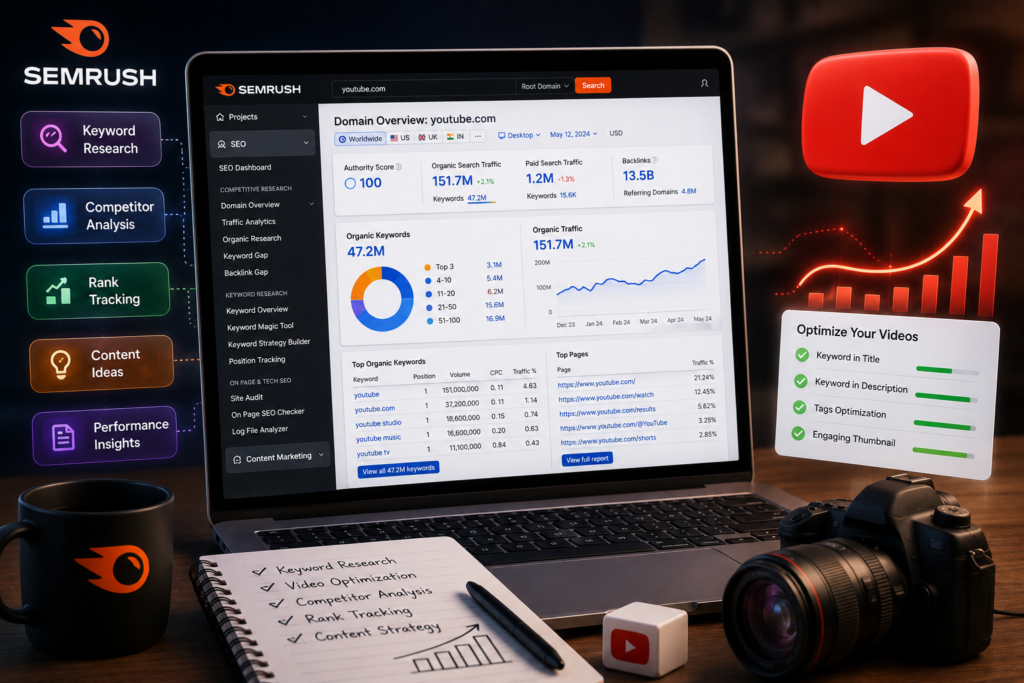
Competitor research isn’t about copying — it’s about understanding the landscape so you’re not guessing. Semrush makes this easier through tools like Keyword Gap and Organic Research, which were built for websites but work well when you point them at a competing channel’s website, blog, or top-ranking video pages.
When you look at competing channels, pay attention to:
- Topics they cover regularly — what subjects show up again and again
- Keywords they seem to be targeting, based on titles, descriptions, and tags
- Content gaps — topics your audience would care about that they haven’t covered, or haven’t covered well
- Video title patterns — the phrasing and structure that shows up across their top-performing videos
- Audience interests — what questions people are asking in the comments section
Content gaps are usually the most valuable find here. If three competing channels all cover the basics of a topic but none of them go deeper into a specific angle, that’s an opening.
The goal is inspiration, not imitation. Use what you learn to make informed decisions about your own content — your angle, your examples, your delivery — rather than recreating someone else’s video with a different face on camera. Audiences can usually tell the difference, and it doesn’t do much for your channel’s identity long-term.
Step 4: Create Better YouTube Titles
Your title has two jobs: help YouTube understand what the video is about, and make a real person want to click. Keyword research gives you the raw material for both.
Once you’ve chosen a target keyword, work it into your title naturally, ideally near the beginning. Then add a reason to click — a benefit, a number, a timeframe, or a bit of curiosity.
A few before-and-after examples:
- Before: “My Workout Routine” → After: “20-Minute Home Workout for Beginners (No Equipment)”
- Before: “Baking Bread” → After: “Easy Sourdough Bread Recipe for Beginners (Step-by-Step)”
- Before: “Budgeting Tips” → After: “How I Budget on a $50k Salary (Simple System That Works)”
Notice that none of these read like a keyword was force-fit into a sentence. If a title sounds awkward when you say it out loud, it’s probably trying too hard — rewrite it until it sounds like something a person would actually say.
Step 5: Optimize Your YouTube Description
The description is where you give both YouTube and your viewers more context. It doesn’t need to be long, but the first two or three sentences matter most, since that’s what shows before someone clicks “show more.”
A solid structure looks like this:
- Open with one or two sentences that naturally include your primary keyword and explain what the video covers
- Add a short paragraph with more detail — what the viewer will learn or get out of watching
- Mention a few related terms where they fit naturally, without forcing them in
- Include useful links — related videos, playlists, resources, or products mentioned in the video
- Add timestamps if the video covers multiple sections, since these help both viewers and YouTube understand structure
Avoid repeating your main keyword five times in five sentences. It reads poorly, and it doesn’t actually help your ranking the way it might have years ago. One natural, well-placed mention does more work than several forced ones.
Step 6: Build a YouTube Content Plan
Keyword research becomes far more useful when it turns into an actual content calendar instead of a spreadsheet you never open again.
Start with one broad topic from your niche, then use the Keyword Magic Tool and Topic Research to branch it into several related, more specific video ideas. For example, a broad topic like “meal prep” could turn into:
- “Meal Prep for Beginners: 5 Easy Recipes”
- “High-Protein Meal Prep on a Budget”
- “Meal Prep Containers: What Actually Works”
- “30-Minute Meal Prep for a Busy Work Week”
- “Meal Prep Mistakes That Ruin Your Food”
Group ideas like these into a simple calendar — even a basic spreadsheet with columns for topic, target keyword, difficulty, and publish date works fine. Mixing a couple of low-competition videos with one more ambitious topic each month keeps momentum going while you build toward bigger goals.
Step 7: Track and Improve Your Strategy
Keyword research tells you where to start, not how you’re actually doing. That part comes from watching real performance data over time, mainly through YouTube Analytics.
A few metrics worth checking regularly:
- Impressions — how often YouTube is showing your video’s thumbnail to people
- Click-through rate (CTR) — the percentage of people who see your thumbnail and actually click
- Watch time — the total minutes people spend watching, which strongly influences how YouTube ranks and recommends videos
- Audience retention — how much of the video people watch before clicking away
- Traffic sources — where your views are coming from, whether that’s YouTube search, suggested videos, or external sites
If a video has strong impressions but a weak click-through rate, the keyword targeting worked but the title or thumbnail isn’t convincing enough. If CTR is solid but retention drops fast, the content itself needs a closer look. Semrush helps you find the opportunity; YouTube Analytics tells you whether you actually took advantage of it.
Common YouTube SEO Mistakes to Avoid
- Targeting overly competitive keywords before your channel has the authority to rank for them
- Writing titles that are stuffed with keywords instead of sounding like something a person would say
- Stuffing descriptions with repeated keywords instead of writing naturally
- Ignoring search intent — targeting a keyword without checking what searchers actually expect to find
- Copying competitors directly instead of using their content for ideas and gaps
- Focusing only on search volume and ignoring competition and relevance
- Neglecting thumbnails and retention, since even a perfectly optimized title won’t help if people click away in the first ten seconds
Is Semrush Worth It for YouTube SEO?
Semrush isn’t a YouTube-specific tool, and it won’t magically fix a channel that’s struggling with content quality, thumbnails, or consistency. What it’s genuinely good at is taking the guesswork out of keyword research — showing you search volume, competition, and related terms in one place instead of piecing it together from scattered sources.
For creators who are serious about growth, run multiple content channels, or want structured competitor insights, it’s a solid investment. For a hobbyist posting occasionally, YouTube’s own search bar, autocomplete, and the “related searches” feature can cover the basics for free.
A reasonable middle ground: use Semrush’s free features or a trial to get a feel for how your niche’s keywords behave, then decide if the paid tier earns its place in your workflow.
Frequently Asked Questions
Can Semrush be used for YouTube keyword research?
Yes. Tools like the Keyword Magic Tool and Keyword Overview can surface search volume, related terms, and questions that work well for planning YouTube video topics, even though Semrush’s data is primarily sourced from Google search.
Is Semrush good for YouTube SEO?
It’s a strong option for keyword research and competitor analysis, but it’s not built exclusively for YouTube. It works best when paired with YouTube’s own tools, like Analytics and autocomplete, rather than used entirely on its own.
How do I find low-competition YouTube keywords?
In the Keyword Magic Tool, filter and sort by keyword difficulty, then check whether the top-ranking results are dominated by large channels or include smaller ones — that’s a good sign the topic is still winnable.
Can Semrush show YouTube search volume?
Semrush’s core search volume data reflects Google search rather than YouTube search specifically. It’s still a useful proxy for demand, since search behavior often overlaps, but it shouldn’t be treated as an exact match to YouTube’s internal numbers.
What is the best Semrush tool for YouTube SEO?
The Keyword Magic Tool is usually the most useful starting point, with Keyword Gap and Topic Research helpful for competitor research and content planning once you’ve settled on a direction.
Is Semrush better than YouTube Analytics for SEO?
They serve different purposes. Semrush helps you plan and research before you publish; YouTube Analytics tells you how videos are actually performing after they’re live. Using both together gives a fuller picture than either one alone.
Can Semrush help a new YouTube channel grow?
It can help by pointing new channels toward realistic, low-competition topics instead of competing head-on with established creators right away. Growth still depends on content quality and consistency, but better keyword choices give new videos a fairer chance of being found.
Try It for Your Next Video
Growing a YouTube channel is rarely about one big breakthrough — it’s usually a series of slightly better decisions made consistently over time. Choosing a keyword with realistic competition, writing a title people actually want to click, and following through with a clear content plan all add up.
If you’ve been publishing videos and hoping the algorithm figures it out on its own, it might be worth spending twenty minutes in Semrush’s Keyword Magic Tool before your next upload. Pick one topic, check the search demand and competition, and see if it changes how you plan the video. It’s a small step, but it’s one a lot of creators skip.