

Speed is the whole pitch with datacenter proxies. No ISP throttling, no flaky home Wi-Fi in the chain, just a server-grade connection built to fire off requests fast and cheap. If your project doesn’t need the extra camouflage of a residential IP, datacenter proxies are usually the smarter buy.
The problem is the market is crowded, pricing structures vary wildly, and “fast” doesn’t mean much if the provider’s pool is small, stale, or already flagged. So let’s get into where to buy datacenter IPv4 proxies, what actually separates a good pool from a mediocre one, and how to avoid paying for speed on paper that never shows up in practice.
What Are Datacenter IPv4 Proxies?
A datacenter proxy is an IP address hosted on a server in a data center rather than assigned by a residential ISP. Your requests get routed through that server, which swaps out your real IP before the traffic ever reaches the target site.
Because these IPs aren’t tied to a home internet connection, they’re not throttled by consumer bandwidth limits, which is exactly why datacenter proxies tend to be dramatically faster and cheaper than residential or mobile alternatives. The trade-off is that datacenter IPs are easier for websites to identify and blacklist, since they’re clearly coming from server infrastructure rather than a real household.
Why IPv4 Specifically?
Even with IPv6 gaining ground, IPv4 remains the default that virtually every website, API, and platform accepts without a second thought. If your project touches tools, dashboards, or targets that haven’t caught up to IPv6, IPv4 datacenter proxies are still the safer, more universally compatible choice.
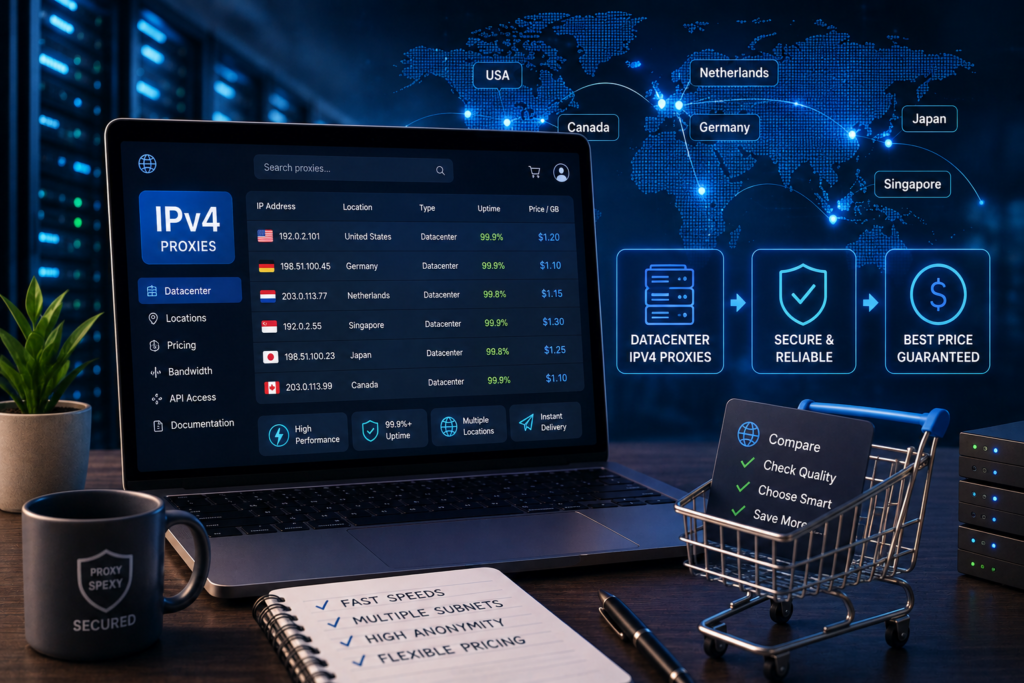
Where to Buy Datacenter IPv4 Proxies: The Real Options
Independent benchmarking consistently sorts the datacenter proxy market into a few clear tiers based on scale, pricing model, and how much hand-holding a provider offers.
Enterprise-Scale Providers
Bright Data sits at the top for large-scale operations, offering a three-tier structure that spans shared pay-per-GB pools, shared unlimited plans priced per proxy, and fully dedicated IPs with unlimited bandwidth. Oxylabs plays in the same league, with shared datacenter proxies across roughly two dozen countries and dedicated options that support city and state-level targeting, making it a strong fit for large-scale scraping projects that need geographic precision.
Balanced, Mid-Market Providers
Decodo and DataImpulse consistently show up as strong all-rounders in independent testing. Decodo offers both shared and dedicated pools with per-connection rotation and competitive per-gigabyte pricing, while DataImpulse covers close to 200 locations with country, state, city, ASN, and ZIP-level targeting alongside HTTP(S) and SOCKS5 support. These are solid picks if you want reliable performance without enterprise-level pricing.
Budget and Beginner-Friendly Providers
Webshare has built a reputation as one of the most affordable entry points into datacenter proxies, and independent benchmarks have found it holding its own on response time against pricier competitors. IPRoyal and Proxy-Seller both offer low-cost single-IP pricing, which makes them attractive for small projects, though it’s worth noting some budget providers restrict targeting to one country per plan or run into limited city-level stock.
Explore high-speed datacenter IPv4 proxy plans
Don’t overpay for proxy IPs.
Compare datacenter IPv4 proxy providers and find the right balance between price, speed, and reliability.
Specialized and Niche Providers
Providers like Rayobyte and ProxyScrape round out the market with rotating datacenter pools and flexible short-term packages, often appealing to users who want to test a small batch of IPs before committing to a bigger plan. If your use case is narrow, these smaller providers can be worth a look, provided you check their money-back or trial terms first.
What Actually Matters When You’re Buying?
The price-per-IP number is what grabs attention, but it’s rarely what determines whether your project actually runs smoothly. Run every provider through this checklist before you commit.
- Shared vs. dedicated: Shared IPs are cheaper but riskier since other users’ activity on the same address can get it flagged. Dedicated IPs cost more but are exclusively yours.
- Pool size and freshness: A small, tired pool means a higher chance you’re reusing an IP someone else already burned.
- Geo-targeting depth: Confirm whether the provider supports country-only targeting or goes down to city, state, or ASN level, depending on what your project needs.
- Rotation options: Check whether IPs rotate per request, on a timer, or stay static, and make sure that matches your workflow.
- Protocol support: Not every provider supports SOCKS5 alongside HTTP(S), so confirm compatibility with your tools before buying.
- Transparent pricing: Watch for “unlimited” claims that hide fair-use caps, and favor providers with clear per-GB or per-IP pricing instead.
Shared, Private, or Dedicated: Which Should You Buy?
- Shared datacenter proxies: The IP pool is used by multiple customers simultaneously. Cheapest option, fine for light, low-risk tasks.
- Private (semi-dedicated) datacenter proxies: Shared with only one or two other users, offering a middle ground on both cost and reliability.
- Dedicated datacenter proxies: The IP is exclusively yours. Best performance and reputation, but priced at a premium and usually the right call for scraping projects at scale.
Check the latest proxy deals and choose a plan that fits your needs
Need affordable, fast, and scalable proxy IPs?
Datacenter IPv4 proxies can be a cost-effective choice for businesses, developers, marketers, and data professionals. Compare providers based on IP quality, locations, bandwidth, speed, and pricing before making your choice.
What Should You Expect to Pay?
Datacenter IPv4 proxies remain the cheapest proxy category on the market, largely because the infrastructure is simple to scale and IPs are far more abundant than residential addresses. Entry-level single-IP plans can run just a couple of dollars, while larger bandwidth-based plans from enterprise providers scale into the hundreds of dollars a month for terabyte-level traffic. Free trials, small starter packages, and money-back windows are common across the market, so there’s rarely a good reason to commit to a large plan before testing a smaller one first.
The Bottom Line
There’s no single best answer to where to buy datacenter IPv4 proxies — it comes down to your budget, how much geographic precision you need, and whether shared or dedicated IPs make sense for your risk tolerance. Enterprise providers earn their premium with scale and granular targeting. Mid-market providers offer the best balance for most everyday projects. Budget providers are perfectly capable for smaller, lower-stakes tasks.
Whichever tier you land on, test a small batch first, confirm the provider’s targeting actually covers what you need, and don’t assume the cheapest IP is the most expensive mistake — sometimes it’s the other way around.
FAQ: Buying Datacenter IPv4 Proxies
Are datacenter IPv4 proxies good for web scraping?
Yes, especially for scraping tasks that prioritize speed and cost over stealth. Datacenter proxies are typically much faster and cheaper than residential alternatives, though sites with aggressive bot detection may flag them more easily since the IPs are clearly tied to server infrastructure rather than a home connection.
What’s the difference between shared and dedicated datacenter proxies?
A shared datacenter proxy is used by multiple customers at once, which keeps the price low but raises the chance of inheriting a flagged IP from another user’s activity. A dedicated proxy is assigned exclusively to you, which costs more but offers better reliability and a cleaner reputation.
How much do datacenter IPv4 proxies typically cost?
Pricing varies by provider and plan structure, but entry-level single-IP options can cost just a few dollars, while larger bandwidth-based plans from enterprise providers can run into the hundreds of dollars per month for high-volume traffic. Per-gigabyte and per-IP pricing models both exist, so it pays to compare based on your actual usage pattern.
Can I get city-level targeting with datacenter proxies?
Many providers do offer city or state-level targeting, though coverage depth varies significantly. Some budget providers restrict plans to a single country or run into limited stock for specific cities, so it’s worth confirming availability for your exact target location before buying.
How do I know if a datacenter proxy provider is trustworthy before paying?
Look for transparent per-GB or per-IP pricing without vague “unlimited” claims, a visible support channel, and either a free trial or a money-back guarantee window. Independent benchmarks that test real success rates and response times are also a reliable way to sanity-check a provider’s claims before you commit.
Ready to Buy Datacenter IPv4 Proxies That Actually Deliver?
You’ve got the tiers, the trade-offs, and the checklist — now it’s time to put a provider to the test. Grab a small plan or free trial, run it against your real workload, and see how it holds up before scaling. The right datacenter IPv4 proxy is fast, affordable, and reliable enough that you stop thinking about it and get back to the work it’s supposed to support.