
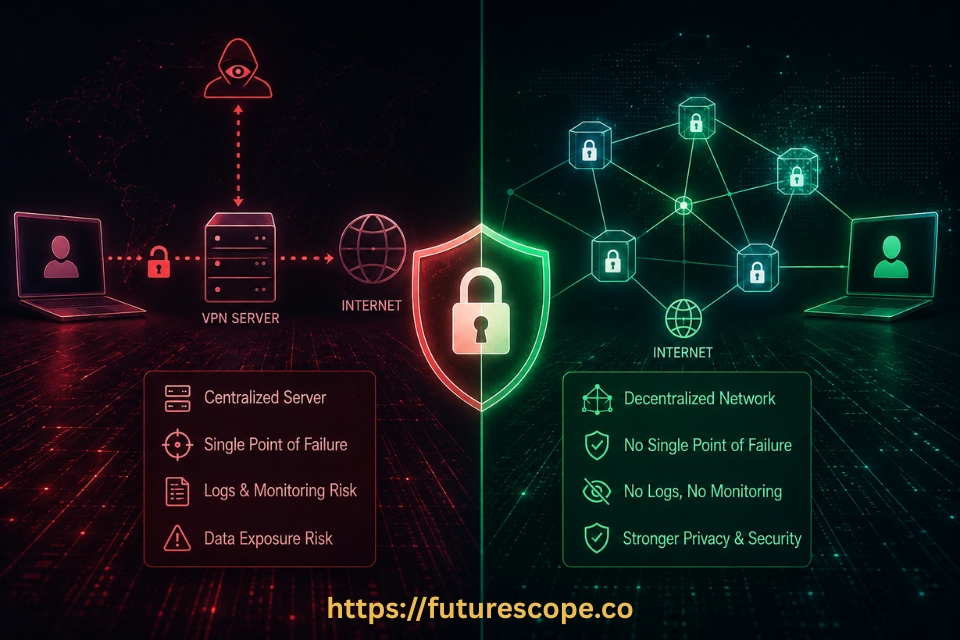

No company to trust. No central server to hack. Sounds perfect, right? The reality of decentralized VPN security is messier than the pitch.
Decentralized VPNs, or dVPNs, market themselves with a tempting pitch: no central company to trust, no single server farm to hack, no corporate logs that could be subpoenaed. Just a peer-to-peer network of regular people’s devices routing your traffic around the internet.
It sounds like the obvious evolution of VPN technology. But does decentralized VPN security actually hold up under scrutiny, or is this another case of blockchain branding outpacing the engineering behind it?
The honest answer, after digging into how these networks actually function, is more nuanced than either camp wants to admit. In this guide, I’ll explain what a decentralized VPN actually is, how it stacks up against traditional VPNs feature by feature, which type genuinely offers stronger security, and what blockchain has to do with any of this.
What Exactly Is a Decentralized VPN?
A decentralized VPN is a type of VPN where other users’ devices act as the VPN servers, rather than a private server fleet owned and operated by a single company. The basic goal is identical to a traditional VPN — mask your IP address and encrypt your traffic by routing it through a device somewhere else — but the infrastructure behind that goal is fundamentally different.
Here’s how the connection actually works, step by step: you open your dVPN client, which is usually an app, and either pick or get automatically assigned an available exit node — someone else’s laptop, phone, or server volunteering bandwidth to the network. Your client encrypts your traffic and routes it through that node. The node decrypts the traffic and forwards it to your destination, so the website you’re visiting only ever sees the node’s IP address, never yours. Return traffic follows the same path in reverse.
The people running these nodes are usually called “peers,” since everyone on the network holds roughly equal standing — there’s no central hub overseeing the whole system. Many dVPNs operate on a pay-per-session model rather than a monthly subscription: when your connection closes, your client sends a small payment, typically in cryptocurrency, to the node operator as compensation for the bandwidth you used.
This is the core philosophical shift: instead of trusting one company’s privacy policy, you’re trusting a distributed network of strangers’ devices and the protocol that coordinates them.
The Core Tradeoff: A traditional VPN asks you to trust one company. A decentralized VPN asks you to trust a crowd of anonymous strangers instead. Neither option eliminates trust — it just relocates where that trust has to be placed.

Decentralized VPN (dVPN) vs. Traditional VPN: Head-to-Head
Let’s compare both models across the factors that actually matter for your security and privacy:
Who controls the infrastructure
Traditional VPN: A single company owns and operates the entire server fleet, giving them consistent control over security standards across every server.
Decentralized VPN: Infrastructure is run by individual users’ personal devices, with no central company owning or directly managing the hardware.
Logging risk
Traditional VPN: The provider could technically log your activity. You’re relying entirely on their privacy policy and, ideally, an independent audit confirming they don’t.
Decentralized VPN: No single company can log all traffic on the network since connections route directly between you and an individual node — but that node itself may still see your activity.
Connection consistency
Traditional VPN: Generally stable and fast, since the provider actively maintains server hardware and network capacity to a known standard.
Decentralized VPN: Highly variable. Performance depends entirely on the individual node you connect through, which could be a fast dedicated server or someone’s spotty home internet.
Vetting of exit points
Traditional VPN: All servers are owned, configured, and monitored by the same provider, ensuring a consistent security baseline.
Decentralized VPN: Nodes are often not rigorously vetted. A node could be poorly secured, or could be set up by a malicious actor specifically to intercept traffic.
Single point of failure
Traditional VPN: If the provider’s central infrastructure is compromised or compelled by legal action, the impact can be widespread across all users.
Decentralized VPN: No single node represents the whole network, so compromising one node doesn’t take down or expose the entire system — but it can still fully expose that node’s specific users.
Payment and accountability
Traditional VPN: Standard subscription billing, typically requiring some payment information tied to your identity unless you specifically use anonymous payment methods.
Decentralized VPN: Often pay-per-session via cryptocurrency, which can offer more payment anonymity, though it adds complexity for typical users.
Neither model is strictly superior across every category — they make different tradeoffs. Traditional VPNs centralize trust but deliver consistency. Decentralized VPNs distribute trust but introduce unpredictability.
Which VPN Type Is Actually Most Secure?
Here’s the part most dVPN marketing pages won’t tell you directly: it’s genuinely difficult to confirm that decentralized VPNs are more secure than traditional VPNs, mainly because dVPN operators tend to be secretive about exactly how their connections are made and secured. For now, the more reliable choice for protecting your data still tends to be a reputable traditional VPN — though that doesn’t mean dVPNs are inherently unsafe.
To understand why, it helps to know how each model actually protects you under the hood.
How Traditional VPNs Secure Your Data
When you connect to a traditional VPN, your connection runs through an encrypted tunnel using an established VPN protocol — OpenVPN, WireGuard, and similar standards that have been extensively documented, audited, and stress-tested by the security community for years. That encryption is genuinely strong: there’s no practical way for your ISP or the site you’re visiting to crack it. The one real weak point is whether the provider keeps logs of your activity, which is precisely why an independently audited no-logs policy matters so much when choosing a provider.
How Decentralized VPNs Secure Your Data
dVPNs work more like Tor than like a traditional VPN: your connection gets relayed through one or more nodes, and each node typically only knows the node immediately before and after it in the chain. The node at the very end — the exit node — is the one that can see which websites you’re connecting to, even if it can’t see exactly what you’re doing there thanks to HTTPS encryption. Some dVPN providers claim to solve this by routing DNS requests through private services and avoiding server-side logging entirely, but because most dVPN operators are notably tight-lipped about their exact security architecture, independently verifying these claims is difficult.
The Verdict, Honestly
Because of that lack of transparency and independent verification, it’s hard to definitively say dVPNs are more secure, despite that being their central marketing claim. They’re not necessarily less secure either — it’s more accurate to say dVPNs lean on the anonymity benefits of chaining multiple nodes together, the same fundamental approach Tor uses, rather than on the kind of well-documented, heavily audited encryption protocols that traditional VPNs rely on. That approach carries real benefits but also inherits some of Tor’s known weaknesses, including a meaningful speed and reliability tradeoff from routing through multiple, unpredictable, volunteer-run nodes.
A Real Security Risk: dVPN networks don't always rigorously vet the nodes that join them. A poorly secured node can become an easy target for hackers, and in some cases, the node itself could be set up specifically by a malicious operator to intercept unencrypted traffic. This is a structural risk that doesn't really have an equivalent in a well-run, centrally managed traditional VPN.
Blockchain-Based Decentralized VPNs: What’s the Connection?
Many dVPNs are built on blockchain technology, and understanding why helps explain both their appeal and their limitations.
Blockchain serves two main functions in a dVPN context. First, it enables the pay-per-session payment model: rather than a monthly subscription processed by a central billing system, your client can automatically transfer a small cryptocurrency payment directly to the node operator the moment your session ends, with the transaction recorded transparently on a public ledger. Second, blockchain reinforces the decentralized governance story — no single company controls the payment rails, the node registry, or the protocol rules, at least in theory.
This creates some genuinely attractive properties on paper:
- Dynamic, hard-to-block node lists: Because nodes constantly join and leave the network, compiling a static blocklist of dVPN exit IPs — something ISPs or streaming platforms might otherwise do — becomes much harder to maintain effectively.
- No central point of legal compulsion: There’s no single corporate entity that a government could serve a subpoena to and expect comprehensive logs in return, since no one company holds that data.
- Direct compensation for participants: Node operators can earn cryptocurrency for contributing bandwidth, creating an incentive structure that helps the network grow organically.
But blockchain integration doesn’t automatically solve the core security transparency problem. The underlying question — exactly how is the connection between you and a given node actually secured, and can that node see what you’re doing — remains largely unanswered by most blockchain-based dVPN whitepapers, which tend to emphasize the network’s resilience to being taken down as a whole rather than detailing the specific cryptographic protections for individual users. A network being hard to shut down entirely is a different property from any single connection within it being fully private and secure.
In practical terms: blockchain makes the payment and governance model genuinely decentralized, but it doesn’t, by itself, make your individual connection through any particular node more secure than it would otherwise be.
So What Should You Actually Do?
Given everything above, here’s a practical way to think about choosing between the two models:
- Choose a traditional VPN if: You want consistent, well-documented encryption, predictable speeds, and a security model that’s been extensively audited and tested over years. Look specifically for providers with an independently verified no-logs policy.
- Consider a dVPN if: You’re comfortable with variable performance, understand the node-trust tradeoffs involved, and are using it for lower-stakes activities — general browsing or accessing geo-restricted content — rather than anything where exposure carries serious consequences.
- Avoid relying solely on a dVPN if: You need strong, verifiable anonymity for high-risk activity. The current lack of transparency around how individual dVPN connections are secured makes them a riskier bet than an audited traditional VPN for anything sensitive.
- Either way, understand what you’re trusting: A traditional VPN asks you to trust one company’s stated policy. A dVPN asks you to trust an unknown collection of individual node operators, some of whom may not be vetted at all. Neither is automatically the safer bet — it depends on which kind of trust you’re more comfortable extending.
Frequently Asked Questions
1. Are decentralized VPNs definitely more private than traditional VPNs?
Not definitively, though there’s a real argument in their favor on one specific point: no single company can log all your traffic on a dVPN, since your connection routes directly between your device and an individual node rather than through a centralized server that one company fully controls. That said, the individual node you connect through can potentially see meaningful information about your activity, including the domains you visit even over HTTPS. Whether that tradeoff results in better overall privacy than a reputable, independently audited no-logs traditional VPN is genuinely unclear and depends heavily on the specific dVPN’s architecture.
2. Can the exit node on a dVPN see what websites I’m visiting?
Generally, yes, at least to some degree. The exit node in a dVPN connection is the point where your traffic leaves the encrypted network and enters the open internet, which means it can typically see the destination domain you’re connecting to, even when that connection itself is protected by HTTPS encryption. Some dVPN providers claim additional measures to keep nodes “blind” to this information, such as routing DNS requests through private services rather than the node itself, but independently verifying these specific claims is difficult given how little detail most dVPN operators publish about their security architecture.
3. Why are dVPNs often slower than traditional VPNs?
Speed gets sacrificed for the anonymity benefits that come from routing your connection through multiple, independently-operated nodes rather than a single well-maintained server. Each additional hop adds latency, and unlike a traditional VPN’s dedicated server infrastructure, a dVPN node might be running on someone’s home internet connection with limited, inconsistent bandwidth. The more nodes your connection passes through to achieve stronger anonymity, the slower and less stable that connection tends to become — a tradeoff dVPNs share with Tor.
4. Do I need to understand cryptocurrency to use a decentralized VPN?
Often, yes, at least at a basic level. Many dVPNs use a pay-per-session model where payment to node operators happens automatically in cryptocurrency rather than through a standard monthly subscription charged to a credit card. This means you may need a cryptocurrency wallet and a basic understanding of how to fund it before you can use certain dVPN services. This added complexity is one practical reason traditional VPNs remain more accessible for users who aren’t already comfortable with crypto.
5. Is a decentralized VPN the same thing as Tor?
No, though they share meaningful similarities. Both rely on volunteer-run, decentralized networks and use encryption to protect your anonymity, and both share the same fundamental weakness of relying on exit nodes that could potentially observe unencrypted or destination-identifying traffic. The key difference is that Tor routes your connection through three separate relay nodes for every session, with no ability to choose your path, which maximizes anonymity at a significant speed cost. A dVPN typically routes through a single node that you can often select yourself, similar to choosing a server location on a traditional VPN, making it faster and more stable than Tor but generally considered less private.
Choose Your Trust Model With Open Eyes
Decentralized VPN security isn’t a settled question yet — and anyone selling you a confident “dVPNs are definitely safer” pitch is skipping past the very real transparency gaps that still exist in how these networks actually protect individual connections.
That doesn’t mean dVPNs are bad. It means you need to choose deliberately, based on what you’re actually doing and how much that activity’s exposure would cost you.
Here’s how to move forward with confidence:
- If your data matters and you need consistent protection, choose a traditional VPN with an independently audited no-logs policy.
- If you’re curious about dVPNs, start with low-stakes use cases — general browsing, not sensitive activity — while you get comfortable with the model.
- Before trusting any dVPN, research how transparent the provider actually is about their node security and DNS handling.
- Never assume “decentralized” automatically means “more secure” — verify the specific claims rather than taking the marketing at face value.
- Whichever model you choose, understand exactly who or what you’re trusting — a company’s policy, or a network of anonymous nodes.
Privacy tools only work if you understand their actual guarantees, not just their promises. Choose the one whose tradeoffs genuinely fit your risk.
Written by a cybersecurity professional who believes ‘decentralized’ is a trust model, not a security guarantee