


The real languages hackers, defenders, and analysts actually use every day
A practical guide to choosing the right language for your cyber security path
Every aspiring cyber security professional eventually hits the same wall: which programming language should I actually learn? Search the topic online and you will find dozens of conflicting opinions, each insisting their favourite language is the one true answer.
Here is the honest truth that most of those articles skip over: there is no single best programming language for cyber security, because cyber security itself is not one job. It is an enormous field spanning penetration testing, malware analysis, security automation, incident response, secure software development, and digital forensics — and each of those specialisations leans on a different set of programming languages for very good reasons.
This guide cuts through the noise and gives you a clear, practical breakdown of exactly which programming languages matter most in cyber security, why they matter, and which ones you should prioritise based on the specific career path you are pursuing.
Why Programming Skills Matter So Much in Cyber Security
It is entirely possible to start a cyber security career with limited programming experience, particularly in roles focused on governance, compliance, or security awareness. But for the technical heart of the field — offensive security, defensive engineering, automation, and threat analysis — programming ability is what separates professionals who can only follow existing tools from those who can build, modify, and understand exactly what is happening underneath the surface.
Attackers write code to build exploits, malware, and automated attack tools. Defenders write code to build detection systems, automate repetitive security tasks, and analyse the tools and techniques attackers use against them. Understanding programming is not optional if you want to operate at a genuinely advanced level in this field — it is the shared language that connects every specialisation within cyber security.
Types of Programming Languages Used in Cyber Security
Before naming specific languages, it helps to understand the broad categories of programming and scripting languages relevant to security work, since different categories serve fundamentally different purposes.
- Scripting languages: lightweight, fast-to-write languages used for automation, quick tool development, and gluing other systems together — Python and Bash are the dominant examples in this category.
- Systems and low-level languages: languages that interact closely with hardware, memory, and operating system internals, essential for malware analysis, exploit development, and reverse engineering — C and C++ dominate here.
- Web development languages: languages used to build the web applications that are simultaneously the most common attack target and the foundation of web application security testing — JavaScript, PHP, and SQL are central.
- Specialised security and query languages: purpose-built languages and query syntaxes used specifically within security tools and platforms, such as SQL for database security testing and PowerShell for Windows-based security operations.
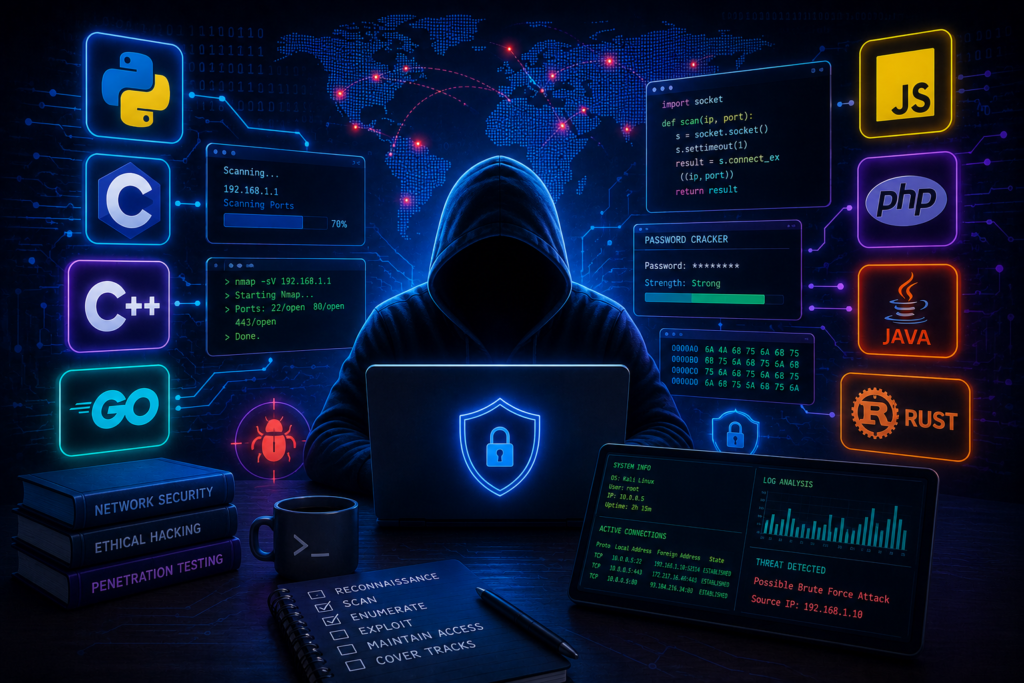
The Best Programming Languages for Cyber Security
With the categories established, here is a detailed look at the specific languages that carry the most weight across real-world cyber security work.
Python: The Universal Security Language
Python has become the default language across nearly every corner of cyber security, and for good reason. Its clean, readable syntax makes it fast to write and fast to learn, while its enormous ecosystem of libraries covers nearly every security use case imaginable — from network scanning and packet manipulation with Scapy, to web application testing, to building machine learning models for threat detection. Penetration testers use Python to write custom exploit scripts and automate reconnaissance. Security analysts use it to parse logs and automate repetitive investigation tasks. Malware analysts use it to write tools that dissect suspicious files. If you can only learn one language for cyber security, Python is consistently the recommendation given by professionals across nearly every specialisation.
C and C++: Essential for Understanding How Attacks Really Work
C and C++ sit much closer to the hardware and operating system than Python, which makes them essential for anyone working in exploit development, vulnerability research, or malware analysis. Most operating systems, and a significant share of the software running on them, are written in C or C++, and a huge proportion of serious vulnerabilities — buffer overflows, use-after-free errors, memory corruption bugs — occur specifically because of how these languages handle memory directly. Understanding C and C++ gives security professionals the ability to read and understand the source code of the systems they are testing, write their own exploits for vulnerabilities they discover, and reverse-engineer malware samples written in these languages, which the majority of serious malware still is.
JavaScript: The Backbone of Web Application Security
Since the overwhelming majority of modern web applications rely heavily on JavaScript for client-side functionality, understanding the language is essential for anyone working in web application security. Cross-site scripting attacks, one of the most common web vulnerabilities, exploit JavaScript directly. Security professionals testing web applications need to read, write, and manipulate JavaScript to identify vulnerabilities, build proof-of-concept exploits, and understand how modern single-page applications and APIs handle data and authentication.
SQL: Critical for Database Security and Injection Testing
SQL injection remains one of the most persistent and damaging vulnerability classes in web application security, consistently appearing in industry vulnerability rankings year after year. Understanding SQL is essential not just for recognising and exploiting injection vulnerabilities during penetration testing, but also for security professionals who need to query and analyse large security datasets, audit database permissions, and understand how applications interact with their underlying data stores.
Bash and PowerShell: The Languages of System Administration and Automation
Bash scripting is fundamental for anyone working with Linux-based security tools and systems, which describes the majority of penetration testing distributions and many enterprise security platforms. PowerShell plays the equivalent role within Windows environments, and has become increasingly central to both offensive security — since attackers heavily use PowerShell for post-exploitation activity on Windows networks — and defensive security, since security teams use PowerShell extensively to automate Windows administration, log collection, and incident response tasks.
| Practical Insight: Most experienced security professionals do not master a single language in isolation. They build working fluency across several languages, typically Python as a primary tool, alongside Bash or PowerShell for the operating system they work with most, and enough C or C++ to read and understand low-level code when investigating vulnerabilities or malware. |
Programming Languages for Specific Cyber Security Jobs
Different cyber security career paths place different priorities on which languages matter most, and understanding this mapping helps focus your learning effort productively.
- Penetration testers and ethical hackers: Python for automation and custom tooling, Bash for Linux-based testing environments, and a working knowledge of C for understanding and modifying exploit code.
- Malware analysts and reverse engineers: C and C++ are essential for understanding malware source code and behaviour, alongside assembly language for the deepest level of reverse engineering work, and Python for building analysis automation tools.
- Security operations centre analysts: SQL for querying security data, Python for automating investigation workflows, and PowerShell or Bash depending on whether the environment is primarily Windows or Linux-based.
- Web application security specialists: JavaScript and SQL are essential, alongside familiarity with whatever backend language a target application uses, commonly Python, PHP, Java, or Ruby.
- Security software developers and DevSecOps engineers: Python and Go have both become increasingly prominent for building security tools and automation infrastructure, alongside whatever language the broader engineering organisation primarily uses.
What Programming Languages Are Actually Used in Cybersecurity Day-to-Day?
Beyond the theoretical breakdown by specialisation, it is worth understanding what languages security professionals are actually writing and reading on a typical working day, since this differs somewhat from the idealised picture often presented in career guides.
In practice, the vast majority of day-to-day scripting and tool-building across cyber security roles happens in Python, simply because it is fast to write, easy to read, and has a library available for almost any task a security professional needs to accomplish. Shell scripting, whether Bash on Linux systems or PowerShell on Windows systems, is the second most universal skill, since nearly every security task eventually requires interacting directly with an operating system’s command line and automating repetitive administrative tasks.
C and C++ appear far less frequently in day-to-day scripting work, but become absolutely essential the moment a security professional needs to understand compiled software, analyse malware, or develop a working exploit for a memory corruption vulnerability — tasks that represent a smaller share of daily work for most security professionals but carry outsized importance in specialised offensive security and malware research roles. JavaScript and SQL appear constantly within web application security testing specifically, but are less central to network security, malware analysis, or governance-focused security roles.
Frequently Asked Questions
Q: What is the single best programming language to learn first for cyber security?
A: Python is consistently recommended as the best starting language for cyber security, regardless of which specific specialisation you eventually pursue. Its readable syntax makes it relatively quick to learn, and its extensive security-focused library ecosystem means you can apply what you learn directly to real security tasks almost immediately, whether that means writing a simple port scanner, automating log analysis, or building a basic web vulnerability scanner.
Q: Do I need to learn C and C++ if I want to work in cyber security?
A: It depends heavily on your chosen specialisation. If you are pursuing malware analysis, exploit development, or vulnerability research, C and C++ knowledge becomes essential, since you will regularly need to read, understand, and sometimes write code at this level. If your focus is on security operations, governance, web application testing, or general security analysis, you can build a successful career with much lighter C and C++ exposure, relying primarily on Python, scripting languages, and domain-specific tools instead.
Q: Is it necessary to know how to code at all to work in cyber security?
A: No, not for every role. Several cyber security career paths, including security governance, risk and compliance, security awareness training, and certain audit-focused roles, can be pursued successfully with limited programming experience, relying instead on policy knowledge, frameworks, and risk assessment skills. However, the more technical and hands-on roles within the field, including penetration testing, security engineering, malware analysis, and security automation, generally require solid programming ability, and even non-technical security roles benefit significantly from basic scripting literacy.
Q: Should I learn Python or Bash first for cyber security?
A: Most career guidance suggests learning Python first, since it offers broader applicability across more security specialisations and a gentler learning curve for programming beginners, while still being powerful enough for serious security tooling. That said, if you are working primarily with Linux-based security platforms from the very beginning of your learning journey, picking up basic Bash scripting alongside Python early on is highly practical, since the two skills complement each other naturally in real security workflows.
Q: How long does it take to become proficient enough in programming for a cyber security job?
A: Building functional proficiency in Python sufficient for entry-level security automation and scripting tasks typically takes three to six months of consistent, focused practice for someone starting with no prior programming background. Becoming genuinely proficient across multiple languages, including the lower-level skills needed for malware analysis or exploit development, is a multi-year journey that most security professionals continue developing throughout their careers, since the specific skills required evolve alongside the threat landscape and the tools the industry uses.
The Bottom Line: Match the Language to Your Path
There is no single correct answer to which programming language is best for cyber security, because the field itself contains multitudes. What matters far more than picking the theoretically perfect language is understanding which specialisation genuinely interests you, and then building targeted programming fluency that supports that specific path.
For nearly everyone entering the field, Python remains the most universally valuable starting point, given its versatility and the breadth of security work it supports. From there, your specific career direction — offensive security, malware analysis, web application testing, or security operations — should guide which additional languages you prioritise next.
The professionals who advance furthest in cyber security are rarely the ones who mastered a single language perfectly. They are the ones who built genuine fluency across the languages their chosen specialisation actually demands, and who kept learning as the tools and threats around them continued to evolve.
| Start Coding Your Way Into Cyber Security Today Every great security professional started with their first script. Write yours this week. Start with Python: learn the basics, then explore security libraries like Scapy and Requests Practice on safe platforms: TryHackMe, HackTheBox, and OverTheWire Build real scripts: a port scanner, a log parser, or a simple automation tool Pick your specialisation, then deepen the language skills that path demands The best security professionals don’t just use tools. They understand the code behind them. |