
The Complete Guide to What’s Actually Trying to Break In
Threat types, real-world examples, true impacts, and the protection strategies that actually work
Somewhere right now, an automated bot is scanning thousands of IP addresses looking for unpatched servers. A carefully worded email is sitting in someone’s inbox, designed to look exactly like it came from their bank. A piece of malicious code is quietly waiting on a compromised website, ready to infect the next visitor who clicks the wrong link.
This is the reality of operating online in 2025. Every individual, business, and government agency exists within a constant, largely invisible landscape of risk — and understanding exactly what a threat to cyber security actually is, in concrete and specific terms, is the first step toward defending against it effectively.
This guide breaks down precisely what counts as a cyber security threat, the major categories you need to know, real examples that illustrate how these threats actually play out, the genuine impact they cause, and the practical steps that meaningfully reduce your risk.
What Exactly Is a Threat to Cyber Security?
A threat to cyber security is any circumstance, event, or actor with the potential to cause unauthorised access to, damage of, disruption to, or theft from a computer system, network, or the data it contains. The key word in that definition is potential — a threat does not need to have already caused harm to qualify as a threat. It simply needs the capability and the opportunity to do so.
It is worth distinguishing a threat from two closely related but distinct concepts that often get confused in everyday conversation. A vulnerability is a weakness in a system that could potentially be exploited, such as outdated software or a misconfigured server. A threat is the actor or mechanism that could exploit that vulnerability, such as a hacker or a piece of malware. When a threat successfully exploits a vulnerability, the result is what security professionals call an incident or a breach. Understanding this distinction matters because effective security strategy requires addressing both sides of the equation: reducing vulnerabilities while also actively monitoring for and defending against active threats.
| Key Insight: Threats to cyber security are not limited to malicious hackers working in isolation. They include automated malware, organised criminal groups, careless employees, natural disasters affecting data centres, and even nation-state intelligence agencies. The threat landscape is genuinely broad, and effective defence requires understanding the full scope of what you are actually defending against. |

The Major Types of Cyber Security Threats
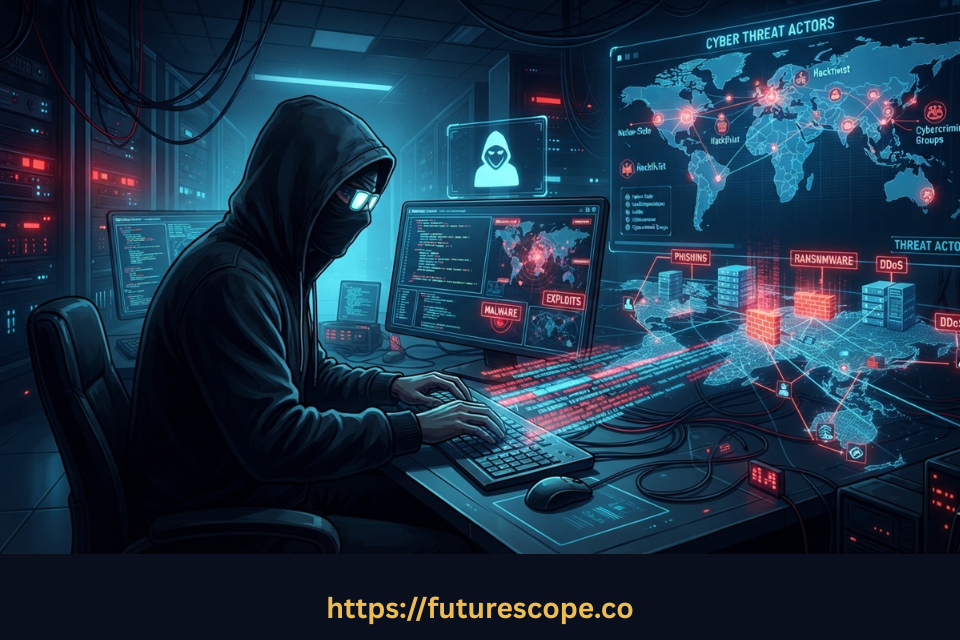
Cyber security threats fall into several broad categories, each requiring somewhat different defensive approaches and each carrying distinct risk profiles.
Malware-Based Threats
Malware, short for malicious software, encompasses any program specifically designed to damage, disrupt, or gain unauthorised access to a computer system. This category includes viruses that attach themselves to legitimate files and spread when those files are shared, ransomware that encrypts a victim’s files and demands payment for their release, spyware that secretly monitors and reports on a user’s activity, and trojans that disguise themselves as legitimate software while carrying out malicious functions in the background. Malware remains one of the most pervasive and financially damaging categories of cyber security threat, affecting individuals and organisations of every size.
Social Engineering and Phishing
Rather than attacking technical systems directly, social engineering threats target human psychology, manipulating people into voluntarily handing over credentials, sensitive information, or access that an attacker could not otherwise obtain. Phishing, the most common form, involves fraudulent emails, messages, or websites designed to impersonate trusted organisations and trick recipients into entering login details or clicking malicious links. More targeted variants, including spear phishing aimed at specific individuals and business email compromise schemes that impersonate executives to authorise fraudulent payments, have become increasingly sophisticated and difficult for untrained users to detect.
Network and Infrastructure Attacks
This category includes threats that target the underlying infrastructure connecting systems together, rather than any single endpoint or application. Distributed denial-of-service attacks flood networks or servers with overwhelming traffic to disrupt availability. Man-in-the-middle attacks intercept communication between two parties to steal data or inject malicious content without either party realising the connection has been compromised. Domain Name System attacks manipulate the internet’s addressing system to redirect users toward malicious destinations without their knowledge.
Insider Threats
Not every threat originates from outside an organisation. Insider threats come from individuals who already have legitimate access to systems and data, whether current or former employees, contractors, or business partners. These threats can be malicious, involving deliberate theft, sabotage, or data leaks motivated by financial gain or grievance, or they can be unintentional, resulting from careless handling of sensitive data, falling for phishing attempts, or simple human error such as misconfiguring access permissions. Insider threats are consistently among the hardest to detect, precisely because the individuals involved already possess legitimate credentials and access.
Advanced Persistent Threats
Advanced persistent threats describe a category of sophisticated, well-resourced attacks, often associated with nation-state actors or highly organised criminal groups, that aim to establish long-term, undetected access to a target network rather than causing immediate, visible damage. These campaigns can persist for months or even years, quietly exfiltrating data or maintaining access for future use, and they typically combine multiple techniques, including custom malware, social engineering, and exploitation of previously unknown vulnerabilities, making them exceptionally difficult to detect and remove completely.
Real-World Examples of Cyber Security Threats in Action
Abstract categories become much clearer when grounded in real incidents that demonstrate how these threats actually unfold in practice.
- Ransomware against critical infrastructure: the 2021 Colonial Pipeline ransomware attack forced the shutdown of a major fuel pipeline supplying the eastern United States, demonstrating how malware-based threats can cause cascading real-world consequences far beyond the digital systems initially affected.
- Large-scale phishing campaigns: business email compromise schemes have collectively cost organisations billions of dollars annually according to FBI Internet Crime Complaint Center data, frequently succeeding through nothing more sophisticated than a convincingly worded email requesting an urgent wire transfer.
- Supply chain compromise: the SolarWinds attack discovered in 2020 involved attackers inserting malicious code into legitimate software updates, ultimately compromising numerous government agencies and private companies who had no direct vulnerability of their own beyond trusting a compromised vendor.
- Insider data theft: numerous documented cases involve departing employees downloading sensitive client lists, intellectual property, or financial data before leaving an organisation, frequently using nothing more than legitimate access credentials they held until their final day.
- DDoS extortion: online businesses across multiple industries have faced ransom demands accompanied by demonstration attacks proving an attacker’s capability to take their services offline during critical business periods.
The Real Impact of Cyber Security Threats
The consequences of a successful cyber security incident extend well beyond the immediate technical disruption, touching nearly every dimension of an organisation’s operations and an individual’s personal life.
Financial impact is often the most immediately visible consequence, encompassing direct costs such as ransom payments, regulatory fines, legal fees, and the cost of remediation, alongside indirect costs including lost business during downtime and the long-term expense of rebuilding damaged systems and security infrastructure. Industry research consistently places the average cost of a data breach for mid-sized and large organisations well into the millions of dollars when all direct and indirect costs are accounted for.
Reputational damage frequently outlasts the financial cost of an incident itself, as customers, partners, and the broader public lose confidence in an organisation’s ability to protect the data and trust placed in it. This erosion of trust can affect customer retention, partnership negotiations, and competitive positioning for years following a significant breach, particularly in industries where data sensitivity is central to the business relationship, such as healthcare and financial services.
Operational impact includes the direct disruption caused by systems being taken offline, whether through ransomware encryption, DDoS-induced unavailability, or the precautionary shutdown of systems while an incident is investigated and contained. For organisations in critical sectors such as healthcare, energy, and transportation, this operational disruption can translate directly into harm to human safety and wellbeing, not merely inconvenience or financial loss.
Legal and regulatory consequences have grown substantially more significant in recent years, as data protection regulations including GDPR in the European Union and various state-level laws in the United States impose mandatory breach notification requirements and substantial penalties for organisations found to have inadequately protected personal data, adding a compliance dimension to what was once viewed purely as a technical security concern.
How to Prevent Cyber Security Threats: A Practical Protection Guide
While no defence is perfect against every possible threat, a layered approach combining technical controls, organisational policy, and human awareness substantially reduces both the likelihood and the impact of successful attacks.
- Keep software and systems updated: apply security patches promptly across operating systems, applications, and network devices, since unpatched known vulnerabilities remain one of the most commonly exploited entry points for attackers.
- Implement multi-factor authentication: require a second verification factor beyond just a password for accessing sensitive systems and accounts, since this single control blocks the overwhelming majority of credential-based attacks even when passwords are compromised.
- Train employees regularly on security awareness: conduct ongoing phishing simulation exercises and security training, since human error and successful social engineering remain leading causes of successful breaches regardless of how strong technical defences are.
- Maintain comprehensive, tested backups: keep regular, isolated backups of critical data that are not accessible from the main network, ensuring that ransomware or destructive attacks cannot hold an organisation hostage with no recovery path.
- Deploy layered technical defences: combine firewalls, endpoint detection and response tools, network monitoring, and email filtering to create multiple opportunities to detect and stop an attack before it succeeds.
- Limit access based on necessity: apply the principle of least privilege, ensuring employees and systems only have access to the specific data and functions genuinely required for their role, limiting the potential damage from any single compromised account.
- Develop and rehearse an incident response plan: prepare a clear, tested plan for how your organisation will detect, contain, and recover from a security incident, since response speed and coordination significantly affect the ultimate cost and impact of any breach that does occur.
Frequently Asked Questions
Q: What is the difference between a cyber threat and a cyber attack?
A: A cyber threat refers to the potential for harm — the existence of a capability, actor, or mechanism that could cause damage to a system, even if no actual attack has occurred yet. A cyber attack is the active execution of that potential, the actual attempt to exploit a vulnerability and cause harm. Threat intelligence and risk assessment focus on identifying and understanding potential threats before they materialise, while incident response deals with attacks that are actively occurring or have already happened.
Q: Which type of cyber security threat is most common today?
A: Phishing and other forms of social engineering consistently rank as the most common initial attack vector across most major industry threat reports, since manipulating human behaviour is often easier and cheaper than directly breaching well-defended technical systems. Ransomware remains the most financially damaging threat category once an initial compromise succeeds, frequently gaining its initial foothold through a successful phishing attempt or an unpatched vulnerability that was exploited before defenders applied an available fix.
Q: Can small businesses really be targeted by serious cyber security threats?
A: Yes, and in fact small and medium-sized businesses are frequently targeted precisely because they often have weaker security defences than large enterprises while still holding valuable data, financial access, or connections to larger partner organisations that attackers can exploit as a stepping stone. Numerous industry surveys have found that a significant proportion of small businesses experience some form of cyber attack attempt each year, and the financial impact of a successful breach can be proportionally more devastating for a smaller organisation with limited cash reserves.
Q: How quickly do organisations typically detect a cyber security breach?
A: Detection times vary enormously depending on the sophistication of the attack and the maturity of an organisation’s security monitoring capability, but industry research has historically found average detection times measured in months rather than days for many types of breaches, particularly more sophisticated and stealthy intrusions such as advanced persistent threats. This extended dwell time, the period between initial compromise and detection, is precisely why proactive monitoring, threat hunting, and well-configured detection tools have become such a central focus of modern security programmes, since faster detection directly reduces the ultimate scope and cost of an incident.
Q: Is antivirus software still enough to protect against modern cyber security threats?
A: No, traditional antivirus software alone is no longer considered sufficient protection against the full range of modern threats, since many contemporary attacks, including sophisticated phishing, fileless malware, and advanced persistent threats, are specifically designed to evade traditional signature-based antivirus detection. Modern security best practice calls for a layered defence approach combining endpoint detection and response tools, network monitoring, regular patching, multi-factor authentication, and ongoing user training, rather than relying on any single tool as a complete solution.
The Bottom Line: Know Your Threats to Defend Against Them
A threat to cyber security is never a single, simple thing. It is a constantly evolving landscape of malicious software, manipulative social engineering tactics, network-level attacks, insider risks, and sophisticated, persistent campaigns, each requiring its own specific blend of technical controls, organisational policy, and human vigilance to defend against effectively.
Understanding exactly what these threats look like, how they have caused real damage to real organisations, and what genuinely effective protection looks like is no longer optional knowledge reserved for security specialists. It is foundational literacy for anyone responsible for protecting data, systems, or an organisation’s reputation in an environment where the threats are not slowing down.
The organisations and individuals who treat cyber security threat awareness as an ongoing discipline, rather than a one-time checklist, are consistently the ones who weather this landscape most successfully.
| Don’t Wait for an Incident to Take Threats Seriously The threats are real, active, and constantly evolving. Your defence strategy should be too. Audit your current defences: patching, MFA, backups, and access controls Train your team: run a phishing simulation this quarter Build your incident response plan before you need it Stay informed: follow CISA.gov and your national cyber security agency The best defence starts with knowing exactly what you’re defending against. |