
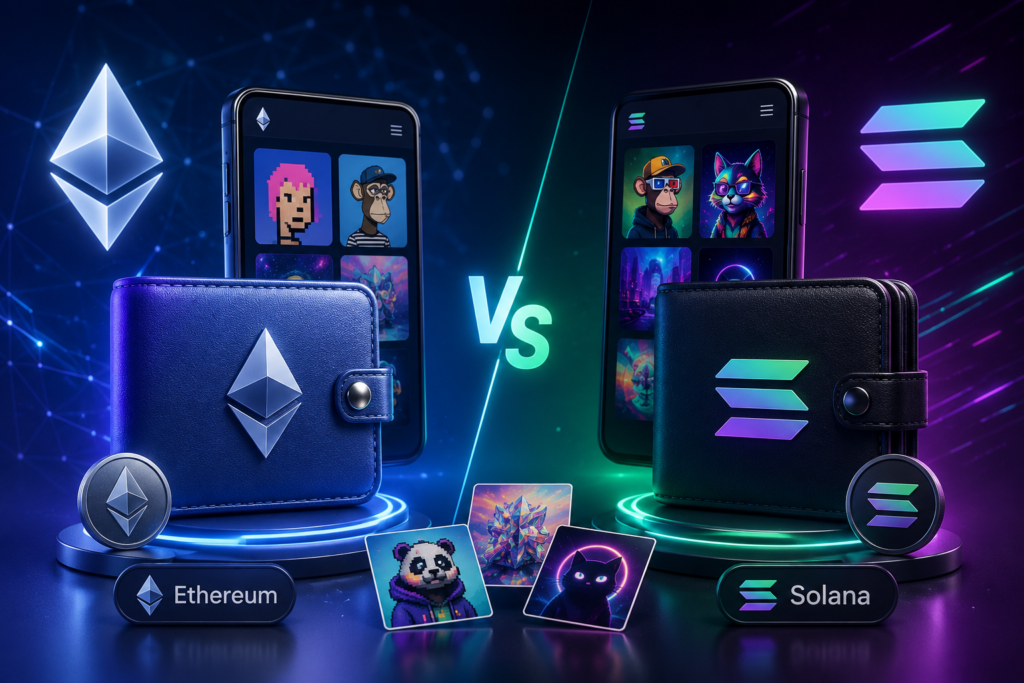
Ethereum NFTs and Solana NFTs live in different ecosystems, work differently, and need different wallets. Here’s how to find yours.
You’ve just minted or bought your first NFT. Or maybe you’re about to. Either way, you’ve hit a wall that trips up a lot of newcomers: which wallet do you actually need?
The answer isn’t the same for everyone. An NFT on Ethereum lives on a different blockchain with different fees, different marketplaces, and different wallet requirements than an NFT on Solana. The wallet that works perfectly for a Solana collector might be useless for someone buying on OpenSea, and vice versa.
This guide cuts through the noise. We’ll cover how Ethereum and Solana NFTs differ, which wallets are best suited to each, and how to decide between them based on your specific needs — whether you’re a casual collector, a serious investor, or a creator launching a collection.
The Core Distinction: Ethereum uses a Proof-of-Stake consensus with ERC-721 and ERC-1155 token standards for NFTs. Solana uses Proof-of-History combined with Proof-of-Stake, with Metaplex as its NFT standard. These technical differences directly affect wallet compatibility, transaction fees, and which marketplaces you can access.
Ethereum vs Solana for NFTs: The Key Differences
Before choosing a wallet, understanding why these two blockchains attract different NFT communities helps explain why the wallet choices diverge so clearly.
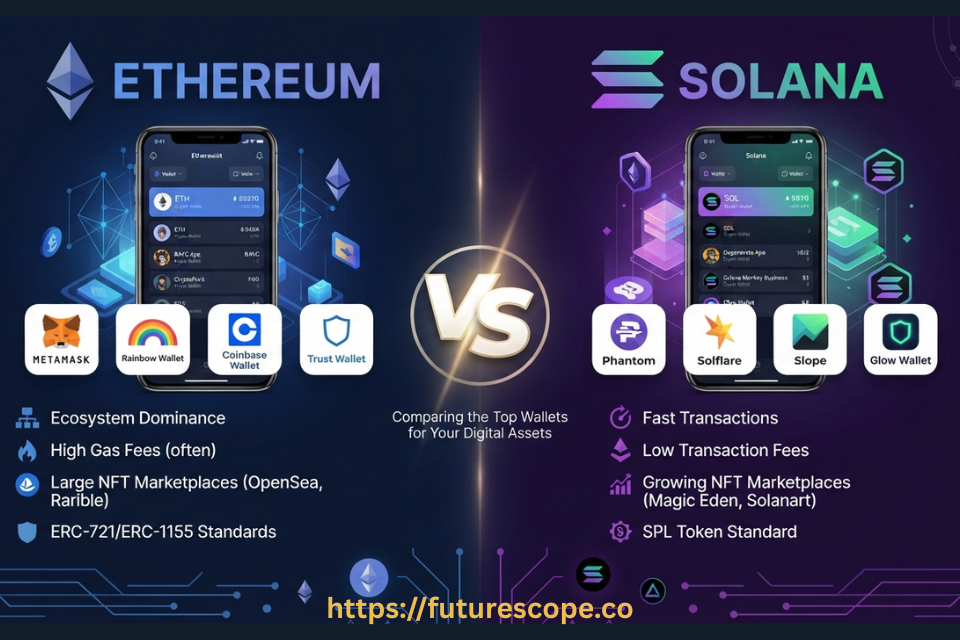
Ethereum is the original home of NFTs. The Bored Ape Yacht Club, CryptoPunks, and most of the high-profile NFT projects that entered mainstream culture live on Ethereum. It carries the largest marketplace ecosystem — OpenSea, Blur, Rarible, and Foundation are all primarily Ethereum-native. The tradeoff is gas fees. Minting or transferring an Ethereum NFT during busy periods can cost anywhere from a few dollars to more than $50, which significantly changes the economics of lower-priced NFTs and high-frequency trading.
Solana entered the NFT space by solving the gas problem aggressively. Transaction costs on Solana consistently stay below $0.01, and the network can process up to 50,000 transactions per second. Marketplaces like Magic Eden became major players on Solana precisely because the low friction enabled a different kind of NFT culture: more accessible, more volume-driven, and popular with gaming and generative art projects. The tradeoff is a smaller (though rapidly growing) developer ecosystem and a history of network outages during high-traffic periods.
- Ethereum NFTs: High-value blue-chip projects, institutional interest, highest marketplace liquidity, higher transaction fees, ERC-721/1155 standard.
- Solana NFTs: Sub-cent transactions, fast throughput, growing gaming and generative art scene, Magic Eden as primary marketplace, Metaplex standard.
Best NFT Wallets for Ethereum
Ethereum NFT wallets need to support ERC-721 and ERC-1155 tokens, connect to Ethereum’s major marketplaces, and ideally handle Layer 2 networks like Polygon and Arbitrum where gas costs are lower.
MetaMask | Ethereum + EVM chains | Best for: Experienced collectors
MetaMask is the de facto standard for Ethereum NFT interaction. As a browser extension and mobile app, it connects to virtually every Ethereum dApp, marketplace, and DeFi protocol. Your private keys are stored locally on your device, giving you full self-custody. OpenSea, Blur, Rarible, and Foundation all support MetaMask as their primary wallet connection.
The learning curve is real for beginners — managing a seed phrase, understanding gas settings, and avoiding phishing sites all require attention. But for anyone serious about Ethereum NFTs, MetaMask’s ecosystem coverage is unmatched.
✔ Supports all ERC-721 and ERC-1155 NFTs
✔ Browser extension compatible with every major Ethereum marketplace
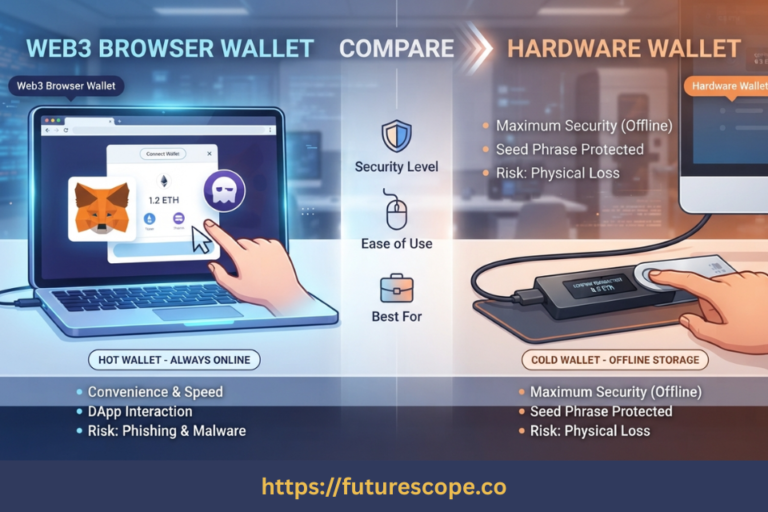
✔ Can connect to hardware wallets (Ledger, Trezor) for cold storage
✔ Supports Polygon, Arbitrum, Optimism, and other EVM Layer 2s
⚠ Beginners can find seed phrase management intimidating
⚠ Requires ETH for gas on every transaction
Rainbow Wallet | Ethereum | Best for: Mobile-first NFT collectors
Rainbow is built with NFTs front and center. Where MetaMask feels like a general-purpose crypto tool, Rainbow feels designed specifically for collecting. Its gallery view makes displaying your NFT collection genuinely enjoyable, and the mobile-first interface is cleaner and more intuitive than most competitors. Rainbow is non-custodial, supports all Ethereum NFTs, and integrates with major marketplaces through WalletConnect.
✔ Beautiful NFT gallery display built into the wallet interface
✔ Supports all major Ethereum NFT standards
✔ WalletConnect integration for marketplace access
⚠ Limited desktop/browser extension support compared to MetaMask
⚠ Still requires seed phrase management and ETH for gas
Ledger Nano (with MetaMask) | Ethereum + Multi-chain | Best for: Security-focused collectors
For collectors holding significant value in Ethereum NFTs, a Ledger hardware wallet connected to MetaMask is the gold standard for security. Your private keys never touch an internet-connected device. Transactions are signed on the Ledger device itself, which means malware on your computer cannot access your keys. The Ledger Nano X connects via Bluetooth and supports over 5,500 coins and tokens including all major Ethereum NFT standards. The Ledger Live app allows direct NFT viewing.
✔ Private keys stored fully offline in a tamper-resistant secure element
✔ Works with MetaMask for full marketplace access
✔ Supports Ethereum, Polygon, and other EVM chains
⚠ Higher upfront cost ($79+) compared to free software wallets
⚠ More setup steps than software-only alternatives

Best NFT Wallets for Solana
Solana NFT wallets need to support the Metaplex token standard (specifically the Solana SPL token program), connect to Magic Eden and other Solana marketplaces, and handle the fast, low-fee transaction model that makes Solana NFTs attractive.
Phantom | Solana + Ethereum + Polygon | Best for: Solana NFT collectors
Phantom is the dominant wallet in the Solana ecosystem — the equivalent of what MetaMask is to Ethereum. It was built from the ground up for Solana, with auto-grouping of NFTs by collection, built-in staking, and native support for Solana DeFi apps. Phantom also expanded to support Ethereum and Polygon, making it a practical multi-chain option for collectors who hold assets on both networks. It rates 4.6/5 from the Milk Road review and is widely considered the best Solana NFT wallet available.
✔ Native Solana wallet — supported by virtually every Solana dApp and marketplace
✔ Auto-groups NFTs by collection for easy management
✔ Built-in SOL staking within the wallet interface
✔ Also supports Ethereum and Polygon for multi-chain users
✔ Browser extension and mobile app for iOS and Android
⚠ Swap token selection is more limited than some competitors
Solflare | Solana | Best for: Safety-conscious Solana users
Solflare was the first wallet built specifically for Solana, and it remains one of the strongest choices for users who prioritize security and transparency. Its standout feature is transaction simulation: before you confirm any smart contract interaction, Solflare shows you exactly what the transaction will do to your wallet balance. This is a genuine safeguard against the malicious NFT scams and drainer contracts that have cost Solana users significant funds. Solflare also includes phishing protection and a built-in junk NFT burning feature for clearing spam airdropped tokens.
✔ Transaction simulation previews smart contract actions before you confirm
✔ Phishing site detection and real-time warnings
✔ Burn spam or scam NFTs directly from the interface
✔ Ledger hardware wallet support for cold storage
⚠ Solana-only — no Ethereum or multi-chain support
⚠ Persistent seed phrase backup reminders can feel intrusive
Backpack | Solana + Ethereum | Best for: Power users and xNFT holders
Backpack is a newer entrant that introduces a genuinely novel concept: executable NFTs (xNFTs). These are NFTs that contain runnable applications — a game, a dashboard, a DeFi interface — that can be opened directly inside the wallet without going to an external website. For users who want to be at the cutting edge of Solana’s evolution, Backpack is worth watching. It also supports Ethereum and serves as the native wallet for the Backpack exchange.
✔ xNFT support — run apps directly inside the wallet
✔ Native wallet for Backpack exchange with deep ecosystem integration
✔ Supports Solana and Ethereum
⚠ Newer wallet with a shorter track record than Phantom or Solflare
⚠ Smaller overall dApp compatibility than Phantom

Best NFT Wallets for Ethereum vs Solana Comparision
Here’s how the top wallets compare across the factors that matter most for NFT collectors:
| Wallet | Chain | NFT Display | Security | Beginner-Friendly | Multi-chain |
| MetaMask | ETH + EVM | Basic | Software | Moderate | Yes |
| Rainbow | Ethereum | Excellent | Software | Good | Limited |
| Ledger + MM | ETH + Multi | Via MM | Hardware | Lower | Yes |
| Phantom | SOL + ETH | Excellent | Software | Excellent | Yes |
| Solflare | Solana only | Good | Software + Sim | Good | No |
| Backpack | SOL + ETH | Good | Software | Moderate | Yes |
Which Wallet Should You Choose?
The choice really comes down to where your NFTs live and what you plan to do with them.
- Ethereum collector, primarily on desktop: MetaMask is your starting point. Add a Ledger hardware wallet as your holdings grow. Connect Rainbow on mobile for a better gallery experience.
- Solana collector, new to crypto: Phantom. It’s the most polished, most widely supported Solana wallet available, and its extension to Ethereum means you won’t be locked out as your interests expand.
- Security-focused Solana user: Solflare’s transaction simulation feature is genuinely valuable protection against the malicious contracts that circulate in any active NFT ecosystem.
- Active on both chains: Phantom’s multi-chain support covers Ethereum, Polygon, and Solana from a single wallet. Coinbase Wallet is an alternative with broad chain coverage.
- Maximum security for significant holdings: A Ledger hardware wallet connected to MetaMask for Ethereum, or connected to Solflare for Solana, keeps your keys fully offline.
Important: Ethereum NFTs and Solana NFTs are not interoperable. You cannot send an Ethereum NFT to a Solana wallet address, or vice versa. If you collect on both chains, you’ll need your wallet to explicitly support each chain — or maintain separate wallets for each ecosystem.
Frequently Asked Questions
1. Can I use MetaMask for Solana NFTs?
No, not natively. MetaMask is built for Ethereum and EVM-compatible blockchains. It does not support the Solana network or Solana NFT standards out of the box. If you want to interact with Solana NFTs, you need a Solana-native wallet like Phantom or Solflare. Phantom now supports both Solana and Ethereum from a single wallet interface, making it a practical choice if you collect on both chains.
2. Which is cheaper to collect NFTs on — Ethereum or Solana?
Solana is dramatically cheaper for transaction fees. Individual transactions on Solana cost fractions of a cent — consistently under $0.01. Ethereum gas fees vary with network demand: during busy periods, minting or transferring a single NFT can cost anywhere from a few dollars to more than $50. Ethereum Layer 2 networks like Polygon reduce this significantly, and many Ethereum NFT projects have migrated to or launched on Polygon to lower collector costs. For budget-conscious collectors or high-frequency trading, Solana’s fee structure is a meaningful advantage.
3. Do I need different seed phrases for Ethereum and Solana wallets?
It depends on the wallet. Phantom uses a single seed phrase to generate both its Ethereum and Solana wallets, which simplifies backup. A standalone Ethereum wallet like MetaMask and a standalone Solana wallet like Solflare each generate their own separate seed phrase — meaning you’d need to back up and secure both independently. If simplicity matters, using a multi-chain wallet like Phantom that covers both ecosystems under one seed phrase is the cleaner solution.
4. Which NFT marketplaces work with Phantom?
Phantom is supported by virtually every major Solana NFT marketplace, including Magic Eden (the dominant Solana marketplace), Tensor, and Exchange.Art. Since Phantom also supports Ethereum and Polygon, it can connect to Ethereum marketplaces like OpenSea and Blur via WalletConnect as well. This broad marketplace coverage is one of Phantom’s strongest practical advantages for collectors who want a single wallet to cover multiple platforms.
5. Is it safe to store high-value NFTs in a software wallet?
Software wallets like MetaMask and Phantom are reputable and widely used, but they store your private keys on an internet-connected device. This exposes them to malware, phishing attacks, and malicious smart contracts in a way that hardware wallets do not. For collections with significant monetary value, connecting a Ledger hardware wallet to MetaMask (for Ethereum) or Solflare (for Solana) provides a meaningfully stronger security model by keeping private keys offline. The rule of thumb: the more valuable your NFT collection, the more seriously you should consider cold storage.
Set Up Your NFT Wallet the Right Way From Day One
The NFT space moves fast. The wallets you choose today determine which ecosystems you can access, which marketplaces you can trade on, and how securely your digital assets are held. Getting the setup right from the beginning saves real headaches later.
Here’s your action plan:
- Decide whether your primary NFT focus is Ethereum, Solana, or both — your answer drives the wallet choice.
- Ethereum collector: start with MetaMask, add Rainbow on mobile for a better gallery view.
- Solana collector: install Phantom for the best ecosystem coverage and cleanest interface.
- Both chains: Phantom’s multi-chain support covers you with a single seed phrase.
- Write down your seed phrase on paper or metal — never digitally. Store it separately from your device.
- For significant holdings, connect a Ledger hardware wallet to keep private keys fully offline.
Your Best NFT wallet is your identity in Web3. Choose one that fits your ecosystem, back it up properly, and the rest follows.
Written by a crypto and NFT specialist. All wallet features and pricing accurate at time of writing and subject to change.