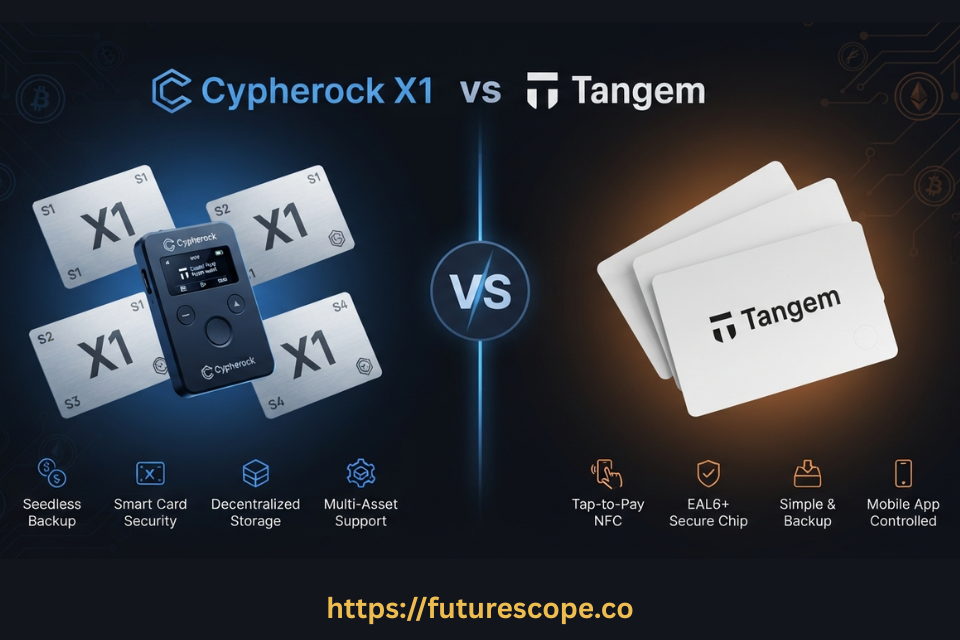

An Honest Security-First Comparison — Verified Spec by Spec
Two of the most-discussed hardware wallets in the seedless security space share almost nothing in common except their shared goal: protecting your crypto without making you depend on a piece of paper. Cypherock X1 is a vault with four NFC cards, a joystick, an OLED screen, and a five-shard Shamir architecture. Tangem is a credit card that fits in your wallet, has no screen, no cables, and sets up in under a minute.
They target the same problem — the seed phrase’s single-failure-point vulnerability — but solve it through completely different philosophies. Cypherock distributes key control across five physical components that cannot individually compromise you. Tangem clones the full key onto multiple cards behind a PIN. One is an engineering deep-dive into maximum security distribution. The other is security through radical simplicity.
This comparison is data-driven. Every spec comes from The Bitcoin Hole’s independent feature database (updated June 2026), Cypherock’s official comparison, and EtherBit’s technical spec database. I’ll give you the honest answer on who each wallet is actually for.
| “Cypherock X1 and Tangem both eliminate the seed phrase problem — but the threat they protect you from most is fundamentally different. Cypherock protects against component-level single points of failure. Tangem protects against the complexity that causes most beginner mistakes.” — Asha Mercer |
At a Glance: Full Spec Snapshot
| CYPHEROCK X1 Price: $249 (vault + 4 cards) Launched: 2022, Singapore Chip: EAL6+ Secure Element Weight: 7.1 oz / 200g Display: 0.96 inch OLED (128x64px) Connectivity: USB-C only Air-Gapped: No (USB-C used for signing) Recovery: Shamir 5-of-5 (any 2 recover) Open Source: Yes — MIT + anti-sell licence Coins: 3,000+ (BTC, ETH, Solana, BNB) Warranty: 1 year Multi-sig: No PSBT multi-sig Mobile App: No (desktop only) | TANGEM WALLET Price: ~$54.90 (3-card set) Launched: 2023, Hong Kong Chip: EAL6+ Samsung S3D232A Weight: 0.1 oz / 3g (credit card) Display: None — phone screen only Connectivity: NFC only (portless, air-gapped) Air-Gapped: Yes — NFC only, fully portless Recovery: Card cloning (3 backup cards) Open Source: No — firmware closed Coins: 6,000+ across 80+ blockchains Warranty: 25 years Multi-sig: No Mobile App: Yes — iOS and Android |

The Fundamental Difference: How They Handle Key Recovery
Both wallets claim to solve the seed phrase problem. But they solve it through architectures that are genuinely, meaningfully different — and understanding that difference is the only way to make the right choice.
Cypherock X1: Shamir’s Secret Sharing (5-of-5, Any 2 Recover)
Cypherock splits your private key entropy into five mathematical shards using Shamir’s Secret Sharing. One shard lives in the X1 Vault device. One lives in each of four NFC hardware cards. No single shard contains enough information to reconstruct your private key. You need any two of the five to sign a transaction or recover your wallet. An attacker who steals the vault gets one shard — useless. A fire that destroys two of your storage locations is recoverable from the remaining three. This is the strongest single-point-of-failure elimination architecture in the consumer hardware wallet market.
Tangem: Card Cloning (Full Key Copied to Backup Cards)
Tangem generates your private key inside the primary card and copies it — in full — to one or two backup cards. Each card is a complete copy of your private key, protected by your access code. If someone steals a card and guesses or extracts your PIN, they have full access to your funds. Conversely, if you forget your access code and have no second card, you may be permanently locked out. Per Cypherock’s own comparison: “each Tangem card contains a complete copy of the private key, protected only by the user’s access code, creating multiple potential points of failure.”
The distinction is architectural and consequential: Cypherock’s model means a single compromised component is definitionally insufficient for an attacker. Tangem’s model means a single compromised card plus a guessed PIN is sufficient. For high-value long-term storage, this difference matters.

Security Analysis: The Factors That Differentiate Them
1. The Screen Problem — and Why It Matters for Both Wallets
Cypherock X1 has a 0.96-inch OLED screen and a joystick. Every transaction you sign is displayed on the device itself. What you see on the device is what gets signed. This is the primary defense against blind signing attacks — where malware on your phone or computer alters transaction details between what you see on screen and what the signing device actually receives. Wallet drainer attacks exploited exactly this gap to steal $494 million in 2024.
Tangem has no screen. All transaction details appear on your phone through the Tangem app. If your phone is compromised, the card will sign whatever it receives without any independent verification. Cypherock’s comparison puts it plainly: “Tangem lacks an independent screen for transaction verification, making it susceptible to potential man-in-the-middle attacks.” This is a real limitation for anyone interacting with DeFi, swaps, or smart contracts — less critical for simple long-term hold-and-receive use cases.
2. Open Source vs Closed Firmware
Cypherock X1’s firmware is published on GitHub under a modified MIT licence with an anti-sell clause, and builds are reproducible — any security researcher can verify that the code on the device matches the published source. Keylabs — the firm that demonstrated extractable vulnerabilities in Ledger and Trezor hardware — audited Cypherock X1 and found features it described as “security firsts we have not seen in other wallets.”
Tangem’s firmware is closed source. Two reputable firms — Kudelski Security and Riscure — have audited it, providing external validation. But users must trust those audit conclusions rather than being able to verify the code themselves. For security-conscious users who follow the principle “don’t trust, verify,” this distinction matters.
3. Taproot Support and Advanced Bitcoin Features
Cypherock X1 supports Taproot (P2TR) addresses — the modern Bitcoin address format that enables privacy improvements and the basis for future smart contract functionality on Bitcoin. It also supports BIP-85 deterministic entropy and advanced passphrase features. Tangem does not currently support Taproot, according to The Bitcoin Hole’s verified feature database (June 2026). For Bitcoin-maximalist users who want to use the latest address formats, Cypherock has a meaningful feature advantage.
4. Tangem’s Practical Advantages You Should Not Dismiss
It would be dishonest to ignore where Tangem genuinely leads. Its 25-year warranty versus Cypherock’s 1-year warranty is a significant durability claim. Its IP68 water and weather resistance makes it meaningfully more rugged than the Cypherock plastic casing. At 0.1 oz versus 7.1 oz, Tangem is physically unmatched for portability. And at $54.90 versus $249, it costs roughly one-fifth as much for the complete kit. These are not trivial advantages for the right user.
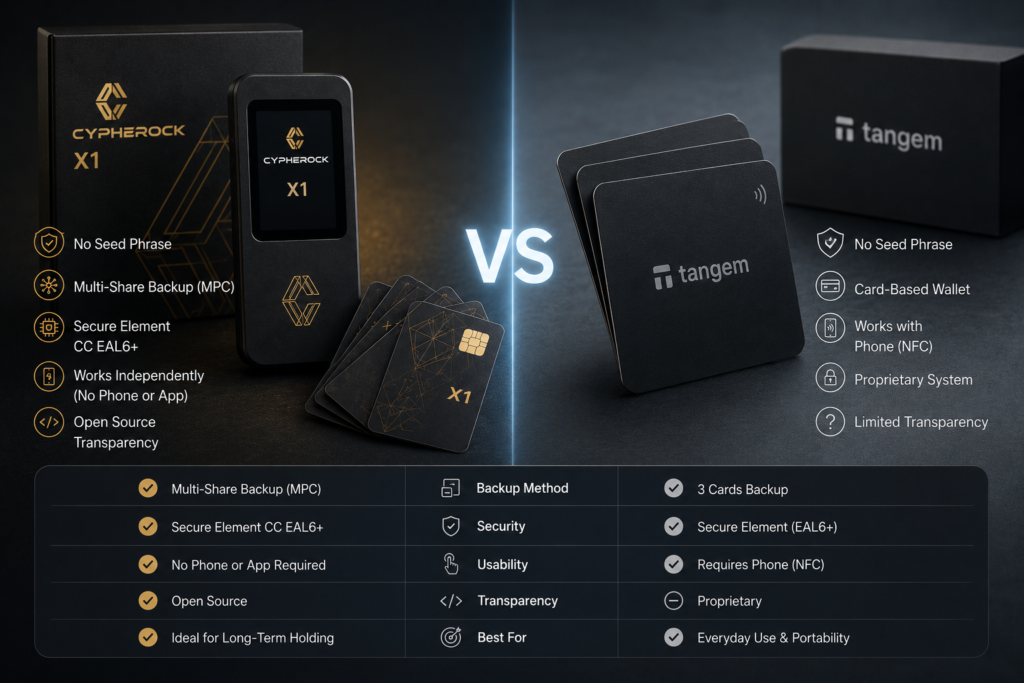
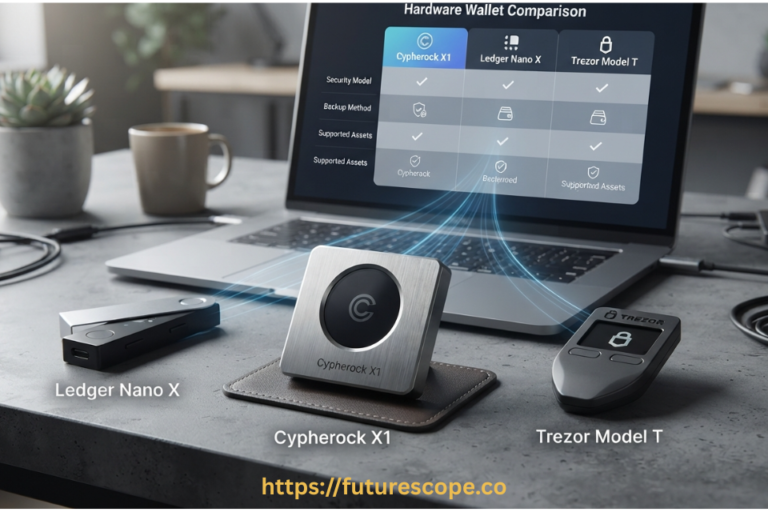
Cypherock X1 vs Tangem: Full Feature Comparison
Verified from The Bitcoin Hole’s independent hardware wallet database (June 2026), Cypherock’s official comparison, and EtherBit spec records:
| Category | Cypherock X1 | Tangem | Winner |
| Price | $249 (full kit) | ~$54.90 (3-card set) | Tangem |
| Security Chip | EAL6+ (dual-chip architecture) | EAL6+ Samsung S3D232A | Tie |
| Recovery Model | Shamir 5-shard (any 2 of 5) | Card cloning (3 copies of full key) | Cypherock X1 |
| Single Failure Point | No — any 2 of 5 components needed | Yes — one card stolen + code = full access | Cypherock X1 |
| Air-Gapped | No (USB-C for signing) | Yes — NFC only, fully portless | Tangem |
| Open Source | Yes — MIT + anti-sell (GitHub) | No — firmware closed | Cypherock X1 |
| On-Device Screen | Yes — OLED (blind-signing protection) | No — phone screen only | Cypherock X1 |
| Coin Support | 3,000+ | 6,000+ across 80+ blockchains | Tangem |
| Mobile App | No (desktop only) | Yes — iOS and Android | Tangem |
| Warranty | 1 year | 25 years | Tangem |
| Weight | 7.1 oz / 200g | 0.1 oz / 3g (credit card size) | Tangem |
| Inheritance Planning | Yes — Cypherock Cover add-on | No dedicated solution | Cypherock X1 |
| Backup Expandable | No (fixed 4 cards) | No (fixed at initial cards) | Tie |
| Firmware Audited | KeyLabs external audit | Kudelski + Riscure audit | Tie |
| Multi-sig | No PSBT support | No PSBT support | Tie |
| Third-Party Trust | None required | None required | Tie |
| Taproot (P2TR) | Yes | No | Cypherock X1 |
| Blind Signing Risk | Low — OLED screen verifies tx | High — phone screen only | Cypherock X1 |
| Score summary: Cypherock X1 wins 8 of 18 categories. Tangem wins 6. 4 are ties. Cypherock leads on recovery architecture, open source, screen protection, and Taproot. Tangem leads on price, portability, warranty, coin coverage, and mobile access. |
Who Should Buy Which Wallet?
| BUY CYPHEROCK X1 IF… [+] You hold significant long-term holdings [+] You want Shamir key distribution (no single point can lose you everything) [+] You interact with DeFi and need on-device transaction verification [+] You prioritize open-source verifiable code over manufacturer trust [+] You want Taproot Bitcoin address support [+] You are planning for inheritance via Cypherock Cover [+] You have 2+ secure physical locations for component distribution | BUY TANGEM IF… [+] You want the simplest, most beginner-accessible cold wallet [+] Budget is a priority – $54.90 vs $249 is meaningful [+] You hold smaller amounts or are new to self-custody [+] You want mobile management on iOS and Android [+] You hold many different coins across 80+ blockchains [+] You want a 25-year warranty and IP68 weather resistance [+] You carry your wallet and want card-size portability |
Final Scorecard
| CYPHEROCK X1 Recovery Architecture: A+ Open Source + Audit: A+ On-Device Screen: A Taproot Support: A Coin Coverage: B Mobile Access: D Price: C Portability: C OVERALL: A (security-first) | TANGEM WALLET Recovery Architecture: B Open Source + Audit: C On-Device Screen: D Taproot Support: D Coin Coverage: A+ Mobile Access: A+ Price: A+ Portability: A+ OVERALL: B+ (simplicity-first) |
Frequently Asked Questions
Which wallet is more secure: Cypherock X1 or Tangem?
For long-term storage of significant holdings, Cypherock X1’s Shamir Secret Sharing architecture is more resistant to single-component compromise. No individual component holds a complete key — meaning one stolen card or device alone cannot drain your funds. Tangem’s card cloning model stores a complete key copy on each card, so a stolen card combined with a discovered PIN is sufficient for full access. Both use EAL6+ certified chips; both have been independently audited. The security difference is in the recovery architecture, not the chip itself. Cypherock’s on-device OLED screen also adds blind signing protection that Tangem’s phone-only display cannot provide.
Can Tangem’s firmware be verified or audited independently?
No. Tangem’s firmware is closed source, meaning you cannot independently verify what the code actually does. Two reputable external firms — Kudelski Security and Riscure — have conducted audits, and Tangem publishes the app and SDK on GitHub. But the core firmware running on the chip is not open for public inspection. Cypherock’s firmware is open source under a modified MIT licence with reproducible builds — any security researcher can verify that the code on the device matches what is published on GitHub. This is a meaningful trust difference for users who prefer verifiable security over trusting an audit conclusion.
Does Tangem have any coin or feature limitations compared to Cypherock?
Tangem supports more coins by volume — 6,000+ across 80+ blockchains versus Cypherock’s 3,000+. However, Tangem does not support Taproot (P2TR) addresses, which are the modern Bitcoin address format enabling future Bitcoin smart contract features and privacy improvements. Cypherock X1 does support Taproot. Tangem also cannot verify transactions on an independent screen (all details appear on your phone), making it less suitable for DeFi use cases where blind signing risk is real. Cypherock’s OLED display addresses this. For simple hold-and-receive with mainstream coins, Tangem’s coverage is excellent.
How does Cypherock’s inheritance feature work, and does Tangem offer anything similar?
Cypherock Cover is an optional add-on service ($199) that uses the distributed card architecture for estate planning. You assign one of the four X1 Cards to a designated person. If Cypherock’s inactivity monitor detects no activity for a set period, a time-delayed recovery process begins using the nominee’s card, AES-encrypted PIN backup, and email OTP verification — without Cypherock ever holding custody of your keys. It is non-custodial and requires no KYC. Tangem has no equivalent native inheritance solution. You would need to share cards and PIN codes with family members directly, which creates the same unsafe seed-sharing dynamic that hardware wallets were designed to avoid.
Can I use both Cypherock X1 and Tangem together?
Yes — and for some holders this is actually the optimal setup. Cypherock X1 is well-suited for a cold storage tier: significant long-term holdings you access rarely, distributed across secure physical locations with Shamir redundancy. Tangem is well-suited for a mobile spending tier: smaller active amounts you access frequently, managed from your phone with the card-in-wallet convenience. The same approach many holders take with Ledger (cold) plus MetaMask (hot) can be replicated with Cypherock (cold) plus Tangem (mobile). Both wallets are fully non-custodial, so mixing them carries no additional trust risk.
| The Right Wallet Is the One That Matches Your Risk Profile. Both Cypherock X1 and Tangem solve the seed phrase problem — but they solve different parts of it. Know what you are protecting, and choose accordingly. CYPHEROCK.COM | TANGEM.COM Always purchase from official manufacturer websites. This is not financial advice. DYOR. |
Sources: The Bitcoin Hole hardware wallet database (Jun 12, 2026), Cypherock official comparisons and audit (Keylabs), EtherBit spec database, ColdWalletCompare.com, Slashdot software comparison. Tangem audit by Kudelski Security and Riscure. Prices accurate as of July 2026.