
An Honest Security Analysis — Compare Cypherock X1 vs Ledger Nano X, Feature by Feature, Trade-off by Trade-off
There is a specific moment every serious crypto holder eventually faces: you have been on an exchange, you have started building meaningful savings, and you realize you actually need to move this somewhere safer. The next decision — which hardware wallet to trust with your long-term holdings — is one of the most important financial security decisions you will make.
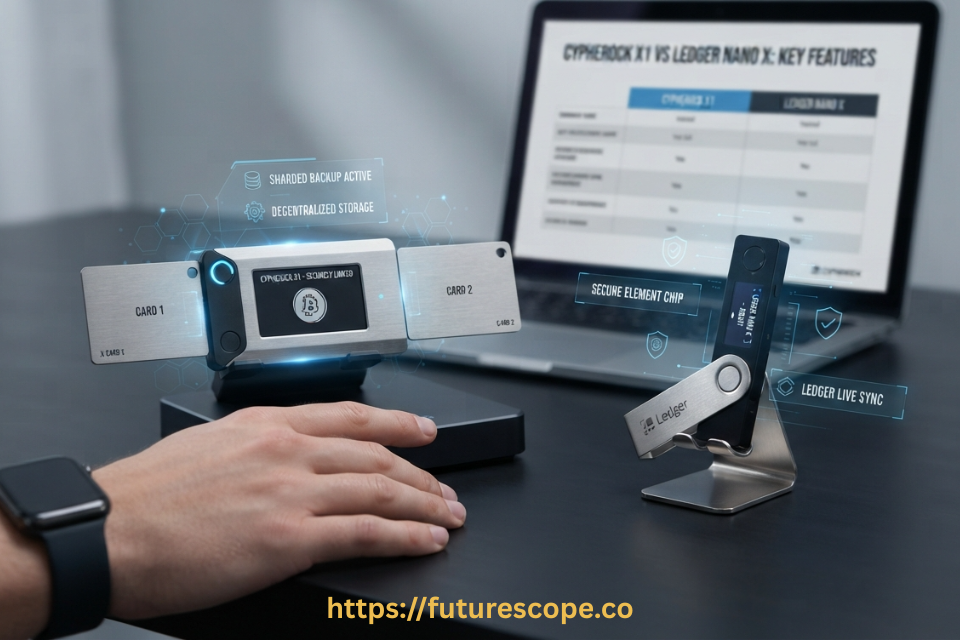
Two wallets come up repeatedly in that conversation: the Ledger Nano X, the world’s most popular hardware wallet with 5.5 million sold and a vast ecosystem, and the Cypherock X1, a newer device built specifically to eliminate the seed phrase as a single point of failure. They are not competing for the same user. But understanding the difference between them is exactly what this comparison is for.
I have reviewed both devices in depth, cross-referenced specs from The Bitcoin Hole’s independent feature-by-feature analysis, Cypherock’s own published comparison, and EtherBit’s community database. This is the comparison that puts security — not marketing — first.
| “The question is not which wallet has more features. The question is which wallet fails you least badly when something goes wrong — a breach, a loss, a theft, or your own mistake.” — Asha Mercer, Crypto Security Analyst |
Cypherock X1 vs Ledger Nano X — Core Specs
| CYPHEROCK X1 Price: $249 (vault + 4 cards) Launch: 2022, Singapore Security Chip: EAL6+ Secure Element Recovery: Distributed (vault + NFC cards, no seed phrase by default) Connectivity: USB-C only (no Bluetooth) Air-Gap: Partial – USB-C connection used Open Source: Yes – hardware + firmware (MIT licence) Coins: 3,000+ (BTC, ETH, ERC-20, Solana, BNB, Polygon) Display: 0.96 inch OLED, 128x64px Warranty: 1 year Multi-sig: No Mobile App: No (desktop/Linux/macOS/Windows only) | LEDGER NANO X Price: $59 (currently discounted from $149) Launch: 2019, France Security Chip: EAL5+ Secure Element Recovery: Single BIP-39 seed phrase (12 or 24 words) Connectivity: USB-C + Bluetooth 5.0 Air-Gap: No – Bluetooth + USB connected Open Source: No – firmware is closed source Coins: 5,500+ (broadest ecosystem on market) Display: 2.4 inch LED, 128x64px Warranty: 2 years Multi-sig: Yes (PSBTs via Sparrow, Electrum, etc.) Mobile App: Yes – Ledger Live on iOS and Android |

The Fundamental Difference: Recovery Model
Before any feature comparison, there is a foundational difference that shapes every other choice between these two devices. It comes down to how you recover your crypto if something goes wrong.
The Ledger Nano X uses the industry-standard model: a 24-word BIP-39 seed phrase that you write on paper at setup. This phrase is the single master key to your entire wallet. It is elegant in its simplicity. It is also a single point of failure — one piece of paper, one photograph, one house fire, one lost notebook, one phishing page where you accidentally typed your words. If that seed phrase is gone or exposed, your funds are gone or drained. This model has existed since Bitcoin’s early days and powers the vast majority of hardware wallets.
The Cypherock X1 was built specifically to break this model. Using a system called distributed secret storage — technically a Shamir Secret Sharing implementation across a vault device and four NFC hardware cards — Cypherock splits recovery data across five physical components. No single item grants full recovery. Lose the vault? The cards are still safe. Lose one card? The vault plus remaining cards still work. A thief who steals just the device? They cannot drain your funds without the required number of cards stored elsewhere.
This is the trade-off in its cleanest form: Ledger is simpler but has a single-failure-point backup. Cypherock is more complex but removes that single failure point entirely. For long-term storage — the context of this comparison — that distinction matters enormously.
Security Deep Dive: EAL6+ vs EAL5+, Open Source vs Closed
Both devices use certified Secure Element chips — the tamper-resistant hardware that stores your private keys and prevents physical extraction attacks. But the certification levels differ in a meaningful way.
Cypherock X1 uses an EAL6+ certified chip — one level above the Ledger Nano X’s EAL5+. EAL6 (Evaluation Assurance Level 6) requires formal mathematical verification of the security design, not just rigorous testing. It is the standard used in high-security passports, military identity cards, and banking smart cards. The difference between EAL5 and EAL6 is not cosmetic — it represents a meaningfully higher bar for attack resistance.
Then there is the open-source question. Cypherock publishes its hardware design, firmware, and software on GitHub under a modified MIT license with reproducible builds — meaning any independent security researcher can verify what the code actually does. Ledger’s firmware is closed source. Users must trust that Ledger’s internal team has written the code correctly and has not introduced vulnerabilities or backdoors. For most users this is a reasonable trust assumption. For users who believe that trust should be verifiable rather than assumed, it is a meaningful security gap.
Ledger’s 2020 data breach also deserves mention in any honest security comparison. A marketing database was compromised, exposing the personal details — including home addresses — of 272,000 customers, and email addresses of over one million. Private keys were not exposed. But the breach turned many users’ names and locations into publicly available information, creating physical security risks for high-value holders. Cypherock has no equivalent incident in its history. Ledger’s Trustpilot score sits at 2.9/5 — a reflection of mixed community sentiment following that breach and subsequent communication failures. Cypherock’s sits at 4.8/5 from verified buyers.

Cypherock X1 vs Ledger Nano X: Full Feature Comparison
Sourced from The Bitcoin Hole’s independent hardware wallet database, Cypherock’s official comparison, and EtherBit’s spec database. Every row is verified:
| Category | Cypherock X1 | Ledger Nano X | Edge Goes To |
| Security Chip | EAL6+ Secure Element | EAL5+ Secure Element | Cypherock X1 |
| Recovery Model | Distributed: vault + 4 NFC cards. No single point of failure | Single 24-word seed phrase — one paper can lose everything | Cypherock X1 |
| Open Source | Yes — hardware, firmware, MIT + anti-sell (GitHub) | No — firmware closed source; partial open | Cypherock X1 |
| Seed Phrase Exposure | No seed phrase used by default — significantly reduces exposure risk | Full reliance on seed phrase written on paper | Cypherock X1 |
| Bluetooth | No — USB-C only | Yes — BT 5.0 for mobile use (adds attack surface) | Cypherock X1 |
| Coin Support | 3,000+ chains/tokens | 5,500+ (largest ecosystem of any hardware wallet) | Ledger Nano X |
| Mobile Management | No (desktop only: Win/Mac/Linux) | Yes — Ledger Live on iOS and Android | Ledger Nano X |
| Multi-sig Support | No PSBT multi-sig | Yes — PSBTs, Sparrow, Electrum, Nunchuk, Casa | Ledger Nano X |
| Third-party App Integrations | Limited | Broad — Sparrow, Electrum, MetaMask, Wasabi, etc. | Ledger Nano X |
| Display Size | 0.96″ OLED | 2.4″ LED | Ledger Nano X |
| Inheritance Planning | Excellent — card-based role distribution | Awkward — seed sharing is dangerous | Cypherock X1 |
| Backup Resilience | High — one lost item not enough for full loss | Low — one lost seed phrase = permanent total loss | Cypherock X1 |
| Price | $249 | $59 (current discount price) | Ledger Nano X |
| Warranty | 1 year | 2 years | Ledger Nano X |
| Trustpilot Score | 4.8/5 (verified buyer community reviews) | 2.9/5 (large review volume, mixed post-breach) | Cypherock X1 |
| Firmware Audit | Open + reproducible builds | Closed — cannot be independently verified | Cypherock X1 |
| Privacy Incident History | None | 2020 marketing DB breach: 272,000 emails + details exposed | Cypherock X1 |
| Cypherock X1 wins 9 of 17 categories. Ledger Nano X wins 7. One is tied. Cypherock dominates on security architecture, open-source, backup resilience, and inheritance planning. Ledger leads on coin support, usability, mobile access, multi-sig integrations, and price. The right pick depends entirely on which category matters more to you. |
Who Should Choose Each Wallet?
| CHOOSE CYPHEROCK X1 IF… [+] Seed phrase loss or exposure is your primary fear [+] You hold significant amounts and plan to rarely transact [+] You want independently verifiable, open-source code [+] Inheritance planning is a priority for your holdings [+] You have 2+ separate, secure physical storage locations [+] You are willing to pay $249 for superior backup architecture [+] You prefer EAL6+ chip certification for maximum chip security | CHOOSE LEDGER NANO X IF… [+] You hold a wide variety of coins across many chains [+] You want smartphone management via Ledger Live mobile [+] You need multi-sig via Sparrow, Nunchuk, or Casa [+] Budget matters — $59 vs $249 is significant to you [+] You use DeFi and need broad third-party app integrations [+] You prefer the world’s most battle-tested platform [+] You are comfortable managing a seed phrase securely |
Final Scorecard
| CYPHEROCK X1 Security / Recovery: A+ Open Source: A+ Coin Support: B Ease of Use: B Value for $249: B+ OVERALL: A (security-first holders) | LEDGER NANO X Security / Recovery: B+ Open Source: C Coin Support: A+ Ease of Use: A Value for $59: A+ OVERALL: B+ (broadest ecosystem) |
Frequently Asked Questions
Is Cypherock X1 more secure than Ledger Nano X?
In the two most important dimensions for long-term holders — recovery architecture and chip certification — yes. Cypherock X1 uses an EAL6+ chip versus Ledger’s EAL5+, and eliminates the single seed phrase as a failure point through distributed card storage. Cypherock also publishes its firmware as open source, while Ledger’s is closed. For pure security architecture, Cypherock X1 is the stronger choice. For overall ecosystem, usability, and coin coverage, Ledger maintains significant advantages.
What happened with Ledger’s 2020 data breach, and should I be worried?
In July 2020, Ledger’s marketing database was breached, exposing the names, email addresses, and home addresses of 272,000+ customers. Private keys, wallet contents, and hardware security were not affected — the breach was of customer contact data only, not of any cryptographic system. However, the exposed home addresses created doxing and physical security risks for high-value holders. Ledger has since improved its data practices. The breach is worth knowing about when assessing the full risk profile of each company. Cypherock has no equivalent incident in its history.
Why is Cypherock X1 so much more expensive than Ledger Nano X?
Cypherock X1 at $249 includes the vault device plus four EAL6+ NFC hardware cards — five separate physical components in total. The price reflects both the certified hardware across five units and the engineering required to implement distributed secret sharing across a vault and card system. The Ledger Nano X currently sells for $59 (discounted from $149), making it a single device at significantly lower cost. Whether the price difference is worth it depends on whether the backup architecture difference matters to your specific risk profile and holdings.
Can Ledger Nano X be used without Bluetooth? Is that safer?
Yes — you can use the Ledger Nano X via USB-C only, with Bluetooth disabled in settings. This is the recommended setup for security-conscious users who do not need mobile management. The Bluetooth connection on Nano X is convenient for Ledger Live mobile but does introduce an additional wireless attack surface that does not exist when Bluetooth is off. Cypherock X1 has no Bluetooth at all — its only connectivity is USB-C for firmware updates and standard operations. For maximum surface reduction, Ledger used without Bluetooth narrows the connectivity gap between the two devices.
Does Cypherock X1 support Bitcoin multi-sig?
Not as of July 2026 — Cypherock X1 does not support PSBT-based multi-sig, which is the standard used by Sparrow, Electrum, Nunchuk, Casa, and Unchained for collaborative custody setups. Ledger Nano X supports PSBTs and integrates with all of those platforms. For holders who want a 2-of-3 or 3-of-5 multi-sig setup for their Bitcoin — the gold standard for institutional-grade self-custody — Ledger Nano X is currently the better choice between these two devices. Cypherock’s distributed card architecture provides a different (and compelling) form of backup redundancy, but it is not a multi-sig implementation in the technical sense.
| Choose Your Wallet. Protect What’s Yours. The right hardware wallet for long-term storage is the one that matches your risk profile — not the one with the most features. If your biggest fear is seed phrase exposure, choose Cypherock. If you want breadth, mobile convenience, and battle-tested reliability, choose Ledger. Either way, get off the exchange. CYPHEROCK.COM | LEDGER.COM Always buy from official manufacturer websites. This is not financial advice. DYOR. |
Sources: The Bitcoin Hole hardware wallet comparison database (July 2026), Cypherock official comparison (cypherock.com/blogs), EtherBit spec database, Slashdot software comparison, ColdWalletCompare.com. Ledger Nano X currently priced at $59 on ledger.com. Cypherock X1 priced at $249 on cypherock.com. All data verified July 2026.