
The No-Fluff Answer for 2026
Ledger, ELLIPAL, SafePal, Tangem, NGRAVE, ZenGo, and More — Honestly Rated
If you type ‘safest crypto wallet for beginners’ into any search engine, you will get a wall of affiliate lists that rank wallets by commission rate, not by what actually keeps a new user’s money safe. I have been in this space long enough to have watched too many beginners lose crypto to preventable mistakes — and most of them were using perfectly legitimate wallets. The wallet was fine. The setup was not.
So let me be clear upfront: the safest crypto wallet for a beginner is not necessarily the most technically secure one. It is the one that fits your situation — your technical comfort, your holding amount, and how often you plan to access your crypto — while preventing the specific mistakes beginners actually make.
Those mistakes, per Coin Bureau’s comprehensive 2026 beginner wallet guide, are consistent: keeping everything on an exchange, photographing a seed phrase, clicking a fake airdrop, sending crypto on the wrong network. The safest wallet is one whose design makes those errors as hard as possible. This guide tells you which wallets do that best — and why — across both hot and cold categories.
| “A beginner using a small mobile wallet for daily use has very different needs from someone storing long-term holdings in a hardware wallet that keeps keys offline. There is no single right answer — but there is a right answer for you.” — Coin Bureau, May 2026 |

The Security Reality Every Beginner Needs to Understand
| $3.96B in crypto stolen from users in 2025 (Chainalysis) | 60% of crypto thefts trace to hot wallet compromise or exchange failures | $54.90 starting price for Tangem — the most beginner-friendly cold wallet in 2026 | EAL7 NGRAVE Zero’s security chip — highest commercial rating available |
The Bitcoin Foundation’s 2026 analysis of beginner wallets found that the majority of new user losses are not from sophisticated technical attacks — they are from social engineering, phishing links, poorly stored seed phrases, and the single most dangerous beginner habit: leaving crypto on an exchange account and treating it like a wallet. An exchange account is not a wallet. It is a promise. And as FTX, Celsius, and Voyager proved, promises from centralized platforms can evaporate overnight.
The foundational security truth for anyone new to crypto is this: custody determines ownership. A custodial account (exchange) means the platform holds your keys and can freeze, lose, or be hacked out of your funds. A non-custodial wallet means you hold your keys — and therefore your crypto — regardless of what happens to any platform. Every wallet recommendation in this guide is non-custodial.
The Safest Crypto Wallets for Beginners in 2026
These picks are organized from most beginner-accessible to most security-focused. The right starting point depends on your comfort level, storage duration and how much you are holding.

ZenGo Wallet — Best Seedless Mobile
Wallet Type: Hot wallet (MPC) | Price: Free | Best for: Seed-phrase-anxious beginners
ZenGo’s core insight is that the seed phrase is the biggest threat to most beginners — not hackers, not exchanges, but the user mismanaging their own 24-word recovery key. Screenshots in cloud storage. Written on a note that gets thrown away. Typed into a phishing site. ZenGo replaces the traditional seed phrase with a Multi-Party Computation (MPC) model that splits cryptographic control between the user’s device and ZenGo’s servers, secured by biometric authentication and a cloud backup encrypted with your personal key.
If you lose your phone, ZenGo’s 3-factor recovery (biometrics, face ID, and backup email) restores your wallet. No 24 words to lose. For a beginner who feels genuinely intimidated by key management, ZenGo makes non-custodial wallet ownership approachable without compromising fundamentally on security.
[+] No seed phrase to lose or expose. MPC security model. Clean mobile UX. 3-factor biometric recovery.
[-] Seedless model means trusting ZenGo’s servers for recovery. Less decentralized than fully self-custodial wallets.
Tangem — Easiest Hardware Wallet for Beginners
Type: Cold — NFC card | Price: $54.90 (2-card set) | Best for: First-time cold storage buyers
Coin Bureau named Tangem the best simple hardware wallet for beginners in their 2026 rankings, and the reasoning is sound. Tangem is a credit-card-sized hardware device that stores your private keys in an EAL6+ certified chip — offline, physically in your hands. What makes it beginner-safe is the elimination of the seed phrase by default. Your backup is a second physical card, not a string of words that can be exposed digitally. Setup takes minutes via NFC tap to your phone. No USB cables. No small screens with tiny buttons. No complicated desktop software. For someone taking their first step into cold storage, Tangem removes the friction that causes most first-time hardware wallet mistakes. It supports 16,000+ cryptocurrencies across all major chains.
[+] No seed phrase required by default. EAL6+ chip (banking grade). 16,000+ coins. Beginner-simplest setup of any cold wallet.
[-] No transaction screen on the card. Requires NFC phone. Closed source firmware. Backup cards cannot be regenerated.
SafePal S1 Pro — Best Budget Cold Wallet
Type: Cold — Air-gapped (QR) | Price: ~$49.99 | Best for: Budget-first beginners ready for cold storage
SafePal, backed by Binance, is the entry point for beginners who want full air-gap cold storage — meaning zero USB, Bluetooth, or wireless connectivity of any kind — without spending $100+. All transactions are signed via QR code: you display a code on the wallet’s screen, scan it with your phone camera through the SafePal app, and confirm. Nothing digital ever crosses a connected interface. For under $50, you get an EAL5+ certified security chip, 30,000+ cryptocurrencies supported across all major chains, and the confidence that remote hacking is architecturally impossible. The Binance integration also makes it practical for users who trade on Binance — move to cold storage for holding, back to exchange when trading. The main beginner adjustment: the small screen and QR workflow take one session to get comfortable with.
[+] Cheapest fully air-gapped cold wallet available. 30,000+ coins. EAL5+. Zero network attack surface.
[-] Small 1.3-inch screen. Requires companion app for all transactions. Closed source. Slightly less polished UX.
Ledger Nano X — Best Mobile Hardware Wallet
Type: Cold — USB-C + Bluetooth | Price: $149 | Best for: Beginners who want mobile cold storage
The Ledger Nano X is the most popular hardware wallet in the world for beginners who want cold storage with smartphone convenience. Its Bluetooth connection to the Ledger Live app means you can manage your portfolio from your phone without plugging in a cable — a meaningful UX difference that makes beginners more likely to actually use it rather than leave crypto on an exchange out of inertia. CC EAL5+ chip, 5,500+ supported assets, and the industry’s most comprehensive app ecosystem — with staking, NFT management, and DeFi access all in one interface. For a beginner moving from a free hot wallet to their first hardware device, Ledger Nano X is the path of least resistance. One transparency note: Ledger’s firmware is not fully open source, and a 2023 marketing SDK breach exposed customer email addresses. Private keys were not affected, but it is worth knowing.
[+] Bluetooth mobile management. 5,500+ coins. Ledger Live app is excellent. Broadest hardware wallet ecosystem.
[-] Closed source firmware. 2023 customer data breach (emails only). More expensive than SafePal or Tangem.
ELLIPAL Titan 2 — Best Fully Air-Gapped Advanced Pick
Type: Cold — Air-gapped (QR only) | Price: ~$139 | Best for: Beginners who want maximum air-gap without NGRAVE’s price
ELLIPAL is for the beginner who has done their research, understands the threat model, and wants the strongest air-gap guarantee at a non-NGRAVE price. The Titan 2 has absolutely no USB port, no Bluetooth, no WiFi, no NFC — zero connectivity pathways. All data transfers via QR codes between the device’s 4-inch color touchscreen and your phone camera. This architecture makes the ELLIPAL immune to every known network-based attack. The large touchscreen makes the QR workflow significantly more comfortable than SafePal’s smaller display.
An anti-tamper self-destruct mechanism triggers if the device detects physical tampering. For a security-conscious beginner with $1,000+ in crypto who wants to know their device cannot be remotely compromised under any circumstances, ELLIPAL is the pick between $59 and $398.
[+] 100% air-gapped via QR. 10,000+ coins. Anti-tamper self-destruct. Large 4-inch touchscreen for comfortable QR use.
[-] Closed source. Requires companion app. Costlier than SafePal. No transaction network connectivity for DeFi.
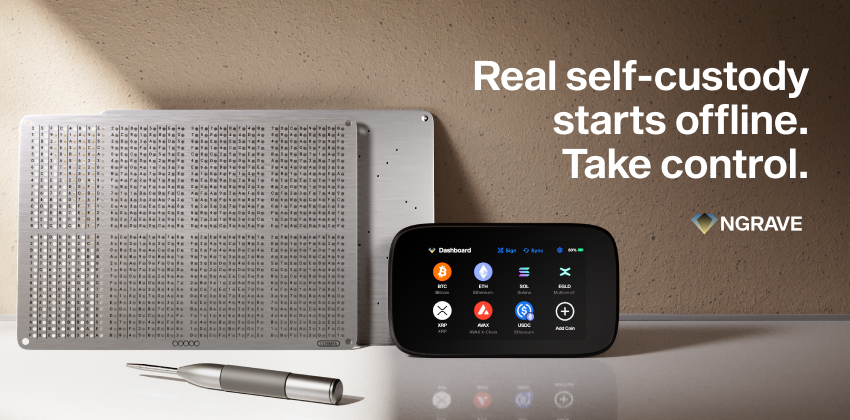
NGRAVE Zero — The Absolute Security Ceiling
Type: Cold — Air-gapped (QR only) | Price: $398 + optional $100 Graphene | Best for: High-value holders who want the best security that exists
NGRAVE Zero holds EAL7 — the highest security certification achievable for any commercial hardware device. It is used as a reference point in professional cryptography. For context, most hardware wallets are EAL5+ or EAL6+. EAL7 requires verification to a standard that governments and military organizations apply to sensitive infrastructure. Beyond the chip, NGRAVE generates private keys using both its own hardware random number generator and ambient light captured during setup — making your key cryptographically unique to a moment in time that cannot be replicated.
Biometric fingerprint authentication, a 4-inch color touchscreen, and fully air-gapped QR-only operation round out a device built for high-net-worth holders who treat crypto seriously. The optional NGRAVE Graphene steel backup plates store your recovery phrase in fireproof, waterproof, corrosion-resistant form. For most beginners, NGRAVE is overkill. For those who need the ceiling, it is the ceiling.
[+] EAL7 (highest commercial certification). Biometric fingerprint. Light-based unique key generation. Steel backup plates available.
[-] Expensive at $398+. Fewer supported chains than Ledger. Overkill for small holdings. Not beginner-first in workflow.
Trust Wallet — Best Free Hot Wallet to Start
Type: Hot — mobile | Price: Free | Best for: Complete beginners building habits
Trust Wallet, recommended by Coin Bureau as the best mobile hot wallet for beginners in 2026, is the right starting point for someone who has just bought crypto for the first time and is not yet ready for hardware. It supports 10+ million assets across 100+ blockchains, meaning whatever you own now and whatever you discover next will almost certainly be manageable from one interface. It is self-custodial — you hold your own keys — and the 12-word seed phrase generated at setup is your responsibility to protect offline. Trust Wallet should be treated as your spending account: for small amounts, for learning, for DeFi experimentation. Once your holdings grow past $500-$1,000, move the bulk to cold storage and use Trust Wallet for active amounts only.
[+] Free. 10M+ assets. 100+ blockchains. Self-custodial from day one. Excellent first wallet experience.
[-] Hot wallet — internet connected. Seed phrase must be manually protected. No physical transaction confirmation.
All Wallets Compared: Quick Reference
Use this table to identify your match across wallet type, cost, recovery method, and beginner difficulty:
| Wallet | Type | Price | Best For | Recovery | Beginner Level |
| Tangem | Hardware card | Start at $54.90 | Simplest cold storage | Backup cards (no seed phrase) | Very Easy |
| ZenGo | Seedless mobile | Free | Seed-phrase anxiety | MPC + biometric | Very Easy |
| Trust Wallet | Hot mobile | Free | Multi-chain mobile | Seed phrase | Easy |
| Exodus | Hot desktop/mobile | Free | Desktop simplicity | Seed phrase | Very Easy |
| SafePal S1 Pro | Hardware (air-gapped) | Buy Now from ~$49.99 | Budget cold storage | Seed phrase | Easy |
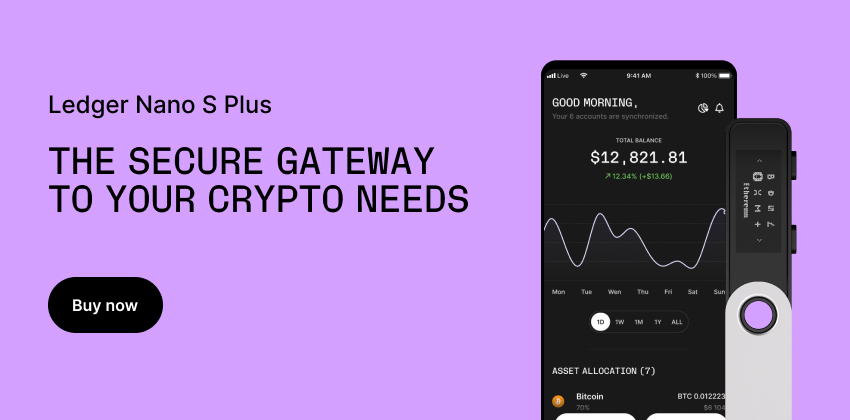
| Ledger Nano S Plus | Hardware | Get the Best Price at $79 | Affordable cold storage | Seed phrase | Moderate |
| Ledger Nano X | Hardware (BT) | Secure Your Copy $149 | Mobile hardware use | Seed phrase | Moderate |
| ELLIPAL Titan 2 | Hardware (air-gapped) | Buy Now from~$139 | Max air-gap security | Seed phrase | Moderate |
| NGRAVE Zero | Hardware (air-gapped) | Own It Today $398 | Highest security | Graphene backup | Advanced |
| Trezor Safe 3 | Hardware (open-source) | Access It Now $59 | Open-source believers | Seed phrase | Moderate |
| The Two-Wallet Setup: Coin Bureau’s 2026 expert recommendation for beginner safety is a two-wallet approach — a free hot wallet (Trust Wallet, ZenGo, Exodus) for small amounts and daily learning, paired with a hardware wallet (Tangem, SafePal, or Ledger) for larger holdings. Think of it as a checking account and a savings safe. One for access, one for security. |
The 5 Beginner Mistakes That Cause Real Losses
No wallet protects you from these errors. Understanding them is more valuable than choosing the most expensive hardware:
- Keeping crypto on an exchange: An exchange account is not a wallet. FTX’s collapse erased billions in user balances overnight. Non-custodial wallets put you in control.
- Storing the seed phrase digitally: A photograph, a note app, a Google Doc — all are accessible to anyone who accesses your device or cloud account. Write it on paper. Store it offline. Consider metal engraving for fire/water protection.
- Clicking wallet pop-ups and airdrop links: Phantom’s 2026 security documentation lists fake airdrops, spam NFTs, and phishing wallet approval requests as the primary vector for beginner losses. Never interact with something you did not initiate.
- Sending crypto on the wrong network: ETH sent on the Polygon network to an Ethereum mainnet address can be unrecoverable. Always verify network compatibility before confirming any transfer.
- Skipping the test transaction: A $1 test send before moving $2,000 takes 30 seconds and prevents the irreversible consequence of a typo in a wallet address.
Frequently Asked Questions
What is the single safest crypto wallet for a complete beginner?
Coin Bureau’s 2026 analysis names Tangem the best simple hardware wallet for beginners, and ZenGo the best seedless mobile wallet. For a beginner who wants cold storage without the complexity of a seed phrase, Tangem at $54.90 is the strongest single recommendation. For a beginner who wants free, mobile-first self-custody and is not yet ready for hardware, ZenGo’s seedless MPC model removes the most dangerous beginner failure point — seed phrase mismanagement. Neither is wrong; the best choice depends on whether you prioritize offline key storage or seed-phrase simplicity.
Do I need a hardware wallet as a beginner, or is a mobile wallet enough?
Per Coin Bureau’s methodology, a hot wallet is appropriate for small balances, learning, DeFi, and everyday use. A hardware wallet becomes clearly worthwhile when your holdings pass $500-$1,000 or when you plan to hold long-term without regular access. The cost of a Tangem ($54.90) or SafePal S1 Pro ($49.99) relative to even $500 in crypto is small. The practical answer: start with a reputable free hot wallet like Trust Wallet or ZenGo, use it for 2-4 weeks to understand how crypto transactions work, then add cold storage as your confidence and holdings grow.
What is the difference between Ledger, ELLIPAL, SafePal, Tangem, and NGRAVE?
All five are hardware wallets, but with important differences. Tangem: card-based, NFC, no seed phrase, EAL6+, the simplest beginner setup. SafePal: cheapest fully air-gapped option, QR-only, 30,000+ coins, Binance-backed. ELLIPAL: air-gapped QR with a larger screen and anti-tamper protection, mid-range price. Ledger Nano X: Bluetooth mobile connectivity, largest app ecosystem, EAL5+, best for users who want phone management. NGRAVE: EAL7 (highest certification), biometric authentication, designed for high-value holdings where maximum security justifies a premium price.
What does ‘air-gapped’ mean and why does it matter?
An air-gapped hardware wallet has zero wireless or wired connectivity — no USB data transfer, no Bluetooth, no WiFi, no NFC. It communicates with the outside world exclusively through QR codes displayed on its screen and scanned by a phone camera. This matters because every connectivity pathway is a potential attack surface. A Bluetooth-connected wallet can theoretically be targeted by Bluetooth exploits. A USB-connected wallet can be targeted by firmware attacks during connection. An air-gapped wallet eliminates all of those vectors. SafePal, ELLIPAL, and NGRAVE are air-gapped. Ledger and Tangem are not — they use USB-C/Bluetooth and NFC respectively.
What should I do immediately after setting up any new crypto wallet?
Four steps, in order. First: write your seed phrase on paper during setup and verify you wrote it correctly by checking each word against the device display. Never photograph it or store it digitally. Second: send a small test transaction (equivalent to $1-$5) before moving larger amounts to confirm the wallet works as expected. Third: send your wallet address to yourself via email or a saved note so you never have to retype it manually for large transfers. Fourth: bookmark the official wallet website (not a search result — the actual URL) so you always open the legitimate version and cannot be redirected to a phishing site during future logins.
| Your First Wallet Decision Is the Most Important One You’ll Make in Crypto. Don’t let paralysis stop you. Pick the wallet that fits your situation today — you can always upgrade as your holdings grow. The only bad choice is leaving your crypto on an exchange and calling it a wallet. TANGEM.COM | SAFEPAL.IO | ELLIPAL.COM | LEDGER.COM | NGRAVE.IO | ZENGO.COM Always purchase hardware wallets from official manufacturer websites. This is not financial advice. DYOR. |
Sources: Coin Bureau beginner wallet guide (May 2026), Bitcoin Foundation wallet analysis (2026), ZenGo beginner resources, Ledger Academy wallet types guide, Quora community insights, Chainalysis 2025 crypto crime report. Prices accurate as of July 2026