
Let’s be honest. DeFi — decentralized finance — is simultaneously one of the most exciting and most treacherous spaces in the entire financial world. For every legitimate protocol generating sustainable yield, there are rug pulls, flash loan exploits, anonymous developers vanishing overnight with investor funds, and smart contracts riddled with vulnerabilities that auditors somehow missed.
The question every serious DeFi investor is asking right now is simple: can AI help cut through the noise and identify which projects are actually low-risk?
The short answer is yes — but with important caveats. AI tools are becoming powerful instruments for DeFi risk assessment, on-chain supervision, and anomaly detection. They are not infallible, and they are not a substitute for fundamental understanding of what you are investing in. But used correctly, AI-based risk assessment tools are changing the DeFi landscape for the better, and understanding how they work is essential knowledge for any sophisticated DeFi participant in 2025.
The DeFi Risk Problem: Why Traditional Analysis Falls Short
Traditional financial due diligence was built for a world of registered companies, audited financial statements, regulated exchanges, and identifiable management teams. DeFi dismantles every one of those assumptions. Protocols are governed by anonymous or pseudonymous teams. Smart contracts replace management with code — code that may contain bugs, backdoors, or deliberately malicious logic. Liquidity can be concentrated in ways that enable market manipulation. Governance tokens can give whales effective control over protocol parameters. And the entire ecosystem moves at a pace that makes quarterly reporting cycles look like geological time.
The result is that by the time traditional analysis has identified a problem — an unsustainable tokenomics model, a governance vulnerability, a suspicious concentration of token ownership — investors have already lost money. Manual analysis of on-chain data, smart contract code, and tokenomics structures is possible but extraordinarily time-consuming, requiring expertise across multiple domains that very few individuals possess.
| The Scale Problem: By 2025, there are over 25,000 active DeFi protocols across dozens of blockchains, with new ones launching daily. No team of human analysts can meaningfully evaluate that volume of projects in the time frames that matter for investment decisions. AI is not a luxury in this environment — it is a necessity. |
How AI Helps Identify Low-Risk DeFi Projects?
AI-based risk assessment in DeFi operates across several distinct dimensions, each addressing a different category of risk that conventional analysis struggles to evaluate at scale. Understanding these dimensions helps you appreciate both the power and the limitations of AI-based DeFi supervision tools.
Smart Contract Vulnerability Detection
Every DeFi protocol runs on smart contracts — self-executing code that manages user funds, governance decisions, and protocol logic without any human intermediary. When that code has vulnerabilities, the consequences can be catastrophic. The Ronin Bridge hack in 2022 cost $625 million. The Wormhole exploit cost $320 million. The Euler Finance attack cost $197 million. In each case, a vulnerability in the smart contract code allowed an attacker to drain funds that users had trusted the protocol to protect.
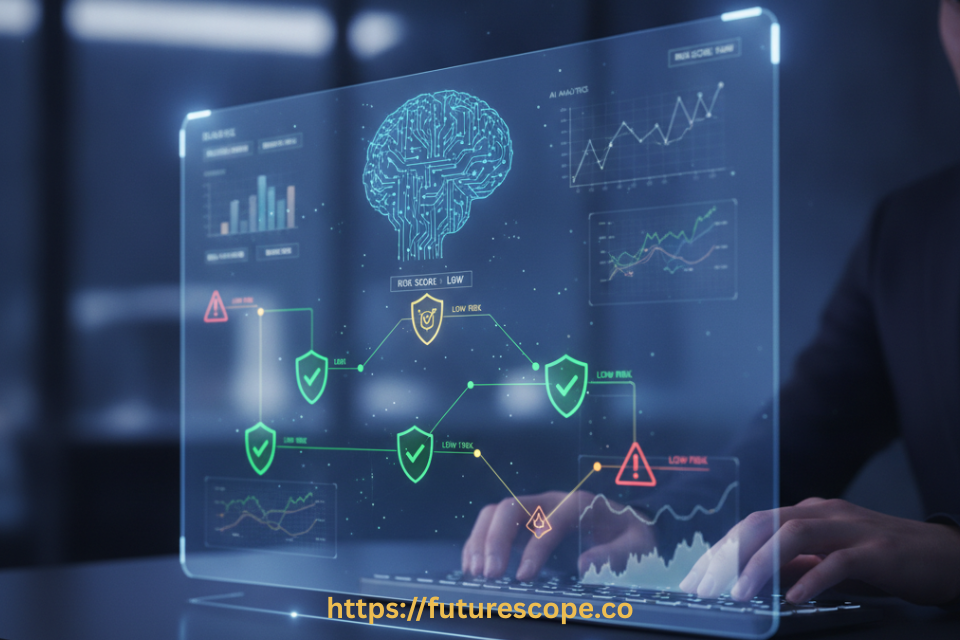
AI-powered smart contract auditing tools use machine learning models trained on thousands of previously audited contracts — both secure and exploited ones — to identify patterns associated with vulnerability. Tools like Slither, Mythril, and more recent neural network-based analysis platforms can scan contract code for known vulnerability classes: reentrancy attacks, integer overflow, access control failures, flash loan attack vectors, and oracle manipulation vulnerabilities. They can do in minutes what a human auditor would take days to accomplish, flagging high-risk patterns for deeper human review.
Critically, AI tools can also analyze the history of similar contract architectures across the entire blockchain, identifying when a new protocol’s code resembles previously exploited patterns even when the code has been modified enough to avoid direct detection by static signature-matching tools.
On-Chain Behavioral Analytics and Anomaly Detection
One of the most powerful applications of AI in DeFi risk assessment is the analysis of on-chain behavioral data — the complete, immutable record of every transaction, liquidity movement, wallet interaction, and governance vote that has ever occurred on a given protocol.
Machine learning models trained on this data can identify anomalous patterns that are associated with high-risk or fraudulent activity. Unusual token distribution patterns — where a small number of wallets hold a disproportionate share of governance tokens or liquidity provider positions — can indicate vulnerability to whale manipulation or rug pulls. Sudden large liquidity withdrawals by insider wallets before a public announcement can indicate coordinated exit activity. Circular transaction patterns between related wallets can indicate wash trading or artificial volume inflation.
Platforms like Nansen, Chainalysis, and Messari’s intelligence tools use AI-driven clustering and behavioral analysis to classify wallet activity, identify related entities, and flag suspicious patterns in real time. For DeFi investors, this means access to intelligence that would previously have required either significant technical expertise to develop independently or expensive institutional-grade data services.
| Real-World Application: In 2024, AI-driven on-chain analytics detected coordinated wallet activity suggesting insider knowledge before several significant DeFi exploits. Platforms monitoring these signals were able to alert users 12-48 hours before publicly disclosed vulnerabilities were exploited — providing a genuine early warning advantage that translated directly into capital preservation for users who acted on the intelligence. |
Tokenomics and Economic Model Assessment
A DeFi protocol’s tokenomics — the economic design of its native token — is one of the most critical but least rigorously analyzed dimensions of project risk. Inflationary tokenomics that rely on perpetual new token emissions to sustain yields are fundamentally unsustainable; they work only as long as new capital enters faster than tokens are created, which is a dynamic that inevitably reverses. Concentrated token vesting schedules that deliver large quantities of tokens to insiders simultaneously create predictable sell pressure events. Circular yield mechanisms — where yield is paid in governance tokens whose value depends on continued participation — create death spiral dynamics when market conditions deteriorate.
AI models trained on the historical performance and eventual failure modes of past DeFi protocols can evaluate the economic architecture of new projects against these known risk patterns. By analyzing token distribution data, vesting schedules, emission curves, and yield mechanism design, these models can produce risk scores that quantify the likelihood of specific economic failure modes — giving investors a structured way to compare the tokenomics risk of different protocols.
Social Sentiment and Governance Risk Monitoring
DeFi projects do not exist in isolation from the communities that govern and use them. AI-powered natural language processing tools can monitor community discussions, governance forums, Discord servers, and social media platforms to identify early warning signals of governance dysfunction, team disputes, community confidence collapse, or coordinated disinformation campaigns. When key developers announce departures, when governance forums show unusual voting coalition formation, or when community sentiment shifts sharply negative without a corresponding on-chain event, these patterns can be detected and flagged by AI monitoring systems in real time.
This social intelligence layer is particularly valuable for identifying what the DeFi community calls ‘soft rugs’ — situations where teams gradually disengage from development, reduce communication, and allow protocol quality to decline over time before eventually abandoning the project entirely. Unlike sudden exploits, soft rugs are often detectable weeks or months in advance through careful attention to community health signals that AI tools can monitor continuously.
AI for DeFi Supervision: The Regulatory and Institutional Perspective
Beyond individual investor due diligence, AI is increasingly central to the emerging field of DeFi supervision — the set of tools and frameworks that regulators, institutional investors, and risk management professionals use to monitor the DeFi ecosystem at a systemic level.
Regulatory bodies including the Financial Stability Board, the Bank for International Settlements, and several national financial regulators have published reports in 2024 and 2025 acknowledging that traditional supervisory approaches are inadequate for the pace and complexity of DeFi markets. AI-based surveillance tools that can monitor the entire on-chain ecosystem in real time — tracking cross-protocol liquidity flows, systemic leverage accumulation, and contagion risk pathways — are being evaluated as the basis for next-generation DeFi regulatory infrastructure.
For institutional investors, AI-based DeFi supervision tools serve a different but related purpose: ensuring that DeFi positions taken by funds and treasury management programs meet risk management frameworks that may require real-time monitoring, automated circuit breakers, and continuous stress testing. Platforms like Gauntlet, Risk Harbor, and Credora use AI models to provide real-time risk scoring for DeFi positions, enabling institutional participants to manage their DeFi exposure with the rigor that their fiduciary obligations demand.
The convergence of regulatory interest and institutional adoption is accelerating the development of AI-based DeFi supervision infrastructure significantly. In 2025, this is no longer a theoretical future state — it is an active area of product development, regulatory engagement, and institutional deployment that is fundamentally changing the risk profile of the DeFi ecosystem.
The Honest Limitations: What AI Cannot Do in DeFi Risk Assessment?
Being enthusiastic about AI’s potential in DeFi risk assessment requires being equally honest about its limitations — because overconfidence in AI tools is itself a significant risk vector.
AI models are trained on historical data, which means they are inherently better at identifying known risk patterns than novel attack vectors. The most sophisticated DeFi exploits — the ones that cause the most damage — are typically novel in design, exploiting interactions between protocols or market conditions that no previous exploit has used in exactly the same way. An AI model that has never seen a particular class of attack cannot reliably flag it as high risk.
Data quality is another fundamental constraint. On-chain data is rich and verifiable, but off-chain context — the identities of team members, the genuineness of audit processes, the actual development activity behind a project — is often opaque, manipulable, or simply unavailable. AI tools that incorporate off-chain signals are dependent on data sources that can be gamed by sophisticated bad actors who understand what signals the tools are monitoring.
Finally, the adversarial nature of the DeFi ecosystem means that as AI-based risk detection tools become more widely used, sophisticated attackers will adapt their behavior to avoid the patterns that these tools flag. The cat-and-mouse dynamic between risk detection and evasion is ongoing and will remain so — which is why AI-based risk tools should be understood as one powerful component of a comprehensive risk management approach, not as a definitive risk oracle.
- AI excels at detecting known vulnerability patterns, anomalous on-chain behavior, and unsustainable tokenomics structures
- AI struggles with novel attack vectors, off-chain deception, and the fundamental uncertainty inherent in early-stage protocol assessment
- The most robust DeFi risk frameworks combine AI-generated signals with human expert review, community due diligence, and conservative position sizing
Frequently Asked Questions
Q: What AI tools are actually available for DeFi risk assessment right now?
A: Several established and emerging platforms provide AI-based DeFi risk assessment capabilities. Nansen offers AI-driven wallet clustering and on-chain behavioral analytics. Chainalysis provides blockchain intelligence including DeFi-specific risk scoring. Gauntlet uses economic simulation and machine learning to assess protocol risk for institutional users. DeFiSafety and other community audit platforms are incorporating AI-assisted scoring. For smart contract analysis, tools like Slither and Mythril provide automated vulnerability detection, while newer neural network-based auditing platforms are entering the market. The landscape is evolving rapidly, and the capabilities of these tools are advancing significantly year over year.
Q: Can AI guarantee that a DeFi project is safe to invest in?
A: No — and any tool or service that claims otherwise should itself be treated as a red flag. AI can significantly improve the quality and efficiency of DeFi risk assessment, and it can surface risk signals that would be difficult or impossible for individual investors to identify manually. But it cannot guarantee safety for several fundamental reasons: DeFi protocols are complex systems with emergent behaviors that even sophisticated models cannot fully predict; novel attack vectors by definition fall outside the training distribution of historical models; and off-chain factors including team integrity and operational security are difficult to assess through on-chain data alone. AI-based risk tools are a powerful component of due diligence, not a replacement for it.
Q: How is AI being used for DeFi supervision at the regulatory level?
A: Regulatory adoption of AI for DeFi supervision is accelerating but still early-stage. The Bank for International Settlements Innovation Hub has published research on AI-based surveillance of DeFi markets. Several national regulators — including the UK’s FCA, the US CFTC, and EU regulators operating under MiCA — are actively evaluating AI tools for monitoring systemic risk in DeFi markets, detecting market manipulation, and identifying unlicensed financial activity. Institutional-grade platforms like Chainalysis and Elliptic are already used by law enforcement and financial intelligence units for blockchain analytics. Full AI-based DeFi regulatory surveillance infrastructure is expected to be more widely deployed across major jurisdictions through 2025 and 2026.
Q: What on-chain signals should AI tools look for when assessing DeFi project risk?
A: The most informative on-chain risk signals include: token distribution concentration (what percentage of supply is held by the top ten wallets); liquidity provider concentration (are a small number of large LPs in a position to drain liquidity quickly); smart contract upgrade patterns (can developers unilaterally modify contract logic, and have they done so without governance approval); historical transaction patterns between deployer wallets and treasury addresses; governance participation rates and voting power concentration; and the correlation between token price movements and large wallet transactions. AI tools can monitor all of these signals continuously and flag anomalies that suggest elevated risk, providing early warning that human monitoring would likely miss.
Q: Is AI-based DeFi risk assessment accessible to retail investors, or only institutional participants?
A: Both, though with significant differences in sophistication and cost. Retail investors have access to free or low-cost tiers of on-chain analytics platforms — Nansen, Dune Analytics, and similar tools provide substantial on-chain intelligence at accessible price points, and community resources like DeFiSafety and Token Sniffer provide basic AI-assisted risk scoring for many protocols. The institutional-grade AI risk assessment tools — continuous real-time monitoring, custom model training, portfolio-level risk aggregation, and regulatory-standard reporting — remain primarily accessible to professional and institutional participants. The gap is narrowing as the market matures, and 2025 has seen several platforms launch significantly improved retail-accessible AI risk tools at competitive price points.
The Bottom Line: AI Is Changing DeFi Risk — But You Still Need to Think
AI is making DeFi safer. That is not hype — it is a demonstrable trend visible in the increasing sophistication of on-chain analytics platforms, the growing institutional adoption of AI-based DeFi supervision tools, and the expanding regulatory interest in machine learning as infrastructure for decentralized finance oversight.
For retail investors, the practical implication is that access to meaningful DeFi risk intelligence is becoming more democratized. The same on-chain signals that institutional analysts use to evaluate protocol risk are increasingly available through accessible platforms, and AI tools are making those signals interpretable without requiring deep technical expertise.
For the DeFi ecosystem as a whole, the integration of AI-based risk assessment is part of a maturation process that will make the space more resilient, more transparent, and more accountable — not by replacing the permissionless innovation that makes DeFi valuable, but by creating the intelligence infrastructure that lets participants make genuinely informed decisions about the risks they are taking.
The best DeFi investors of the next decade will not be those who ignore risk. They will be those who use every available tool — including AI — to understand it clearly, price it accurately, and manage it intelligently.
Start Using AI to Research Your DeFi Positions Today
The tools exist. The intelligence is available. The only question is whether you use it before or after something goes wrong.
- On-chain analytics: nansen.ai | dune.com | chainalysis.com
- Smart contract risk: defisafety.com | tokensniffer.com
- Institutional DeFi risk: gauntlet.xyz | credora.com
- Protocol intelligence: messari.io | defillama.com
In DeFi, the best risk management is informed decision-making. Let AI be part of your toolkit.