

The Honest Answer — No Hype, No Gatekeeping
It is one of the most common questions I get from people just entering crypto: “I only have $200 in Bitcoin. Do I really need a hardware wallet?” And I genuinely love this question — because it shows someone is thinking before they act, which already puts them ahead of most beginners.
The short answer? Probably not yet — but the decision is less about the amount and more about where you are headed. If that $200 is a one-time experiment you could lose without serious consequences, a decent hot wallet with good security hygiene is fine. If it is the beginning of a savings habit you plan to grow — or if losing it would genuinely hurt — the case for cold storage starts much earlier than most people expect.
Let me give you the unfiltered version that most crypto content either oversimplifies or overhypes.
| “A hardware wallet does not automatically make you safe. It just makes you the one responsible when something goes wrong. The question is whether you are ready for that responsibility — and whether the risk of not having one outweighs the cost.” — Austin Liu, Coinmonks (2026) |
The Real Question Is Not About Amount — It’s About Risk
Here is what most articles get wrong: they frame the hardware wallet decision purely around dollar thresholds. “Get one when you have over $1,000” is the common advice. But that framing misses the actual variables that matter.
Think about it differently. The question is not how much crypto do I have but rather: what happens if I lose it? And the follow-up: what is the realistic probability of that happening with my current setup?
Those two questions — combined with an honest look at your own technical habits — are what should drive the decision. Here is what I mean:
- Exchange risk is real at any amount: FTX collapsed with over $8 billion in user funds locked. Celsius froze withdrawals. Voyager went bankrupt. Every user on those platforms held an IOU, not actual crypto. At $200 or $20,000, the exposure is identical in nature.
- Phishing attacks do not check your balance first: The most common crypto theft for small holders is not an exchange hack. It is a fake MetaMask pop-up, a Discord DM from a ‘support agent,’ or a typo-squatted website. Hot wallets on internet-connected devices are vulnerable regardless of amount.
- Your habits compound: The holder who builds proper security habits at $200 is the holder who does not lose $5,000 two years later when prices have moved. Security muscle memory matters.
What the Data Says About Crypto Losses in 2026
| $3.96B stolen from crypto users in 2025 (Chainalysis) | $600M+ approximate FTX user losses still unrecovered | $500 the general threshold where hardware wallets become clearly cost-effective | EAL6+ security chip standard on Tangem — same as banking hardware |
These numbers contextualize the decision. Nearly $4 billion in crypto was stolen in 2025 alone. The majority of small-holder losses are not from sophisticated attacks — they are from wallet drainers on compromised browser extensions, seed phrases stored in Google Docs, and exchange collapses that swept up users who thought their funds were safe.
According to Bleap Finance’s 2026 beginner wallet guide, the practical threshold where a hardware wallet becomes clearly cost-effective is around $500 in holdings. Below that, a reputable non-custodial hot wallet with strong passwords, 2FA, and no seed phrase stored digitally is a reasonable starting position. Above that threshold — particularly for holdings you plan to grow — a $50-$60 hardware wallet becomes arguably the best risk-adjusted purchase in crypto.
Start Here: What ‘Small Amount’ Security Actually Looks Like
Before we get to hardware wallets, let us be honest about what the baseline for a small holder should look like. Most beginners skip this step and go directly to worrying about hardware — when in fact, basic security hygiene on a hot wallet would address 80% of their actual risk.
If you have under $500 in crypto right now, your immediate priority should be:
- Move off exchanges for anything you are holding more than a week: Coinbase Wallet, Trust Wallet, and MetaMask are free, non-custodial, and store your keys locally. You control your crypto. The exchange cannot freeze it.
- Write your seed phrase on paper — never digitally: No screenshots. No notes apps. No cloud storage. A piece of paper in a drawer beats a Google Doc every time.
- Use a unique, strong password and a hardware security key for your email: Your email is the skeleton key to most financial accounts. Protect it first.
- Enable 2FA everywhere using an authenticator app: SMS-based 2FA is vulnerable to SIM-swap attacks. Google Authenticator or Authy are free and significantly stronger.
- Never interact with wallet pop-ups you did not initiate: The vast majority of small-holder losses are social engineering and phishing — not technical exploits.
This is not glamorous advice. But implementing it consistently is more protective for a $300 portfolio than buying a hardware wallet you do not understand how to use
Hardware Wallets Worth Considering for Small & Growing Portfolios
Once your holdings pass the $500 threshold — or when you decide you are serious about crypto regardless of the amount — here are the wallets I recommend, ranging from genuinely beginner-friendly to more advanced:
Tangem Wallet [Cold — NFC Card]
Price: $54.90 (2-card set) | Rating: 4.7/5 | Best for: Simplest entry into cold storage, beginners.
Tangem is the most beginner-accessible hardware wallet on the market in 2026, and it is my top recommendation for small holders making their first move into cold storage. Rather than a device with a screen and USB cable, it is a credit-card-sized NFC chip that pairs with your phone. More importantly: there is no seed phrase. Your backup is a second physical card. Lose your phone? Your crypto is still safe on the card. Lose one card? Your backup card restores access. The EAL6+ security chip matches banking-grade hardware. If you are sitting on $300-$800 and want to take the first step toward self-custody with zero complexity, Tangem is the answer.
[+] No seed phrase removes the biggest beginner failure point. EAL6+ chip (banking-grade). 16,000+ coins supported. Truly beginner-friendly setup.
[-] No screen for transaction verification. Requires NFC-capable smartphone. Backup cannot be regenerated.
SafePal S1 Pro [Cold — Air-Gapped (QR)]
Price: ~$49.99 | Rating: 4.4/5 | Best for: Budget-conscious holders with multi-chain portfolios
SafePal, backed by Binance, offers something remarkable: a fully air-gapped hardware wallet for under $50 that supports over 30,000 cryptocurrencies. No USB. No Bluetooth. No WiFi. All transactions are signed via QR code, which your phone camera scans. For small holders who own crypto across multiple chains — BNB, ETH, SOL, and others — SafePal’s multi-chain coverage at this price is unmatched. The Binance integration also makes it easy to move between SafePal and Binance when you want to trade without leaving cold storage longer than necessary.
[+] Lowest-cost fully air-gapped wallet available. 30,000+ coins across all major chains. Binance ecosystem integration.
[-] Small 1.3-inch screen. Less polished interface than Ledger. Closed source.
ELLIPAL Titan 2 [Cold — Air-Gapped (QR)]
Price: ~$139 | Rating: 4.5/5 | Best for: Holders who want max air-gap integrity + great UX.
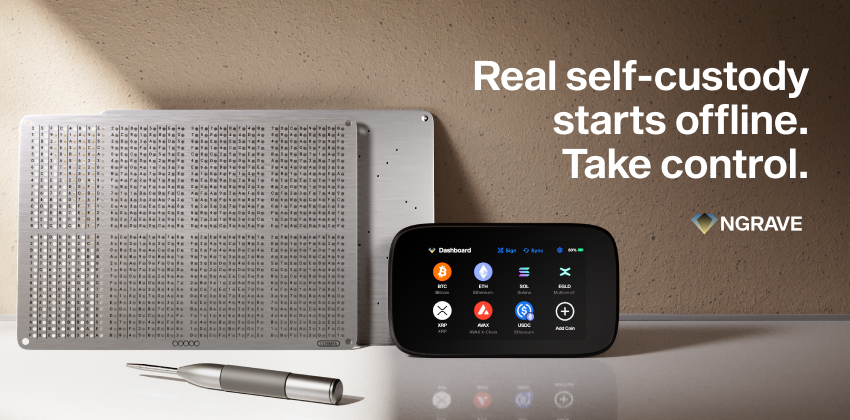
ELLIPAL takes the air-gap concept further than any other wallet at its price point. The Titan 2 has zero connectivity of any kind — no USB, Bluetooth, WiFi, or NFC. Data moves exclusively via QR code scanning between the device and your phone. The result is a device physically immune to every known network-based attack vector. The 4-inch color touchscreen makes the QR workflow more comfortable than it sounds, and the anti-tamper self-destruct mechanism adds physical protection. For a holder at $1,000+ who wants the strongest air-gap guarantee without going to NGRAVE Zero territory, ELLIPAL is the pick.
[+] 100% air-gapped via QR only. 10,000+ coins. Anti-tamper self-destruct. Large touchscreen for comfortable use.
[-] More expensive than SafePal or Tangem. QR-only workflow requires the ELLIPAL app. Closed source.
Ledger Nano X [Cold — USB-C + Bluetooth]
Price: $149 | Rating: 4.6/5 | Best for: iPhone/Android users who want Bluetooth mobile access.
Ledger remains the most recognized hardware wallet brand globally, and the Nano X is their flagship for mobile users. The Bluetooth connection to the Ledger Live app makes managing your portfolio from a phone genuinely practical — no cables, no desktop required. With CC EAL5+ chip certification, support for 5,500+ coins, and the most comprehensive app ecosystem of any wallet here, it is the strongest choice for users who want professional-grade security combined with everyday usability. Worth noting: Ledger’s firmware is not fully open source, and a 2023 data breach exposed customer contact information (though not private keys). That transparency shortcoming is why some privacy-focused holders prefer Trezor.
[+] Bluetooth mobile management. 5,500+ coins. Ledger Live app is excellent. Industry-leading ecosystem.
[-] Closed source firmware. Costlier at $149. Ledger’s 2023 breach was a trust hit despite no key exposure.
Trezor Safe 3 [Cold — USB-C (no BT)]
Price: $59 | Rating: 4.5/5 | Best for: Open-source believers, technically inclined holders.
Trezor has built its entire identity around open-source transparency, and the Safe 3 is the most compelling expression of that commitment at an accessible price. Every line of firmware is publicly auditable on GitHub. The Safe 3 adds an EAL6+ certified Secure Element chip for the first time at this price point, addressing the only meaningful criticism of previous Trezor models. At $59, you get fully auditable code, top-tier chip certification, and support for 7,000+ assets. The limitation: no Bluetooth and no mobile app means it is a desktop-first wallet. For a small holder who cares deeply about verifiable security and does not need phone management, this is one of the strongest value propositions in the market.
[+] Fully open-source (every line on GitHub). EAL6+ Secure Element. $59 accessible price. 7,000+ coins.
[-] No Bluetooth or native mobile app. USB-C + desktop only. Plastic build. Desktop-first workflow.

The Hardware Wallet Decision Framework: Which Situation Applies to You?
Use this table to cut through the noise and find your starting point based on where you actually are right now:
| Your Situation | Recommended Option | Reasoning |
| < $500 in crypto, just starting | Reputable hot wallet (Trust Wallet, MetaMask) | Risk doesn’t justify hardware cost yet; focus on basic security hygiene first |
| $500–$1,000, holding for months | Hot wallet + strong security OR budget hardware wallet (SafePal S1, Tangem) | Hardware wallet starts making sense; Tangem at $54.90 is near-costless insurance |
| $1,000–$5,000, long-term holder | Hardware wallet (Tangem, SafePal, Trezor Safe 3) | Clear value case; a $60 wallet protecting $2,000 is a no-brainer |
| > $5,000 or long-term savings | Premium hardware wallet (Ledger Nano X, ELLIPAL Titan 2) | This is real money; invest in serious cold storage |
| DeFi / NFT user of any size | Hardware wallet always recommended | Smart contract risk makes hot-wallet-only setups vulnerable regardless of amount |
| Living in high-risk jurisdiction | Hardware wallet even for small amounts | Platform seizure risk changes the calculus entirely |
| The Custody-in-Layers Approach: Most experienced crypto holders do not put everything in one place. Small amounts for spending or DeFi stay in a hot wallet (MetaMask, Trust Wallet). Long-term savings move to cold storage. This is exactly how people treat money in the traditional financial system — checking account for daily use, savings account for reserves. Crypto is no different. |
When a Hardware Wallet Is NOT Your First Priority?
Let me be direct here because most hardware wallet content has an obvious interest in getting you to buy one immediately. There are situations where a hardware wallet is genuinely not your first move:
- You are still learning: If you are three weeks into crypto and still figuring out what a blockchain address is, a hardware wallet adds complexity that can lead to mistakes. Get comfortable first.
- Your basic account security is weak: If your exchange account has a weak password and SMS 2FA, fix that before buying hardware. A hardware wallet does not protect an account that can be socially engineered at the exchange level.
- You cannot safely store a seed phrase: If you live in unstable circumstances where physical paper security is not realistic, a hardware wallet that depends on a seed phrase may not make sense. Consider an MPC wallet (ZenGo, Bleap) that uses biometric/social recovery instead.
- You are actively trading: Moving crypto repeatedly between a hardware wallet and an exchange defeats much of the security benefit and adds friction. Cold storage is for funds you plan to hold, not funds you are actively trading.
Frequently Asked Questions
At what dollar amount should I get a hardware wallet?
The general industry consensus, supported by both Bleap Finance’s 2026 beginner guide and community discussions on Reddit’s r/BitcoinBeginners, is around $500 as the practical threshold where cold storage becomes clearly cost-effective. At that point, a $54.90 Tangem or $59 Trezor Safe 3 is less than 12% of your holdings — inexpensive insurance. That said, there are reasons to get one earlier: if you are in a high-risk jurisdiction, if you plan to grow holdings significantly, or if you hold DeFi positions where smart contract risk amplifies your vulnerability. The amount threshold is a guideline, not a rule.
Is a hot wallet like Trust Wallet or MetaMask safe enough for small amounts?
For amounts below $500 that you are comfortable potentially losing, a reputable non-custodial hot wallet with proper security hygiene is reasonable. ‘Proper hygiene’ means: unique strong password, hardware-based 2FA for your email, seed phrase written on paper and stored securely, never clicking unsolicited wallet links, and using only official app downloads. The Bleap Finance beginner guide notes that Trust Wallet supports 10 million+ assets across 70+ blockchains and is free — a solid starting point. The caveat is that hot wallets are internet-connected by definition, and that surface area always carries risk that cold storage eliminates.
Can I use the same hardware wallet as my holdings grow?
Yes — and this is one of the underappreciated arguments for getting started with hardware storage early. A Tangem or SafePal purchased for your first $300 in crypto will protect $30,000 just as effectively when your portfolio grows. You are not buying security for a specific dollar amount; you are building the habit and infrastructure for self-custody that scales with you. The only reason to upgrade is if you outgrow the coin support of your wallet or if you want features (like Ledger’s broader app ecosystem or ELLIPAL’s stronger air-gap) that your current device does not offer.
What is the difference between Ledger, ELLIPAL, SafePal, and Tangem for a beginner?
For pure beginners: Tangem is the most accessible entry point — card-based, no seed phrase, NFC to your phone, EAL6+ certified. SafePal S1 Pro is the best budget air-gapped wallet for multi-chain holders. ELLIPAL Titan 2 is for those who want maximum air-gap integrity and a larger screen with more comfortable QR workflow. Ledger Nano X is the choice for users who want Bluetooth mobile management and the largest coin ecosystem. Each has a legitimate use case — the ‘best’ depends on whether you prioritize simplicity, budget, air-gap purity, or mobile integration.
What happens to my crypto if I lose my hardware wallet?
Your crypto is not stored on the device — it lives on the blockchain. The hardware wallet stores your private keys. Lose the device and you recover access by importing your seed phrase (24 words, for most wallets) into a new hardware wallet or compatible software wallet. This recovery works as long as your seed phrase is intact and stored safely. Tangem users recover using their backup card(s) instead of a seed phrase. The critical point: losing the device is recoverable. Losing the seed phrase without a backup is not. Proper seed phrase storage — paper or engraved metal, offline, in two separate physical locations — is the most important step in cold storage setup.
| Start Small. Stay Safe. Grow With Confidence. Your first $100 in crypto deserves the same respect as your first $10,000. Build good security habits now — before they matter most. EXPLORE: TANGEM.COM | SAFEPAL.IO | ELLIPAL.COM | LEDGER.COM Always buy hardware wallets directly from official manufacturer websites. Never from third-party marketplaces or resellers. |