
Combining two privacy tools sounds like double protection. Sometimes it is. Sometimes it’s the opposite. Here’s how to tell the difference.
If you’ve spent any time in privacy forums, you’ve seen the debate. Someone asks whether they should use Tor over VPN or VPN over Tor, and the replies split into two camps almost instantly. One camp says combining them is genius. The other says it’s a rookie mistake that actually makes you easier to track.
Both camps have a point. That’s the frustrating, honest truth about this topic.
Tor and VPNs solve different privacy problems, and stacking them doesn’t automatically multiply your protection. Sometimes it helps. Sometimes it backfires badly. The right answer depends entirely on who you’re trying to hide from, and what you do when you set things up.
In this guide, I’m breaking down exactly how Tor over VPN and VPN over Tor work, when combining a VPN with Tor actually makes sense, why using a VPN and Tor together can backfire on your privacy, and which setup actually protects you better depending on your situation. No fence-sitting — just a clear, honest breakdown.
First, What Are You Actually Comparing?
A VPN encrypts your traffic and routes it through a single server operated by your VPN provider. Your ISP can no longer see your browsing activity, but your VPN provider can — they know your real IP address and, depending on their logging policy, potentially your activity too. It’s fast, simple, and works with any app or browser on your device.
Tor works completely differently. The Tor Browser routes your traffic through three random, independent relays operated by volunteers around the world, wrapping your data in multiple layers of encryption — like an onion, which is where the name comes from. No single relay knows both who you are and what you’re doing. The entry node sees your IP but not your destination. The exit node sees your destination but not your IP. It’s slower, but the anonymity model is fundamentally stronger for hiding your identity from any single party.
Both tools are good at different things. A VPN is built for speed, convenience, and protecting you on untrusted networks. Tor is built for anonymity through distributed trust. Combining them creates two distinct configurations — and they are not interchangeable.
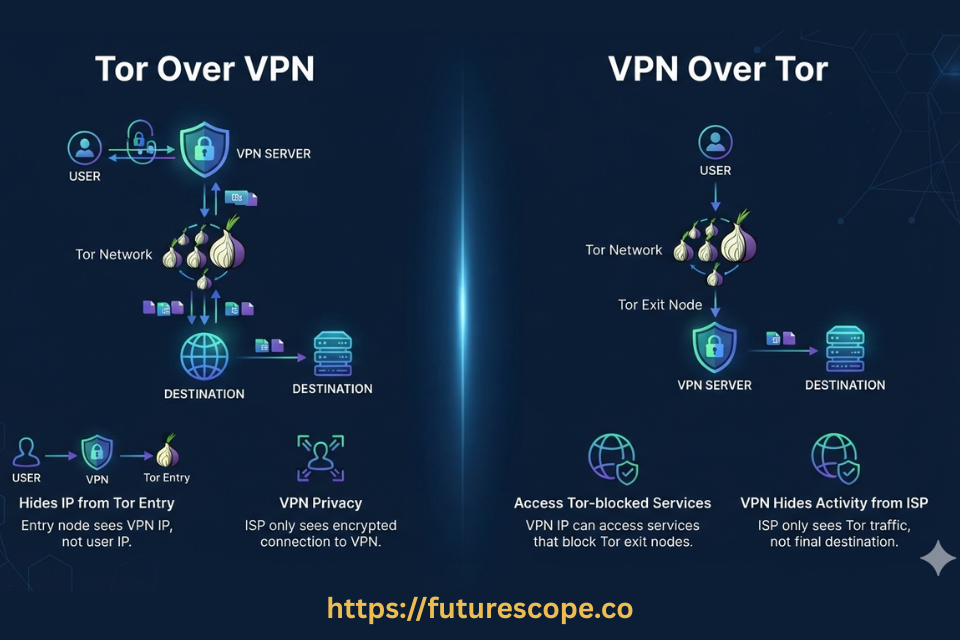
Quick Distinction: Tor over VPN means you connect to your VPN first, then open Tor Browser on top of that connection. VPN over Tor means you connect to Tor first, then route a VPN connection through the Tor network. The order changes everything about who can see what.

Tor Over VPN: How It Works and What It Protects
Tor over VPN — also called Onion over VPN — is the far more common and far more practical setup. You launch your VPN client, connect to a server, and then open Tor Browser on top of that connection. Your traffic path looks like this: You → VPN → Tor → Internet.
Here’s what this arrangement actually buys you:
- Hides Tor usage from your ISP: Your internet provider only sees an encrypted connection to a VPN server. They have no idea you’re using Tor at all — which matters in places where Tor usage itself draws unwanted attention.
- Hides your real IP from the Tor entry node: The first Tor relay sees your VPN’s IP address, not your home IP. If that entry node happened to be malicious or compromised, your actual location stays hidden.
- Adds a layer of encryption before Tor: Your traffic is encrypted by the VPN before it even reaches Tor’s network, on top of Tor’s own three layers of onion encryption.
- Works with any reputable VPN: Some providers like NordVPN even offer a dedicated “Onion over VPN” feature that automates the whole process.
The tradeoff: your VPN provider can see that you’re connecting to the Tor network, and they always know your real IP address. This setup requires real trust in your VPN provider — if they log data or get compromised, your starting point is exposed, even if Tor itself stays intact.
VPN Over Tor: How It Works and What It Protects
VPN over Tor flips the order. You connect to Tor first, then route a VPN connection through Tor’s network to your destination. The path looks like this: You → Tor → VPN → Internet.
This setup is far less common, considerably harder to configure, and only supported by a handful of VPN providers. Here’s what it offers when done correctly:
- Hides your Tor usage from destination websites: The site you visit sees your VPN’s IP address, not a known Tor exit node IP — useful since many websites block or flag Tor exit nodes outright.
- Bypasses Tor-blocking restrictions: Some platforms refuse connections from Tor exit nodes entirely. Routing through a VPN afterward gets you past that block.
- Adds encryption after the Tor exit node: Tor exit nodes can see your unencrypted traffic if you’re not using HTTPS. A VPN layered after Tor protects that final hop.
- Doesn’t require trusting a VPN with your real IP: Since Tor already anonymized your starting point before the VPN ever sees your connection, the VPN provider never learns your true identity.
The tradeoff here is real complexity. Very few VPN providers support this configuration out of the box, and connection speed takes a significant hit, since you’re now passing through Tor’s three relays and then a VPN tunnel. For most people, this setup isn’t practical to maintain.
Tor Over VPN vs. VPN Over Tor: Which Actually Protects You Better?
There’s no universal winner here — it genuinely depends on your specific threat model. Let’s compare both setups across the factors that matter most:
Who sees your real identity
🧅 Tor over VPN: Your VPN provider knows your real IP address. Tor’s entry node only sees the VPN’s IP.
🧅 VPN over Tor: Nobody sees your real IP except Tor’s entry node — not even your VPN provider.
Ease of setup
🧅 Tor over VPN: Simple. Most VPN apps support this with a normal connect-then-browse flow.
🧅 VPN over Tor: Complex. Requires manual proxy configuration and provider support, which is rare.
Connection speed
🧅 Tor over VPN: Faster of the two combined setups, though still slower than VPN alone.
🧅 VPN over Tor: Noticeably slower due to routing order; not ideal for everyday browsing.
Best for hiding Tor usage from
🧅 Tor over VPN: Your Internet Service Provider (ISP) and local network administrators.
🧅 VPN over Tor: The destination websites you visit, and platforms that block Tor exit nodes.
Level of trust required
🧅 Tor over VPN: High trust in your VPN provider, since they see your real IP.
🧅 VPN over Tor: Low trust in your VPN provider, since your identity is hidden by Tor first.
Most privacy-focused comparisons agree that Tor over VPN is the setup more experts recommend for typical users, since it works with virtually any VPN provider and offers meaningful protection without the steep complexity of VPN over Tor.
Why Using a VPN and Tor Together Can Backfire on Your Privacy
Here’s the part that gets glossed over in a lot of “combine them for double security” articles: stacking a VPN with Tor isn’t automatically safer, and in several real scenarios, it actively works against you.
Your VPN Provider Becomes a Single Point of Failure
In Tor over VPN, your VPN provider knows your real IP address and knows you’re connecting to Tor. If that provider keeps logs, gets hacked, or is compelled by a government request to hand over data, your anonymity chain has a weak link that didn’t exist with Tor alone. This risk grows when VPN providers require personal details like email addresses or payment information during signup — both of which make tracing you significantly easier.
VPN-to-Tor Connections Are More Conspicuous, Not Less
This is counterintuitive but important. Connections flowing from a known VPN server IP directly into the Tor network can create a recognizable pattern. Techniques like deep packet inspection and website traffic fingerprinting can sometimes identify these connections despite encryption, meaning your traffic could stand out more than a typical, undistinguished Tor connection would on its own.
Misconfiguration Can Expose Your Real IP Instantly
If your VPN connection drops unexpectedly and you don’t have a kill switch or firewall rule in place, your traffic can silently fail over to your unprotected real IP address without any warning. Complex setups — like routing through transparent proxies for VPN over Tor — are especially error-prone, and the Tor Project has explicitly warned that poorly configured combinations can create new vulnerabilities rather than removing them.
It Can Weaken Tor’s Core Anonymity Model
Tor’s anonymity strength comes partly from the size and diversity of its user base — blending into a massive crowd of ordinary Tor users with standard, predictable connection patterns. Some privacy researchers argue that bolting on a non-standard VPN tunnel makes your traffic pattern deviate from that crowd, which could make you easier to single out rather than harder. Others push back on this, noting that a trustworthy VPN simply replaces your ISP in the equation without adding meaningful new risk. This is a genuinely contested point in the privacy community, not settled science.
It Doesn’t Solve the Problem You Think It Solves
Privacy forums often raise a fair counterpoint: if you don’t trust your VPN, the whole reason for layering Tor on top is to protect yourself from that distrust. But if you fully trust your VPN, you may not have needed Tor in the first place for everyday privacy — unless you specifically need Tor’s anonymity properties or access to onion services. Combining them isn’t pointless, but it’s not a magic doubling of protection either; it’s an exchange of one risk profile for another.
Straight From Tor Project: Tor’s own support documentation states plainly that combining a VPN with Tor Browser can reduce anonymity or break Tor’s protections if not configured correctly, and that they generally don’t recommend it unless you’re an advanced user who fully understands how to configure both tools without compromising your privacy.
Combining a VPN With Tor: Does It Actually Make Sense?
Despite everything above, there are legitimate scenarios where pairing a VPN with Tor genuinely helps — as long as you choose a trustworthy, no-log provider and understand exactly what you’re protecting against.
- Your ISP is part of your threat model: If you’re worried about your internet provider noticing and reporting Tor usage — relevant in workplaces, schools, or countries where Tor draws scrutiny — a VPN hides that fact effectively.
- You already use and trust a reputable VPN: If you’ve already vetted a no-log provider for other reasons, adding Tor on top costs you little extra trust exposure, since that provider already sees your traffic patterns regardless.
- You’re in a region with heavy censorship: In countries like China or Iran, where Tor itself may be blocked or flagged, a trustworthy VPN can help establish the initial connection. That said, dedicated tools like Tor bridges — specifically obfs4 bridges — are generally a better-designed solution for this exact problem, since they’re built specifically to disguise Tor traffic as ordinary internet traffic.
- You’re a journalist, activist, or whistleblower: People facing serious, targeted risk may accept the added complexity and VPN trust requirement in exchange for hiding Tor usage from their network entirely. Even here, traffic fingerprinting risks remain, so this isn’t a perfect shield.
For the vast majority of everyday privacy-conscious users — people who want to browse without ad tracking, avoid casual surveillance, or research sensitive topics privately — using Tor Browser alone, or a reputable VPN alone for non-Tor browsing, is simpler, faster, and sufficiently protective. The added complexity of combining both tools is best reserved for specific, elevated threat models.
Using Tor Browser With a VPN the Right Way
If you’ve weighed the tradeoffs and decided combining them suits your situation, doing it correctly matters enormously. A few sloppy mistakes can undo all the protection you were hoping to gain.
- Choose a strict no-log VPN: Look for providers that have undergone independent audits confirming they don’t retain connection logs, and ideally accept anonymous payment methods like Monero.
- Connect to the VPN first, then open Tor Browser: This is the standard Tor over VPN flow, and the order matters — don’t try to force Tor traffic through a VPN client afterward unless you specifically need VPN over Tor and know how to configure it.
- Enable your VPN’s kill switch: This prevents your real IP from leaking if the VPN connection drops unexpectedly while Tor Browser is open.
- Avoid logging into personal accounts: Using Tor or Tor-plus-VPN to log into your real Gmail, banking, or social media accounts defeats the purpose — it links your anonymous session straight back to your identity.
- Don’t install random browser extensions: Extensions can fingerprint your browser or leak data outside the protected tunnel, undermining everything else you’ve set up.
- Keep Tor Browser updated: Security patches address known fingerprinting and deanonymization techniques as they’re discovered.
Real-World Lesson: Analysis of real deanonymization cases, including high-profile dark web takedowns, consistently shows that the biggest privacy failures came from human error and operational mistakes — reusing usernames, logging into personal accounts, or bragging online — rather than from any cryptographic weakness in Tor or VPN technology itself. Tooling matters, but discipline matters more.
Frequently Asked Questions
1. Is it ever a bad idea to use Tor over VPN?
It can be, depending on your threat model. If your biggest concern is your VPN provider itself being compromised, subpoenaed, or untrustworthy, then Tor over VPN doesn’t protect you — your VPN still sees your real IP address. It can also make your traffic pattern more conspicuous to sophisticated network observers, since VPN-to-Tor connections aren’t the typical, anonymous-by-volume traffic Tor is designed around. For most everyday users worried mainly about their ISP, though, it remains a reasonably solid, low-complexity option.
2. Should I just use Tor bridges instead of a VPN?
For censorship circumvention specifically, many privacy experts consider Tor bridges — especially obfs4 bridges — a more purpose-built solution than a VPN. Bridges are designed specifically to disguise Tor traffic so it doesn’t look like Tor traffic at all, which is exactly the problem you’re often trying to solve. A VPN, by contrast, hides that you’re using Tor from your ISP but doesn’t disguise the Tor traffic pattern itself once it leaves the VPN server. That said, bridges and VPNs aren’t mutually exclusive — some setups use both together for layered protection in high-censorship environments.
3. Can my VPN provider see what I do once I’m inside Tor?
No. Once your encrypted traffic enters Tor’s network through the VPN tunnel, your VPN provider can see that you’re connecting to Tor, but Tor’s own layered encryption prevents them from seeing your destination websites or activity within Tor. This is the core benefit of Tor over VPN: your VPN knows you’re using Tor, but not what you’re doing with it. The reverse is true in VPN over Tor — your VPN sees your destination but never learns your real identity.
4. Does combining Tor and VPN make me completely anonymous?
No combination of tools delivers complete anonymity, and any source claiming otherwise is overselling. Both Tor over VPN and VPN over Tor meaningfully improve your privacy against specific threats, but neither protects against every risk — website fingerprinting, browser fingerprinting, behavioral patterns, and simple human error (like logging into a personal account) can all undermine anonymity regardless of which tunneling setup you use. Treat these tools as strong privacy layers, not invincibility cloaks.
5. Which setup should a complete beginner choose?
For most beginners, Tor over VPN is the more practical and forgiving starting point. It’s simpler to configure correctly, works with almost any reputable VPN provider, and several providers even offer a dedicated one-click feature for it. VPN over Tor offers a different anonymity benefit but requires manual configuration that’s genuinely easy to get wrong, and getting it wrong can be worse than not combining the tools at all. If you’re new to this, start with a trustworthy no-log VPN and Tor Browser used separately, then explore Tor over VPN once you understand your specific privacy needs.
Know Your Threat Model Before You Stack Your Tools
There’s no universally “correct” answer to whether you should use Tor over VPN or VPN over Tor — and anyone who tells you otherwise without asking about your specific situation is giving you incomplete advice.
Privacy isn’t about stacking every tool you can find. It’s about understanding exactly who you’re protecting yourself from, and choosing the setup that actually addresses that threat — without introducing new weak points along the way.
Here’s how to move forward with confidence:
- Define your threat model first — are you hiding from your ISP, the websites you visit, or both?
- If your main concern is your ISP, try Tor over VPN with a reputable, independently audited, no-log VPN provider.
- If you’re in a heavily censored region, research Tor bridges (obfs4) as a purpose-built alternative or companion to a VPN.
- Always enable your VPN’s kill switch before opening Tor Browser to prevent IP leaks on disconnect.
- Never log into personal accounts while using Tor or Tor-plus-VPN — operational discipline matters more than any tool.
- When in doubt, start simple: use Tor Browser alone or a trusted VPN alone before layering complexity you may not need.
The strongest privacy setup isn’t the most complicated one — it’s the one that matches your actual risk and that you can configure correctly, every single time.
Written by a cybersecurity professional who believes good privacy advice starts with asking “who are you protecting yourself from?”