
You have probably heard the advice a hundred times: “Write your 24 words on paper, store it somewhere safe, and never lose it.“ And you have probably felt the quiet anxiety that follows. What if there is a fire? What if I forget where I put it? What if someone finds it? What if I make a mistake writing it?
That anxiety is not irrational. According to Ryder’s April 2026 analysis, over 3 million Bitcoin have been lost globally — not because of sophisticated hacks, but because of seed phrase mismanagement. Written words on paper that were stored in the wrong place, destroyed by water or fire, transcribed with a single error, or simply forgotten over the years.
In 2026, you do not have to accept that risk. A generation of hardware wallets has been designed to either eliminate the seed phrase entirely or make it optional — using cryptographic methods that are architecturally more resilient than paper. This guide covers the best of them, from the budget-friendly to the security-maximizing, so you can choose the right fit for how you hold crypto.
| “The seed phrase was a breakthrough in 2013. In 2026, it is the reason most people lose their crypto. These wallets let you skip it — without sacrificing security.” — Ryder.id, April 2026 |
Why Seed Phrases Keep Failing Real People
| 3M+ Bitcoin lost globally due to seed phrase mismanagement (not hacks) | $494M stolen by wallet drainer attacks in 2024 — screenless wallets most vulnerable | 9,000+ cryptocurrencies supported by Cypherock X1 — the most seedless-flexible option | 2-of-5 Shamir threshold: only 2 of 5 shards needed to recover Cypherock or Ryder |
The $494 million in wallet drainer losses in 2024 highlighted a second danger that matters specifically for seedless wallets: blind signing. When a wallet has no screen of its own, transaction details are displayed on your phone or computer — and malware can alter what you see before you tap to approve. A wallet drainer exploits exactly this gap: it shows you one transaction, you sign a different one. This is why on-device screens are not a luxury — they are the primary defense against the most common DeFi attack in 2024-2026.
Two of the wallets in this guide have on-device screens (Cypherock X1 and Ryder One). Two do not (Tangem and Bitkey). The right choice depends on what you hold and how actively you use it.
What ‘Without a Seed Phrase’ Actually Means
Not every seedless wallet works the same way, and the difference matters for your security model:
- Fully seedless: the wallet never generates a seed phrase. Your private key exists only in hardware and is backed up through an alternative method. Tangem and Bitkey work this way by default. If you lose all physical components and have not enabled alternative backups, access may be permanently lost.
- Seed phrase optional: the wallet uses an alternative recovery method by default but lets you view and export the seed phrase if you ever need to migrate to a different wallet. Cypherock X1 and Ryder One work this way. This gives you a genuine exit path without forcing you to rely on the phrase.
- Seedless software wallet (MPC): ZenGo replaces the seed phrase with Multi-Party Computation — splitting cryptographic control between your device and ZenGo’s servers, secured by biometric authentication and cloud backup. No hardware device required, but recovery depends partially on ZenGo’s infrastructure.
Per Ryder’s 2026 analysis: “Seed phrase optional is the safer design for most people because it gives you an exit path without forcing you to depend on one component.”
The Best Hardware Wallets Without a Seed Phrase in 2026
These five picks represent the meaningful choices across the seedless spectrum — from the most distributed security to the most user-friendly entry point:
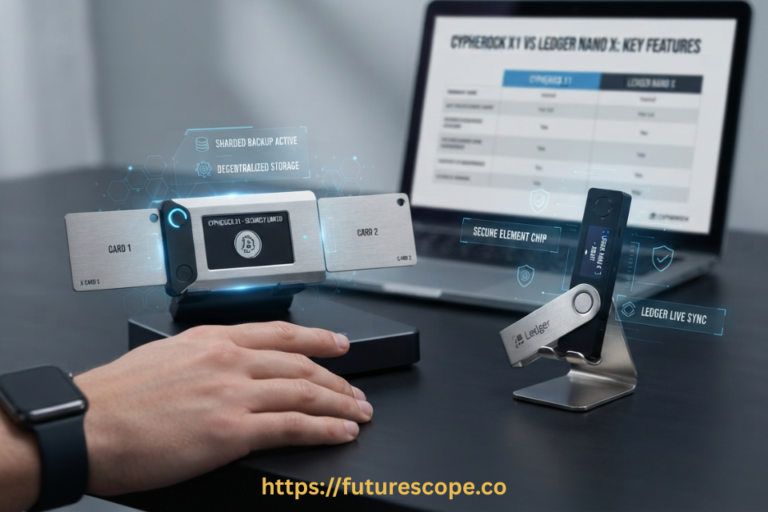
Cypherock X1 — Best for Maximum Key Distribution + Open Source
Price: $99-199 | Recovery: Shamir 5-of-5 (any 2 of 5 recover) | Screen: OLED on-device screen Coins: 9,000+ tokens | Best for: Open-source security maximizers
Cypherock X1 uses Shamir’s Secret Sharing to split your private key entropy into five shards: one in the X1 Vault device and one in each of four NFC hardware cards. You need any two of the five components to sign a transaction or recover your wallet. No single item contains a complete private key — including the device itself. An attacker who steals the vault has nothing useful without at least one card. The X1’s OLED screen and joystick provide on-device transaction verification — meaning you confirm what you are actually signing on the hardware, not on a potentially compromised phone.
The firmware is fully open source with reproducible builds on GitHub. Keylabs — the firm that demonstrated extractable vulnerabilities in Ledger and Trezor hardware — audited Cypherock X1 and noted it features ‘security firsts we have not seen in other wallets.’ Trade-offs: USB-C connection means it is not air-gapped in the way NFC-only devices are. Managing four cards plus a vault is more complex than alternatives. Desktop-first workflow with no native mobile app.
[+] Most distributed key model: any 2 of 5 components recover. OLED on-device screen blocks blind signing. Fully open source + Keylabs audited. 9,000+ coins.
[-] USB-C connection (not fully air-gapped). Steeper setup curve. No mobile app. Bulkier form factor.
Tangem — Best Budget Seedless Wallet
Price: ~$70 (3-card set) | Recovery: Card cloning (3 backup cards) | Screen: None — phone screen only Coins: 6,000+ tokens across 80+ chains | Best for: Budget-conscious beginners
Tangem takes the most stripped-down approach to seedless storage. Your private key is generated inside a credit-card-sized NFC chip and cloned to two backup cards. No seed phrase, no USB cable, no desktop app. Setup takes under 60 seconds. The EAL6+ Samsung secure element chip matches banking card certification. The trade-offs are real and worth understanding. Each backup card is a full copy of your private key — protected only by your access code. Someone who gets a card and guesses your code has full access.
More importantly, Tangem has no screen: all transaction details appear on your phone, creating the blind signing vulnerability described above. In late 2024, a bug in the Tangem mobile app accidentally logged seed phrase data for users who enabled the optional phrase feature — resolved quickly, but documented. For smaller holdings and casual users, Tangem’s simplicity and $70 price point are genuinely compelling. For larger holdings or active DeFi, the screenless design is a meaningful limitation.
[+] Cheapest on this list at ~$70. Dead simple setup. Air-gapped NFC only. EAL6+ chip. 6,000+ coins across 80+ chains.
[-] No on-device screen — blind signing risk. Each backup is a full key copy. Cannot add more backups after setup. 2024 logging incident (resolved).
Bitkey — Best for Bitcoin-Only Holders
Price: ~$150 | Recovery: 2-of-3 multisig (device + phone app + Block server) | Screen: None — fingerprint only Coins: Bitcoin only | Best for: Bitcoin-only holders who want foolproof recovery
Bitkey, built by Block (the company behind Square and Cash App), takes a fundamentally different approach. Instead of sharding one key, it uses 2-of-3 multisig: three independent keys exist — one on the hardware device, one in the phone app, one encrypted on Block’s servers. Any two of the three authorize a transaction. Lose your phone? Device + server recover you. Lose the hardware? Phone + server recover you. Block’s servers down? Device + Emergency Access Kit (stored in your cloud backup) get you in.
No seed phrase exists at all — not optional, not hidden. The recovery model is genuinely foolproof for everyday users, the inheritance feature is built-in, and the entire stack (app, firmware, server code) is open source. The fingerprint scanner adds biometric authentication. The honest limitation: one of your three keys lives on Block’s servers. Bitkey cannot steal your funds unilaterally, but this is a third-party trust assumption that traditional self-custodians reject. And it is Bitcoin only — no ETH, no Solana, no tokens.
[+] Truly seedless (no phrase exists). 2-of-3 multisig is near-foolproof recovery. Inheritance feature built-in. Full open-source stack. Built by publicly traded company.
[-] One key on Block’s servers (partial third-party trust). Bitcoin only. No on-device screen. Relies on cloud backup for phone key recovery.

Ryder One — Best Overall Resilience + On-Device
Screen Price: $229 | Recovery: TapSafe Shamir (Recovery Tags + phone + contacts) | Screen: 1.6 inch AMOLED color touchscreen Coins: 60+ tokens (BTC, ETH, SOL, Stacks) | Best for: Users who want best-in-class recovery + transaction verification
Ryder One is the only wallet on this list that combines distributed recovery with a color touchscreen in a portless NFC-only design. During setup, your wallet is backed up in a single tap to a Recovery Tag using Shamir’s Secret Sharing distributed across the tag, your phone, and optionally trusted Recovery Contacts. No single component gives access alone. Extra Recovery Tags can be added anytime ($29 for two) — allowing your backup redundancy to grow with your holdings. The AMOLED touchscreen means transaction details are verified on the device, not on your phone — the primary defense against the wallet drainer attacks that stole $494 million in 2024.
The EAL6+ Infineon SLC38 secure element is among the top-rated chips in consumer hardware wallets. Halborn — a respected external security firm — audited and published findings. Trade-offs: asset coverage is focused on mainstream chains (BTC, ETH, SOL, Stacks) rather than thousands of niche tokens. At $229, it is the most expensive option. And the 60+ token limit means multi-chain DeFi users with unusual positions may need a complementary solution.
[+] Distributed Shamir recovery by default. AMOLED screen blocks blind signing. NFC-only air-gapped design. Expandable recovery (add tags anytime). External Halborn audit published.
[-] Premium price at $229. Focused on mainstream chains (60+ tokens vs 6,000+ on Tangem). Smaller community than Ledger/Tangem.
ZenGo — Best Seedless Mobile Wallet (Software)
Price: Free | Recovery: MPC + biometric + cloud backup (3-factor) | Screen: Phone screen Coins: 1,000+ tokens | Best for: Seed-phrase-anxious mobile users not ready for hardware
ZenGo is the seedless option for people who are not ready to invest in hardware but want to escape the seed phrase model. It uses Multi-Party Computation (MPC) to split cryptographic control between your device and ZenGo’s servers — no seed phrase anywhere. Recovery uses three factors: biometric (Face ID), email, and your unique encryption key. Lose your phone? ZenGo’s 3-factor recovery restores your wallet without ever reconstructing the full key in one place.
ZenGo is a hot wallet — internet-connected by definition — which means it carries risks hardware wallets eliminate. It is best understood as a step above keeping crypto on an exchange (you control your non-custodial access) but a step below hardware cold storage. For amounts under $500, as a learning wallet, or for DeFi experimentation, it is genuinely useful. For significant long-term holdings, a hardware option from the list above is the right upgrade.
[+] Truly seedless with no seed phrase. Free. 3-factor biometric recovery. Non-custodial self-custody model. Easy for beginners.
[-] Hot wallet — internet connected. Recovery partially depends on ZenGo’s servers. 1,000+ coins (fewer than hardware options). Not cold storage.

Full Comparison: All 5 Seedless Wallets
Every key spec at a glance. Cypherock X1 highlighted — the most distributed self-sovereign option:
| Wallet | Price | Recovery Model | Screen | Air-Gapped | Coins | Third-Party Trust | Best For |
| Cypherock X1 | Get The Best Price $99-199 | Shamir 5-of-5 (any 2 recover) | OLED Yes | No (USB-C) | 9,000+ | None | Open-source max security |
| Tangem | Own It Today ~$70 | Card cloning (3 backups) | No | Yes (NFC) | 6,000+ | None | Budget + simplicity |
| Bitkey | ~$150 | 2-of-3 multisig (device+app+server) | No | NFC | Bitcoin only | Block (1 key) | Bitcoin-only holders |
| Ryder One | $229 | TapSafe Shamir (tags+phone) | AMOLED Yes | Yes (NFC) | 60+ | None | Best overall resilience |
| ZenGo | Free | MPC + biometric (seedless) | Phone | No | 1,000+ | ZenGo servers | Seedless mobile wallet |
| The On-Device Screen Rule: If you actively use DeFi, interact with smart contracts, or use any third-party dApp, a wallet with an independent screen (Cypherock X1, Ryder One) is significantly safer than a screenless device. Wallet drainer attacks work by altering what you see before you sign — an attack that a device screen blocks entirely, because the device shows you what it received, not what your phone displays. |
Which Seedless Wallet Is Right for You?
Here is the decision framework based on your situation:
- Maximum security + open-source transparency: Cypherock X1. Five-shard Shamir with no single point of failure. OLED screen. Fully audited open-source code. Best for significant long-term holdings you rarely touch.
- Best overall balance of resilience + screen + simplicity: Ryder One. Distributed Shamir by default. AMOLED screen. Air-gapped NFC. Expandable backups. Best if you want both transaction verification and seedless recovery without complexity.
- Bitcoin-only and want foolproof seedless recovery: Bitkey. 2-of-3 multisig is nearly impossible to lose access to under normal circumstances. Inheritance included. Open source. Accept the one-key-on-Block’s-servers trade-off.
- Budget and simplicity above all: Tangem. $70, dead simple, air-gapped NFC card. 6,000+ coins. Know the trade-offs: no screen, each backup is a full key copy, cannot expand recovery later.
- Not ready for hardware yet: ZenGo. Free, seedless, 3-factor biometric recovery. A meaningful upgrade from an exchange account or seed-phrase hot wallet for amounts you are actively learning with.
Frequently Asked Questions
Is it safe to use a hardware wallet without a seed phrase?
Yes — if the alternative recovery method is well-designed. The seed phrase itself was never the security; it was one way to back up a private key. Wallets like Cypherock X1, Ryder One, and Bitkey use cryptographic methods (Shamir’s Secret Sharing, 2-of-3 multisig) that are arguably more resilient than a single piece of paper because they eliminate the single point of failure. The Ryder April 2026 analysis notes: ‘They all share the same insight: the seed phrase is the single biggest point of failure in self-custody, and there are better ways to handle recovery.’
What is Shamir’s Secret Sharing and how does it work?
Shamir’s Secret Sharing is a cryptographic method that splits a secret (like a private key) into multiple pieces where no single piece reveals anything on its own. You define a threshold — for example, any 2 of 5 pieces — and the secret can only be reconstructed when enough pieces come together. Cypherock X1 splits across a vault and four cards (2-of-5 threshold). Ryder One distributes across a Recovery Tag, phone, and optional contacts. The practical result: losing one component does not lose your crypto, and a thief stealing one component cannot access your funds.
What is blind signing and why does it matter for seedless wallets?
Blind signing is the act of approving a blockchain transaction without being able to verify exactly what you are signing. It happens when a wallet has no screen — all transaction details appear on your phone or computer, which can be compromised by malware to show you false information. Wallet drainer attacks stole $494 million from over 332,000 wallets in 2024 by exploiting this gap. Hardware wallets with on-device screens (Cypherock X1, Ryder One) display the actual transaction data received by the device, not what your phone shows you — blocking this attack entirely. Screenless wallets (Tangem, Bitkey) transfer this verification responsibility to your phone.
Can I switch from Ledger or Trezor to a seedless wallet without moving my crypto?
Yes. Cypherock X1 specifically supports importing an existing BIP-39 seed phrase from another wallet — so you can import your current Ledger or Trezor seed and set up Cypherock’s Shamir-based recovery on top of it, without transferring funds on-chain. Ryder One also supports importing existing seed phrases via TapSafe setup. This makes migration practical: you keep your existing addresses and balances while upgrading your recovery architecture from a single paper to a distributed system.
What happens if Cypherock or Tangem goes out of business?
For Cypherock X1: the wallet is BIP-39 compatible, meaning you can always view and export your seed phrase on the device if needed. You could import it into any standard hardware or software wallet. The firmware is fully open source, so the wallet can be supported by the community indefinitely. For Tangem: no seed phrase exists by default, so recovery depends on your backup cards. Tangem also enables an optional seed phrase in settings for users who want an exit path. For Bitkey: Block provides an Emergency Access Kit in your cloud backup that allows recovery without Block’s servers.
| The Seed Phrase Had a Good Run. Now There’s Something Better. Every wallet on this list protects you against the single failure mode that has caused more crypto losses than all hacks combined. Choose the one that fits your life — and stop carrying the burden of 24 words. CYPHEROCK.COM | TANGEM.COM | BITKEY.WORLD | RYDER.ID | ZENGO.COM Always purchase from official manufacturer websites. This is not financial advice. DYOR. |
Sources: Ryder.id seedless wallet guide (April 2026), Tangem seedless wallet blog, Transak Top 7 seedless wallets analysis, Keylabs Cypherock X1 audit, ScamSniffer wallet drainer report 2024, ainvest.com lost crypto analysis 2025. Prices accurate as of July 2026.