
The Wallet That Kills the Seed Phrase Problem
Is Cypherock’s Distributed Card System the Future of Crypto Self-Custody?
Ask any experienced crypto holder what their biggest fear is — not market crashes, not regulatory news — and most will give you the same answer: losing the seed phrase. That one piece of paper, those 24 words written on a yellow Post-it or a folded sheet in a drawer, is the single point of failure that can erase everything you own in crypto.
Cypherock X1 was built around one specific insight: the seed phrase model is fundamentally broken for most self-custody users. Not because blockchains are insecure, but because humans are. We photograph things. We leave paper in places that flood. We trust single storage locations. We die without leaving recovery instructions anyone can follow.
This Cypherock X1 review for beginners walks you through exactly what this wallet does differently, who it is genuinely right for, what it does not solve, and whether a first-time hardware wallet buyer should consider it — with real context drawn from TokenToolHub’s comprehensive security-first analysis, Decrypt’s hands-on review, and community feedback on Trustpilot.
| “Cypherock X1 is not built to be the most minimal device. It is built to solve a specific and common self custody failure: the single seed phrase backup. If you can store components separately and follow a recovery plan, it gives you something classic wallets struggle to deliver.” — TokenToolHub Security Review (Feb 2026) |
The Problem Cypherock X1 Was Built to Solve
| $3.96B stolen from crypto users in 2025 — most via backup failures not chain hacks | #1 cause of irreversible crypto loss: seed phrase exposed or destroyed | 3,000+ coins supported by Cypherock X1 including BTC, ETH, Solana, BNB | EAL6+ security chip rating — same standard as high-security banking hardware |
The seed phrase problem is not theoretical. Every week, crypto holders lose funds through a painfully small set of failure modes that repeat constantly: a seed phrase backed up to iCloud (photographed or synced digitally), written on paper that gets thrown away during a house move, destroyed by a flood or fire, or — most insidiously — typed into a phishing site disguised as a wallet recovery portal. TokenToolHub’s February 2026 security review identifies these backup-failure modes as the dominant cause of self-custody loss, not sophisticated hacking.
Cypherock X1’s answer to all of this is a concept called distributed secret storage. Instead of one seed phrase in one location holding full recovery power, Cypherock splits your wallet recovery data between a vault device and a set of hardware cards — so that no single compromised item gives an attacker or an accident enough to drain you. This is the entire thesis, and it changes the risk calculation meaningfully for the right user.
What Is the Cypherock X1? The System Explained Simply
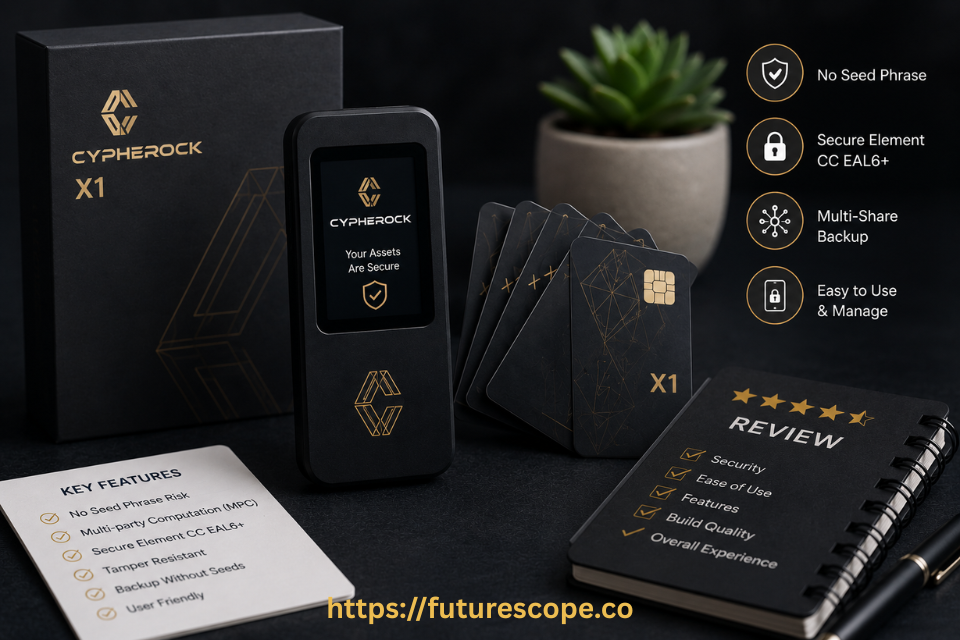
Cypherock X1 is not just a hardware wallet. It is a hardware wallet system — a vault device plus four hardware cards that work together to secure your private keys without any single component being enough for full recovery.
Here is the setup in plain English:
- The vault (X1 device): the primary device you use for daily management — signing transactions, viewing balances, and accessing accounts. It connects to the cySync desktop app for an interface. Air-gapped via QR codes, with no USB data transfer during transactions.
- The four hardware cards: physical cards (resembling credit cards but with embedded EAL6+ secure elements) that store shards of the recovery data. You need a threshold number of cards plus the vault to recover — meaning one lost or stolen card alone gives an attacker nothing.
- The cySync app: a desktop companion application (Windows, Mac, Linux) that provides the interface for account management, transaction signing, and firmware verification. All sensitive operations occur on the vault device, not on the computer.
Decrypt’s hands-on review describes the experience this way: the setup is more deliberate than plugging in a Ledger, but the payoff is a custody architecture where losing one component is survivable — a statement that no traditional hardware wallet can honestly make about a lost seed phrase.
Cypherock X1 Key Specifications
| PRICE ~$99–$130 (vault + 4 cards) | SECURITY CHIP EAL6+ Secure Element (CC certified) |
| CONNECTIVITY USB-C (device only); QR codes for air-gapped signing | RECOVERY MODEL Distributed sharding across vault + cards |
| OPEN SOURCE Yes — hardware design + firmware (GitHub) | COIN SUPPORT 3,000+ including BTC, ETH, ERC-20, Solana, BNB, MATIC |
| COMPATIBLE OS Windows, macOS, Linux (via cySync app) | SEED PHRASE REQUIRED? No — eliminates single-paper backup by design |
| INHERITANCE PLANNING Yes — multi-role card distribution supported | PASSPHRASE SUPPORT Yes — BIP39 passphrase supported |
How It Works — As a Beginner, This Is What You Need to Understand
The concept sounds cryptographically complex but the practical mental model is simple. Think of Cypherock as a safe that requires multiple keys from different locations to open. Instead of one master key that can let anyone in if found, control is distributed.
What this means in everyday scenarios:
- If someone breaks into your house and steals the vault: they have the device but not the cards. The device alone should not grant account recovery. Your crypto is safe.
- If one of your hardware cards is stolen from a separate location: they have a card but not the vault and not the other cards. Again, not enough.
- If your house floods and destroys one storage location: if you stored components across independent locations, the remaining components allow recovery.
- If you die without leaving instructions: you can design card distribution to give trusted family members recovery access — structured so no single person has everything, but designated people together can recover.
The critical rule, emphasized repeatedly by TokenToolHub’s security analysis: do not store all components together. The entire model depends on physical separation. Cards in the same box as the vault recreate a single point of failure. The safety gain comes from location independence.
Threat Matrix: How Cypherock X1 Handles Real-World Scenarios
This is the most useful table in any hardware wallet review — not coin support or screen size, but what actually happens when things go wrong:
| Threat Scenario | Classic Seed Wallet | Cypherock X1 Model |
| Seed phrase photographed / synced to cloud | High risk — photo alone can drain funds | One item compromise should not grant full recovery if stored separately |
| Paper seed lost in a move or fire | Often total loss if only backup | Recovery possible if other components survive in different locations |
| Physical device stolen | Safe if PIN is strong | One device alone should not be enough if cards are stored separately |
| Single card stolen | Not applicable | One card alone should not grant recovery — by design |
| Phishing / fake recovery page | Dangerous if user enters seed | Still a risk — device cannot stop you typing into a scam site |
| Inheritance / family recovery | Often fails — seed unknown or unclear | Easier to design multi-role plans without giving one person everything |
| The most important line in this table is the last one: phishing is NOT solved by Cypherock or any hardware wallet. If a beginner types their recovery information into a fake website, no wallet design saves them. Hardware wallets protect against remote attacks — not against users who approve the wrong transaction or trust the wrong site. |

Is the Cypherock X1 Right for You as a Beginner?
The honest beginner’s answer is: it depends on which beginner you are. This is not a wallet that rewards impatient setup. It rewards people who are willing to think about their custody plan — where components go, how recovery would work, and who might need access if something happened to them.
The Cypherock X1 IS right for you if:
- Your biggest fear is losing your seed phrase or having it exposed: the distributed model was built for exactly this fear.
- You hold crypto you plan to keep for years and access rarely: the deliberate signing workflow suits long-term holders, not daily traders.
- You have multiple secure physical locations: a home safe, a safety deposit box, a trusted family member’s location. Without separation, the model’s benefits are limited.
- You are thinking about inheritance: Cypherock is one of the most structured tools available for building a recoverable custody plan that family can execute without technical knowledge.
The Cypherock X1 might NOT suit you if:
- You want the simplest possible first wallet: if you are completely new and want to hold $200 of Bitcoin without complexity, a Tangem or Ledger Nano S Plus is more beginner-accessible.
- You frequently interact with DeFi: high-frequency transaction signing across multiple dApps is slower with Cypherock’s QR air-gap workflow. Many advanced users run Cypherock as a cold tier and a separate hot wallet for DeFi.
- You cannot separate storage locations: if all components live in one place, you lose the core security benefit.
Cypherock X1 vs Classic Hardware Wallets: Honest Comparison
| Feature | Cypherock X1 | Classic Hardware Wallet (Ledger/Trezor) |
| Recovery model | Distributed across vault + cards | Single seed phrase on paper |
| Backup failure risk | Reduced (one item not enough) | High if seed is exposed or lost |
| Setup complexity | Moderate — multiple components | Lower — one phrase to write down |
| Inheritance planning | Easier — role-based component split | Awkward — sharing seed is dangerous |
| Air-gap | Yes (QR-based transaction signing) | Varies by model (some use USB/BT) |
| Open source | Yes (hardware + firmware) | Partial (Ledger closed; Trezor open) |
| Supported coins | 3,000+ (BTC, ETH, Solana, etc.) | 5,500+ (Ledger) / 7,000+ (Trezor) |
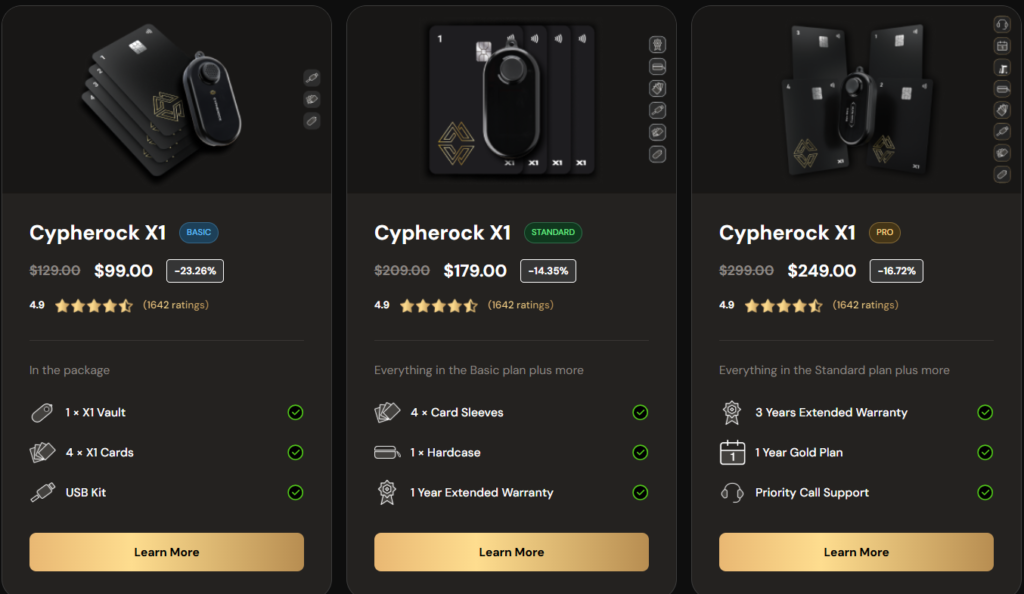
| Price | Grab it For ~$99–$130 | Own It Today $59–$149 |
| Open Source Note: Cypherock publishes both hardware designs and firmware on GitHub — making it one of the few fully open-source hardware wallets available. This matters because independent security researchers can audit the code, rather than users being forced to trust a manufacturer’s claims. BitDegree’s 2026 review highlights this as a meaningful differentiator. |

Verdict: Pros and Cons for Beginners
| PROS FOR BEGINNERS [+] Eliminates the single seed phrase failure point by design [+] Fully open-source hardware and firmware (auditable on GitHub) [+] EAL6+ certified secure element — banking-grade chip [+] Air-gapped transaction signing via QR (no USB data exposure) [+] Structured inheritance planning is genuinely accessible [+] Reduces catastrophic loss from one location disaster [+] Encourages intentional custody planning from day one | CONS FOR BEGINNERS [-] More components to manage than a single-device wallet [-] Security benefit only holds if components are stored separately [-] Steeper learning curve than plug-and-play alternatives [-] Desktop-only app (no native mobile management) [-] Fewer supported coins than Ledger (3,000+ vs 5,500+) [-] QR-based workflow feels slower for frequent transactions [-] Does not protect against phishing or blind signing |
Frequently Asked Questions
Is the Cypherock X1 a good first hardware wallet for beginners?
It can be — but with one caveat. Cypherock X1 rewards beginners who are willing to spend 30 minutes thinking about their custody plan: where components will be stored, how recovery would work, and who might need access in an emergency. If you want the simplest possible entry into cold storage with minimal setup, a Tangem or Ledger Nano S Plus is more immediately accessible. If you want the strongest backup failure protection from day one and are willing to follow a structured plan, Cypherock X1 is one of the best options available.
Does Cypherock X1 completely remove the seed phrase?
Yes — Cypherock X1 eliminates the traditional 24-word seed phrase backup by design. Instead of writing one phrase on paper that holds full recovery power, your recovery data is distributed across the vault device and hardware cards, so a single compromised item is not enough for full wallet recovery. This is the core design principle, confirmed by both TokenToolHub’s security analysis and Decrypt’s hands-on review.
What happens if I lose the vault device or one of the cards?
The design specifically protects against the loss of a single component. If you lose the vault device alone, someone who finds it cannot recover your funds without the required number of cards. If you lose one card, your remaining cards and vault can still be used for recovery — depending on your threshold setup. The critical condition is that components are stored in separate physical locations. If they are all together and one location is compromised, the benefit disappears. TokenToolHub strongly recommends: ‘Do not store all components together. Separation is the core of the security model.’
Can Cypherock X1 protect me from phishing or malicious transactions?
No — and no hardware wallet can fully protect you from this. If you click a fake wallet link and approve a malicious transaction on-device, the funds leave your wallet. Cypherock’s air-gap design means transactions are signed via QR codes and confirmed on the device screen, which gives you a verification step — but that verification only helps if you actually read and check what you are signing. The wallet protects your keys at rest; it cannot protect you from approving something harmful. For this reason, TokenToolHub recommends separating cold holdings from wallets you use for active DeFi interactions.
How does Cypherock X1 compare to Ledger and Trezor for beginners?
For beginners focused on ease of setup, Ledger Nano X or Trezor Safe 3 are more immediately simple — one seed phrase, one device, clear instructions. For beginners focused on eliminating the seed phrase risk or planning for inheritance from the start, Cypherock X1 is architecturally superior. Cypherock is also fully open source on both hardware and firmware — a distinction over Ledger (closed firmware) that matters to users who want independently verifiable security. BitDegree’s 2026 review notes that Cypherock’s open-source commitment and card-based recovery model represent ‘a meaningful evolution in the hardware wallet category for serious self-custody users.’
| Your Seed Phrase Is a Single Point of Failure. Cypherock X1 Is Designed to Fix That. If the biggest risk in your self-custody setup is one paper in one location holding everything — the Cypherock X1’s distributed recovery model was built for exactly that problem. Start your research at the official site. EXPLORE THE CYPHEROCK X1 AT CYPHEROCK.COM Always buy hardware wallets from official manufacturer websites only. This is not financial advice. |
Sources: TokenToolHub Cypherock X1 Security Review (Feb 2026), Decrypt hands-on review, BitDegree 2026 hardware wallet analysis, Trustpilot community reviews, Chainalysis 2025 crypto crime report. Prices accurate as of July 2026.