
The Honest Security Analysis That Goes Beyond the Marketing
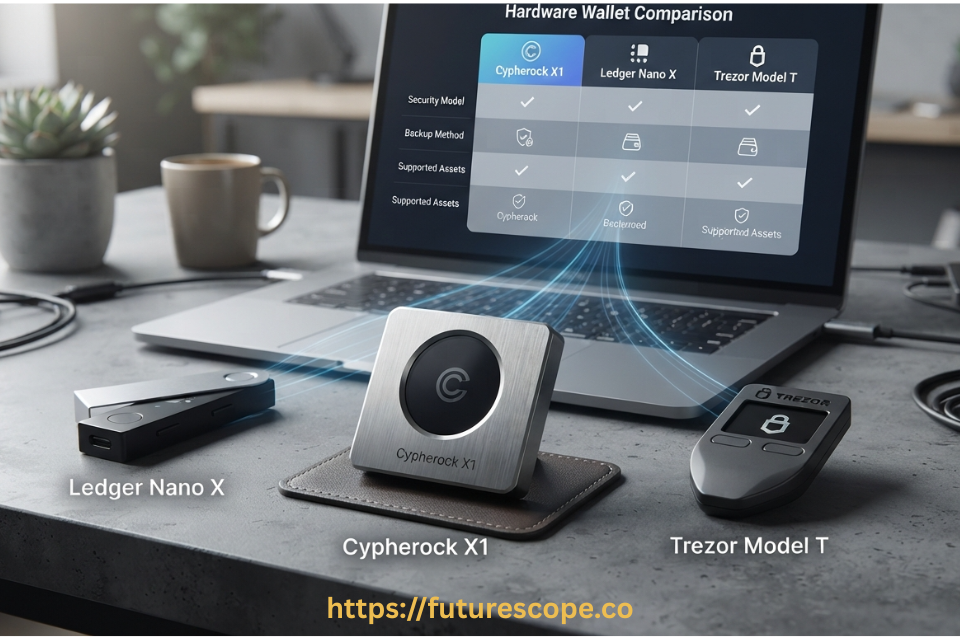
Here is a question that was unthinkable three years ago: is it time to replace your Ledger or Trezor? Not because those devices are bad. They are the reason hardware wallets exist as a category. They have protected billions of dollars in crypto over the past decade. But the security model they both share — one device, one seed phrase, one piece of paper — was designed when the threat landscape was different and the holder community was smaller.
Cypherock X1 emerged in 2023 with a specific challenge to that model. Not a faster chip or a bigger screen — a fundamentally different answer to the question: what happens when something goes wrong with your backup?
After deep-diving Keylabs’ formal audit of the Cypherock X1, cross-referencing 99Bitcoins’ hands-on review (9.4/10 overall), and mapping the threat matrix against Ledger and Trezor, here is my honest answer to the question everyone is asking.
| “The Cypherock X1 is an innovative wallet that uses many hardware and software security best practices and even features several security firsts that we have not yet seen in other wallets.” — Keylabs Security Audit (official auditors of Ledger and Trezor vulnerabilities) |
The Problem That Cypherock X1 Was Built to Solve
| #1 cause of irreversible crypto loss: seed phrase mishandled or destroyed | EAL6+ security chip in Cypherock X1 — one level above Ledger Nano X | 2-of-5 threshold: only 2 of 5 Shamir shards needed to recover funds | 8,000+ cryptocurrencies supported on the Cypherock X1 platform |
Ledger and Trezor are excellent at solving the first category of hardware wallet risk: keeping your private keys offline and away from remote hackers. They do this well. But there is a second category they have never fully solved — the human backup failure. A seed phrase written on paper can be lost in a flood, destroyed in a fire, found by a family member, photographed by mistake, or simply lost in a move. According to 99Bitcoins’ Cypherock review, Tayler McCracken — who has worked at a crypto wallet company and reviewed dozens of wallets over eight years — notes that “one recurring theme I’ve heard hundreds of times is users losing all their funds through mishandling their recovery phrases.”
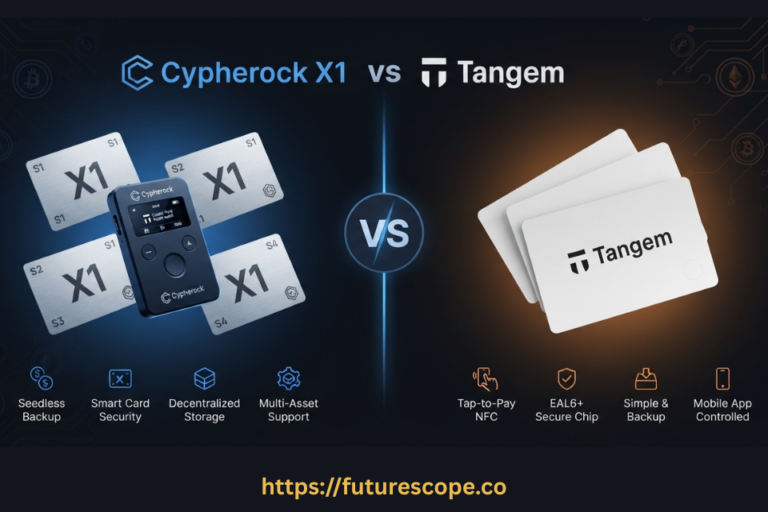
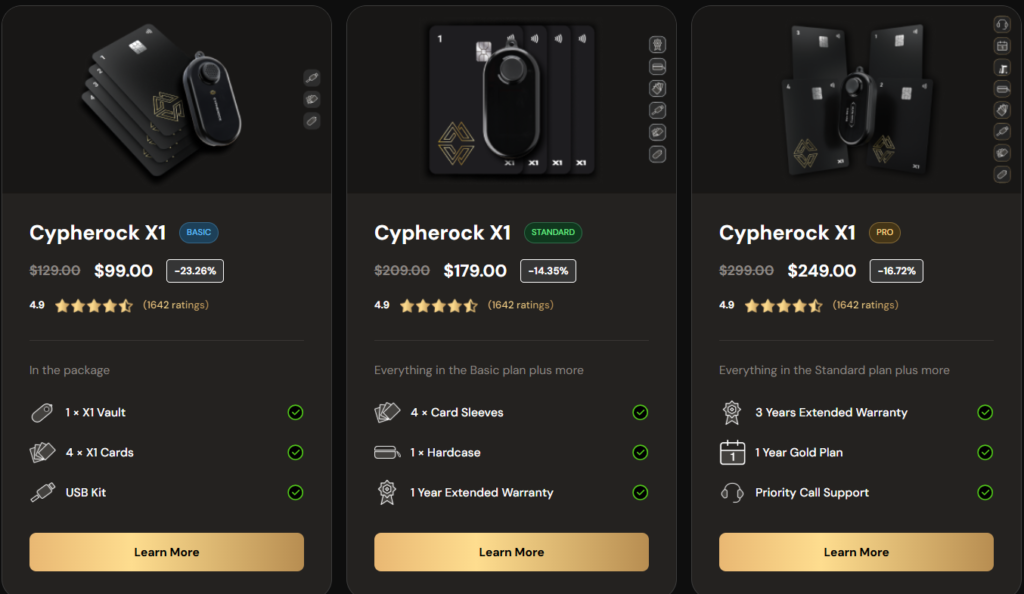
Cypherock’s answer is Shamir’s Secret Sharing — a mathematical method that splits your private key entropy into five parts (shards), stored across the X1 Vault device and four NFC hardware cards. Any two of those five parts can reconstruct your wallet. The technical implication: no single component holds enough information to give an attacker — or an accident — full access to your funds. This is the core architectural difference from Ledger and Trezor, and it is meaningful.

What Ledger and Trezor Got Right — and What They Left Unfinished
Before dismissing either platform, let us be honest about what they achieved.
Ledger created a user-friendly bridge between hardware security and software ecosystem integration. Ledger Live remains one of the cleanest wallet management interfaces available. Support for 5,500+ coins, Bluetooth mobile management, and a sprawling third-party app ecosystem — Sparrow, MetaMask, Electrum, Nunchuk, Casa — makes Ledger Nano X the most connected hardware wallet on the market. The CC EAL5+ chip is certified and proven.
Trezor built the first hardware wallet in the world and doubled down on open-source principles. Trezor’s firmware is fully auditable on GitHub, a stance that has built lasting trust in a skeptical community. The Trezor Safe 5 upgraded to an EAL6+ chip, improving on a historical gap. Multi-sig via PSBT is well-implemented and widely supported.
The shared vulnerability: both rely on a 24-word seed phrase written on paper as the ultimate recovery mechanism. Keylabs — the same firm that audited Cypherock — has demonstrated voltage glitch attacks that extracted private key data from physical Trezor and Ledger devices in controlled testing. Cypherock’s decoupled architecture, where no complete private key is ever stored in a single component, directly addresses this vulnerability. If an attacker successfully glitched the X1 Vault, they would obtain at most one Shamir shard — not usable alone.

5 Things Cypherock X1 Does Better Than Ledger and Trezor
1. Eliminates the Single-Backup Failure Point
This is the headline. A 24-word seed phrase is a single point of failure. One piece of paper in one location. Cypherock requires two of five components to recover — stored across different locations. Losing one card or the vault itself does not lose your funds. 99Bitcoins’ review concludes: “this wallet represents a major leap forward in crypto security… eliminating the single point of failure associated with traditional recovery phrases.”
2. Hardware-Audited Security by the Industry’s Toughest Critics
Keylabs — the firm that found exploitable vulnerabilities in both Ledger and Trezor devices — audited Cypherock X1 and gave it a positive assessment. They specifically noted hardware attestation through manufacturer-derived signatures and Shamir Secret Sharing as “security firsts we have not seen in other wallets.” This is not marketing. This is adversarial testing by people who found the weaknesses in Ledger and Trezor hardware.
3. Non-Upgradeable Cards Block Insider Firmware Threats
One vector of attack that Ledger and Trezor cannot fully close: a rogue firmware update pushed through an upgrade path. Cypherock’s four X1 Cards are intentionally non-upgradeable. They hold cryptographic shards and will never accept firmware updates, eliminating any attack path that relies on malicious firmware reaching the key storage components. The X1 Vault can be updated — but holds only one of five shards alone.
4. Three-Factor Authentication as Architecture
Cypherock requires three independent factors to operate: the X1 Card (something you have), the PIN (something you know), and the X1 Vault device (the physical signing environment). Ledger and Trezor offer PIN plus device — two factors. The third factor in Cypherock’s model is structural — the card must physically tap the vault. There is no software emulation of this process.
5. Cypherock Cover: The First Inheritance Solution for Self-Custody
Inheritance planning in crypto is genuinely unsolved by both Ledger and Trezor. Sharing a seed phrase with a family member is a security disaster. Multi-sig is technical. Cypherock Cover, which uses the distributed card architecture to assign cards to nominees with time-delayed activation and email OTP verification, is the first non-custodial, non-KYC inheritance solution built directly into a hardware wallet ecosystem. 99Bitcoins calls it “a first of its kind in the crypto industry.”
Where Ledger and Trezor Still Have the Edge
Being honest about Cypherock requires acknowledging where it is not yet the replacement for established platforms:
- Coin support: Trezor supports 7,000+ assets. Ledger supports 5,500+. Cypherock supports 3,000+. For multi-chain DeFi users with positions across obscure ERC-20 tokens or niche chains, coin coverage still favors Ledger and Trezor.
- Multi-sig: PSBT-based multi-sig (Sparrow, Electrum, Nunchuk, Casa, Unchained) is a core feature of both Ledger and Trezor. Cypherock does not currently support multi-sig. For institutional or high-value collaborative custody setups, this is a real gap. Cypherock’s Shamir approach provides a different form of redundancy but is not a multi-sig replacement.
- Mobile access: Ledger Live on iOS and Android is one of the most polished crypto apps available. Cypherock is desktop only. If you want to check your balance or sign a transaction from your phone, Ledger is the better choice today.
- Ecosystem integrations: Ledger integrates with MetaMask, WalletConnect, and dozens of third-party platforms. Cypherock’s integration ecosystem is smaller, though WalletConnect access does bring DeFi access.
- Price: Ledger Nano X is $59. Trezor Safe 5 is $129. Cypherock X1 is $249. The price premium is justified by the architecture, but it is a real barrier for budget-conscious holders.
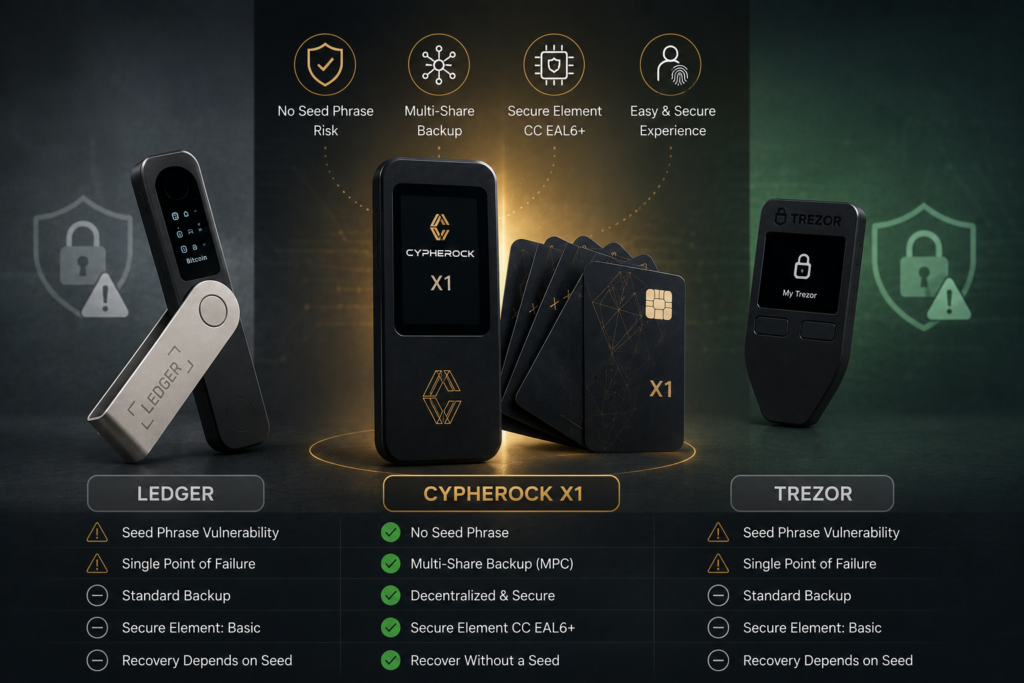
Cypherock X1 vs Ledger Nano X vs Trezor Safe 5: Full Comparison
Every meaningful category, verified from official sources, Keylabs, 99Bitcoins, and The Bitcoin Hole database:
| Category | Cypherock X1 | Ledger Nano X | Trezor Safe 5 |
| Price | $249 (vault + 4 cards) | $59 (current discount) | $129 |
| Recovery Model | Shamir Secret Sharing — no single seed phrase | Single 24-word seed phrase on paper | Single 24-word seed phrase on paper |
| Single Failure Point | Eliminated — need 2 of 5 components | Yes — one lost paper = total loss | Yes — one lost paper = total loss |
| Open Source | Yes — full hardware + firmware (MIT) | No — firmware closed source | Yes — firmware open source |
| Security Chip | EAL6+ (banking grade) | EAL5+ | EAL6+ (Safe 5) |
| Inheritance Planning | Cypherock Cover — best in class | No dedicated solution | No dedicated solution |
| Multi-sig Support | No PSBT multi-sig | Yes — PSBT via Sparrow, Nunchuk | Yes — PSBT multi-sig |
| Coin Support | 3,000+ | 5,500+ | 7,000+ |
| Mobile App | No (desktop only) | Yes — Ledger Live (iOS + Android) | No (Trezor Suite desktop) |
| Audited By | Keylabs + WalletScrutiny | Not equivalent open audit | Not equivalent open audit |
| Voltage Glitch Risk | Mitigated by decoupled key storage | Past extraction demonstrations | Past extraction demonstrations |
| Data Breach History | None | 2020: 272K+ customer data exposed | None |
| Trustpilot Score | 4.8/5 | 2.9/5 | ~4.1/5 |
| Firmware Update Risk | Cards non-upgradeable (key protection) | Standard firmware update path | Standard firmware update path |
| The Keylabs connection matters: Keylabs is the same independent security firm that publicly demonstrated extractable vulnerabilities in Ledger and Trezor hardware using voltage glitching. Their audit of Cypherock X1 found no equivalent vulnerabilities due to the decoupled key architecture — no single component holds a complete private key. This is the most credible third-party security validation available in the hardware wallet market. |
The Verdict: Can Cypherock X1 Replace Ledger or Trezor?
For long-term holders who are worried about seed phrase failure, the honest answer is: yes, for cold storage, Cypherock X1 is architecturally superior to both Ledger Nano X and Trezor in the specific ways that matter most. It eliminates the most common cause of real-world crypto loss. It has been audited by the industry’s toughest critics. Its non-upgradeable card shards close an attack path both competitors leave open.
For active DeFi users, multi-sig participants, or multi-chain portfolio managers, Ledger and Trezor still have meaningful advantages in ecosystem coverage, mobile access, and third-party integrations that Cypherock has not yet matched.
The practical answer for serious holders is not either/or. It is both: Cypherock X1 for cold storage of significant long-term holdings, and a Ledger or Trezor (or MetaMask) for active DeFi and trading positions. This mirrors how sophisticated holders already manage their crypto — a vault tier and an active tier. Cypherock is the vault.
| CYPHEROCK X1 Recovery Security: A+ Open Source: A+ Audit Trail: A+ Inheritance: A+ Coin Support: B Mobile UX: C Price Value: B Multi-sig: F OVERALL: A | LEDGER NANO X Recovery Security: B Open Source: C Audit Trail: B Inheritance: D Coin Support: A+ Mobile UX: A+ Price Value: A+ Multi-sig: A OVERALL: B+ | TREZOR SAFE 5 Recovery Security: B Open Source: A+ Audit Trail: B Inheritance: D Coin Support: A Mobile UX: C Price Value: A Multi-sig: A OVERALL: B+ |
Frequently Asked Questions
Can Cypherock X1 fully replace a Ledger for everyday crypto use?
Not entirely — yet. For long-term cold storage where you rarely transact, Cypherock X1 is an excellent replacement and offers a stronger recovery architecture. But for everyday DeFi interaction, token trading, and mobile portfolio management, Ledger’s broader ecosystem and Ledger Live mobile app still have practical advantages that Cypherock has not matched. The most practical setup for active crypto users in 2026: Cypherock X1 for holdings you plan to keep for months or years, and Ledger or a hot wallet for amounts you actively manage.
How does Shamir Secret Sharing compare to Ledger’s and Trezor’s seed phrase model?
Ledger and Trezor both use a single BIP-39 seed phrase (24 words on paper) as the recovery mechanism. Losing or exposing that phrase means total loss or theft of all funds. Shamir Secret Sharing, implemented by Cypherock, splits your wallet’s entropy into five parts (shards). Any two shards can reconstruct the wallet. No single shard is enough for recovery or for an attacker to drain funds. Stored across different locations, this architecture removes the single-paper vulnerability that causes most real-world hardware wallet losses. Trezor’s firmware also supports SLIP-39 (Shamir) seed imports, but the backup mechanism itself is still the standard paper phrase at wallet creation.
What was the Keylabs audit of Cypherock, and why does it matter?
Keylabs is an independent security firm that has publicly demonstrated extractable vulnerabilities in both Ledger and Trezor hardware using voltage glitching attacks. They are one of the most credible adversarial security testing groups in the crypto hardware space. Keylabs audited the Cypherock X1 and released a formal report stating it uses ‘many hardware and software security best practices and even features several security firsts that we have not yet seen in other wallets.’ The absence of any single stored private key across components was highlighted as a specific architectural advantage. This audit is cited by 99Bitcoins, CoinBureau, and the Cypherock official site as a key credibility signal.
Does Cypherock X1 support multi-sig like Ledger and Trezor?
No — as of July 2026, Cypherock X1 does not support PSBT-based multi-sig. Both Ledger Nano X and Trezor Safe 5 integrate with multi-sig coordinators like Sparrow, Electrum, Nunchuk, Casa, and Unchained Capital. For holders who want a 2-of-3 or 3-of-5 multi-sig setup — the standard for institutional and high-value Bitcoin self-custody — Ledger and Trezor are the better choices. Cypherock’s Shamir architecture provides a different form of distributed key resilience, but it is not multi-sig and does not interact with PSBT workflows.
What is Cypherock Cover and does Ledger or Trezor offer anything similar?
Cypherock Cover is a non-custodial, non-KYC inheritance and recovery service that uses the distributed card architecture to assign estate recovery to a nominee. If a user becomes inactive for a defined period, a time-delayed process allows a designated person to recover access using their assigned card, AES-encrypted PIN data, and email OTP verification — without Cypherock ever having custody of the keys. Neither Ledger nor Trezor offer an equivalent. Ledger’s Recover service (announced in 2023) is a custodial seed phrase backup that requires KYC and trusts three third-party companies with shards of your seed — the opposite of Cypherock’s self-custodial approach. Trezor has no official inheritance solution.
| The Seed Phrase Era Is Over. What Comes Next Is Your Choice. Ledger and Trezor built the hardware wallet industry. Cypherock X1 is asking whether that architecture is still the right answer. For long-term holders who think hard about failure modes, the answer is increasingly clear. CYPHEROCK.COM | LEDGER.COM | TREZOR.IO Always buy from official manufacturer websites only. This is not financial advice. DYOR. |
Sources: Keylabs Cypherock X1 Wallet Audit (dl.keylabs.io), 99Bitcoins Cypherock Review by Tayler McCracken (Oct 2025), Cypherock official blog comparisons, The Bitcoin Hole hardware wallet database, CryptoNews Trezor vs Ledger analysis (2026). Prices accurate as of july 2026