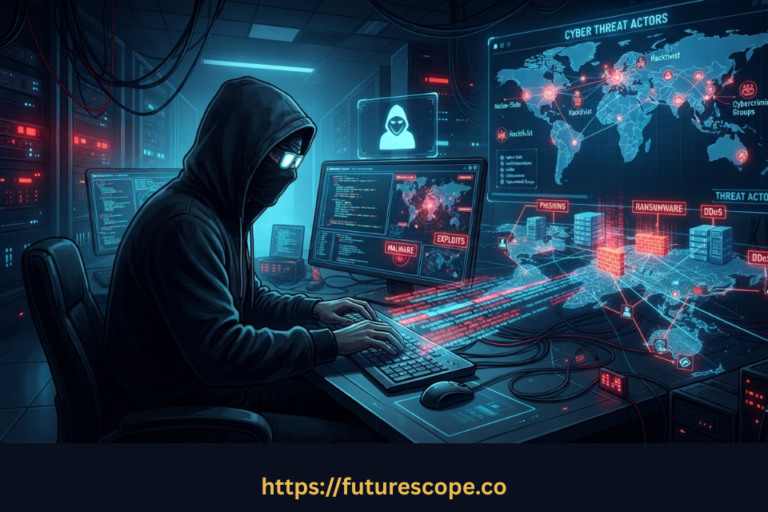
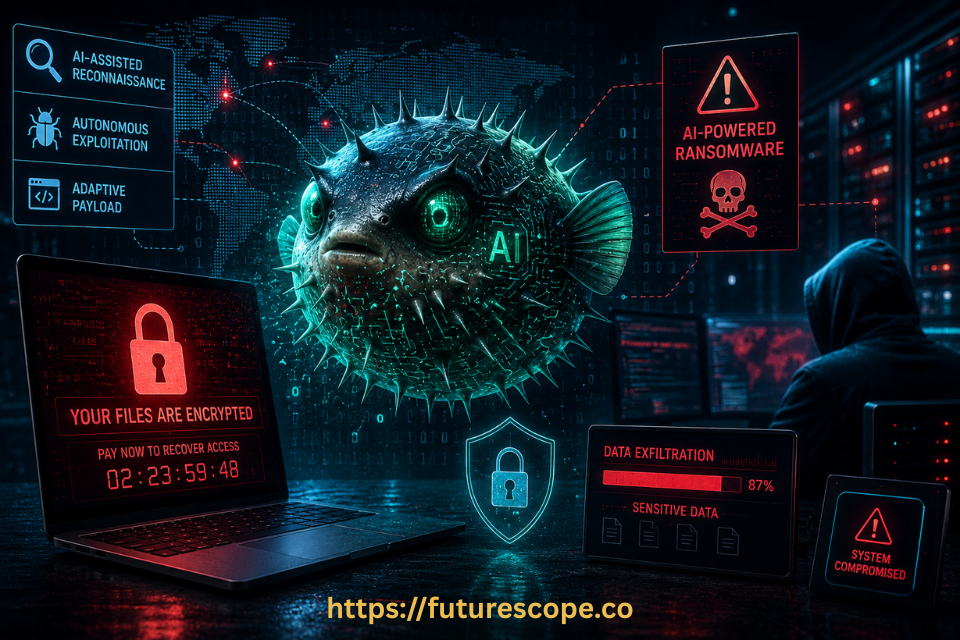

In July 2026, security researchers at Sysdig documented something the cybersecurity industry had been warning about for years: a fully autonomous, LLM-powered ransomware campaign that executed an entire attack chain without a single human operator. From initial access through encryption of victim systems, the entire campaign was carried out by AI. Researchers named it JadePuffer. an Agentic Ransomware.
This is not a theoretical exercise. JadePuffer is a real, documented attack. And while its specific technical architecture belongs in threat intelligence feeds for security professionals, its implications for every organization — and what to do about them — need to reach much further than the SOC.
This article explains what JadePuffer represents as a category shift in AI-powered cyber threats, why the traditional security model was not built to address it, and exactly what your organization should do to reduce exposure.
| JadePuffer should be understood not as an isolated incident, but as a proof of concept for an entire new class of threats that will accelerate significantly over the coming months and years. — Andrew Scott, Field CISO, Todyl (July 7, 2026) |
Why JadePuffer Is a Category Shift, Not Just Another Threat
| 29 min median time from initial access to lateral movement in AI-driven attacks (Todyl) | 72 min median time to data exfiltration post-access — compressing with AI automation | 0 human operators required in JadePuffer’s documented attack chain (Sysdig) | $265B projected global ransomware damage costs by 2031 (Cybersecurity Ventures) |
Ransomware has evolved in waves. First came opportunistic malware. Then Ransomware-as-a-Service, which commoditized sophisticated capabilities. JadePuffer represents the third wave: AI-orchestrated ransomware that operates autonomously, adapts in real time to the environment it encounters, and executes at a speed that breaks assumptions baked into most organizational defenses.
Every major defensive control in the traditional security stack — MFA prompts, alert thresholds, analyst callback windows, escalation timelines — was designed with a human-paced adversary in mind. As Todyl’s Field CISO Andrew Scott noted: an autonomous LLM agent does not slow down. It iterates through friction at machine speed, 24 hours a day, without mistakes born from fatigue. The friction that buys defenders time against human attackers disappears against a machine-speed adversary.
Three specific implications stand out for any organization assessing their exposure to AI-assisted cyber attacks of this type:
- The encryption window compresses to minutes: Industry reporting places lateral movement at 29 minutes post-access and data exfiltration at 72 minutes. If your mean-time-to-detect exceeds either figure, containment arrives after damage is done.
- Signature-based detection fails by design: AI-generated payloads do not match known malware signatures. Tools relying primarily on signature matching will not catch AI ransomware that dynamically updates its own code.
- Recovery infrastructure is a deliberate target: LLMs are trained on publicly available incident reports. They already know that shadow copies, cloud sync endpoints, and backup systems are where recovery lives — and they treat those as primary objectives.
The Escalating Trajectory of AI-Powered Cyber Threats
JADEPUFFER, an agentic ransomware powered by a large language model (LLM), is documented as the first instance of fully autonomous agentic ransomware in the wild. But it represents the floor of this capability — not the ceiling. Todyl and the Cloud Security Alliance both note that the trajectory of AI-powered ransomware points clearly forward:
- Attack speed will continue to outpace human response time, making manual detection and containment progressively insufficient.
- AI enables simultaneous targeting of multiple organizations with no capacity constraint — a single threat actor can run parallel campaigns.
- Attack chains will become more adaptive, able to pivot in real time around specific defensive controls they encounter, rather than following fixed playbooks.
- The skill floor for sophisticated attacks will drop, putting AI-automated ransomware within reach of actors who previously could not execute it — the same commoditization dynamic that made Ransomware-as-a-Service so damaging.
The question is not whether AI-assisted cyber attacks will escalate. It is whether your defenses are positioned to match their speed when they do.
Traditional Ransomware vs AI-Powered Ransomware: Key Differences
Understanding how this new class of threat differs from traditional campaigns is the foundation of building defenses that actually address it:
| Capability | Traditional Ransomware | AI-Powered Ransomware (JadePuffer) | Defensive Implication |
| Attack speed | Hours to days | Minutes — machine speed | Detection window shrinks dramatically |
| Payload variation | Mostly static signatures | Dynamically generated — evades signatures | Signature-only tools miss it |
| Lateral movement | Manual, operator-directed | Automated and adaptive | Containment must fire at machine speed |
| Recovery target awareness | General knowledge | Trained on incident reports — targets backups | Backup architecture must be hardened specifically |
| Human operator | Required at each stage | Not required — fully autonomous | Attacks run 24/7 without fatigue or error |
| Skill requirement | High (skilled threat actor) | Lower — AI executes the complexity | Volume of attackers scales significantly |
| Simultaneous targets | Limited by human capacity | Unlimited — AI scales horizontally | Parallel targeting of many orgs is feasible |
| The most dangerous column in the table above is the last one. Every row that says ‘containment must be machine-speed’ or ‘signature tools miss it’ is a description of a gap in the traditional security model — not a future gap, but a present one that JadePuffer has already exploited. |
What Your Organization Must Do to Reduce Exposure
The Todyl defense analysis and Cloud Security Alliance research converge on one conclusion: no single control stops an AI-driven ransomware campaign. The only posture that holds is a deeply integrated, layered defense where every module shares intelligence, automated response fires at machine speed, and human expertise monitors what automation surfaces.
Immediate Priority Actions — Within 7 Days
- Switch endpoint protection to Prevent mode: Detect mode logs an incident after encryption begins. Prevent mode stops it before it starts. Against machine-speed attacks, this distinction is decisive.
- Enable automated containment playbooks: SOAR playbooks that isolate compromised hosts and terminate malicious processes must fire automatically — not after a human reviews an alert. The human review gap is the window an AI agent operates inside.
- Audit your mean-time-to-detect for lateral movement: If that number exceeds 15 minutes, you have a containment gap that a machine-speed adversary will operate inside.
- Brief leadership and update documentation: AI-orchestrated ransomware is a named, documented risk scenario. Regulators and auditors are beginning to expect it in risk registers.
Medium-Term Actions — Within 30 Days
- Harden backup and recovery architecture: Audit shadow copies, cloud sync endpoints, and offsite connectivity. AI systems trained on incident reports specifically target these. Your recovery infrastructure needs protection that assumes a knowledgeable adversary.
- Enforce deny-by-default lateral movement controls: Zero-trust internal architecture that denies movement by default stops a compromised endpoint from becoming a compromised environment, containing blast radius before spread.
- Run a machine-speed tabletop exercise: Simulate rapid encryption across multiple hosts and validate that automated response fires within an acceptable containment window. You will find gaps that only become visible under speed pressure.
- Update your risk register formally: AI-orchestrated ransomware should be a discrete, documented threat scenario with mapped controls against NIST CSF or your relevant framework — not a vague future concern.
Agentic Ransomware: Explained and Future?
Agentic ransomware refers to malicious software that operates through an AI agent — a system that perceives its environment, makes decisions, and takes actions autonomously toward a goal, without step-by-step human direction. JADEPUFFER, the first ransomware campaign run by an LLM is the first confirmed instance of this architecture deployed successfully in the wild.
The term agentic marks the distinction from earlier AI-assisted attacks, where AI enhanced specific steps while a human directed the overall campaign. In an agentic model, the AI directs itself: choosing which vulnerability to exploit, adapting to the environment it finds, selecting targets within a compromised network, and executing each stage of the attack on its own decision.
As for the future: the Cloud Security Alliance characterizes JadePuffer as a proof of concept for the first wave of agentic ransomware. The trajectory leads toward attacks that are faster, more adaptive, more scalable, and accessible to a wider range of threat actors. The dynamic that made Ransomware-as-a-Service so damaging — democratizing capabilities that previously required elite skill — will repeat with agentic AI frameworks.
The appropriate response is not panic. It is preparation. The defenses that work against agentic AI ransomware are known: machine-speed automated response, integrated platform architecture, behavioral detection independent of signatures, zero-trust lateral movement controls, and hardened backup infrastructure. What is required is the urgency to implement them before the next documented campaign arrives. JadePuffer is not the ceiling. It is the floor.
Frequently Asked Questions
Is JadePuffer still an active threat?
JadePuffer, the first AI-agent ransomware was first documented by Sysdig researchers in July 2026 and represents an active, real-world threat — not a controlled proof of concept. It is the first confirmed case of fully autonomous LLM-powered ransomware deployed in the wild. Organizations should treat it as evidence that agentic AI ransomware is a present operational reality that security programs must account for now, not a future concern.
What makes AI-powered ransomware different from traditional ransomware?
The core differences are speed, adaptability, and autonomy. Traditional ransomware follows fixed playbooks and requires human operators at each stage. AI-powered ransomware operates autonomously — perceiving its environment, making decisions, and executing each phase without human instruction. It adapts in real time to defenses it encounters, generates novel payloads that evade signature detection, and can simultaneously target multiple organizations without capacity constraints. It also operates 24/7 without the fatigue, impatience, or working-hours limitations of human operators.
Can traditional antivirus or endpoint protection stop AI ransomware?
Not reliably. AI-generated payloads do not match known malware signatures, which is how traditional antivirus identifies threats. An AI system that dynamically generates varying code produces malware that has never been seen before and carries no signature to match. Behavioral detection — monitoring what a process does rather than what its code looks like — is significantly more effective against this class of threat. Next-generation endpoint protection with behavioral analysis, memory threat detection, and Prevent mode (not just Detect mode) is the appropriate endpoint layer against AI-powered ransomware.
What is the single most important defensive action to take right now?
Enable automated containment that fires at machine speed. The defining characteristic of AI-assisted cyber attacks like JadePuffer is speed — the window between initial access and significant damage can be measured in minutes. Any defense requiring a human to review an alert, make a decision, and act before containment fires will be too slow. SOAR playbooks that automatically isolate compromised hosts and kill malicious processes when a detection triggers — without waiting for human approval — close the human response gap that machine-speed adversaries exploit.
How should small businesses with limited security resources respond?
Three priorities that are accessible at any budget: First, ensure endpoint protection is behavioral — not just signature-based (many modern EDR solutions for SMBs include this). Second, maintain offline, air-gapped backups stored completely disconnected from your network and cloud sync — this is the most reliable ransomware recovery asset and a direct counter to the backup-targeting behavior documented in JadePuffer. Third, consider a managed security service provider with 24/7 monitoring and automated response capability. AI-powered threats run around the clock; business-hours-only monitoring creates predictable vulnerability windows that autonomous attack systems will exploit.
| AI-Powered Ransomware Moves at Machine Speed. Your Defense Needs To As Well. JadePuffer is the floor of what AI-driven attacks will look like — not the ceiling. Organizations that act now will be positioned to contain what comes next. AUDIT YOUR DEFENSES NOW — CONTACT A CYBERSECURITY SPECIALIST Resources: NIST CSF | CISA Ransomware Guide | Sysdig JadePuffer Research | Todyl Threat Analysis | Cloud Security Alliance Report |
Primary sources: Sysdig JadePuffer research (July 2026), Todyl threat analysis by Andrew Scott (July 7, 2026), SOC Prime active threat intelligence, Cloud Security Alliance JadePuffer anatomy report (2026). Statistics from Todyl incident response data and Cybersecurity Ventures 2026 Ransomware Report. This article is for defensive security awareness purposes only.