
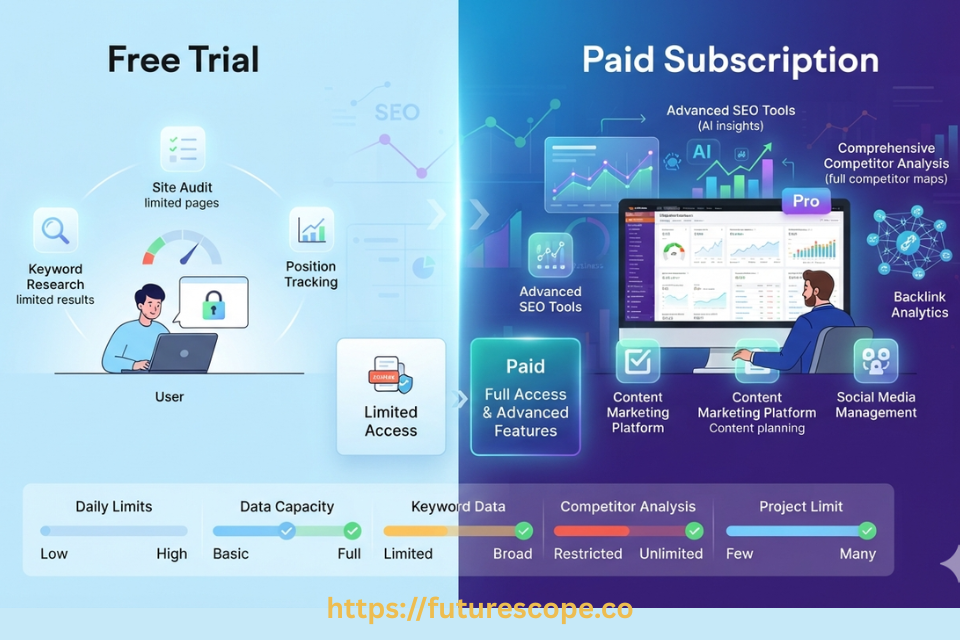

“Is Semrush free, or do I have to pay to use it?” It’s a fair question, because the answer is genuinely a little of both.
Semrush offers a permanently free account with real, usable tools — just heavily limited ones. It also offers a 7-day free trial that unlocks a full paid plan temporarily, and paid subscriptions that remove the daily limits altogether. Those are three different things, and mixing them up is where most of the confusion comes from.
This guide walks through what each option actually includes, based on Semrush’s current official documentation, so you can decide which one makes sense for where you’re at.
SEMRush Free Trial vs Paid: Quick Answer
Here’s the short version: the free account lets you use Semrush’s tools in small daily doses, indefinitely, without paying or entering a card. The 7-day trial removes those limits temporarily so you can test a paid plan at full strength. A paid subscription removes them permanently, for as long as you keep paying.
| Free Account | 7-Day Free Trial | Paid Plan | |
| Cost | $0, no card needed | $0 for 7 days, card required | $139.95–$499.95/mo (SEO Toolkit tiers) |
| Access duration | Ongoing, no expiration | 7 days, then auto-converts to paid | Ongoing, billed monthly or annually |
| Keyword research | 10 queries/day | Full plan limit (500–5,000 tracked) | 500–5,000 keywords tracked, by tier |
| Domain/competitor research | 10 queries/day | Unlimited within plan limits | Unlimited within plan limits |
| Position tracking | 10 keywords | Up to plan limit (500–5,000) | 500–5,000 keywords, by tier |
| Site audits | 100 pages/month | Up to plan limit (100k–1M pages) | 100,000–1,000,000 pages/month |
| Projects (websites) | 1 | Up to plan limit (5–40) | 5–40 websites, by tier |
| Reports | Basic, limited exports | Full plan reports incl. scheduled PDFs | Full reports, 3 scheduled PDFs included |
| Historical data | Not included | Included if trialing Guru or Business | Included from Guru tier up |
| Team/user access | 1 user (no user management) | 1 user by default, same as paid | 1 user included; extra seats purchasable |
A couple of things worth noting up front: Semrush’s exact figures can shift with promotions or plan updates, and the company also sells a newer bundled option called Semrush One (Starter, Pro+, Advanced) alongside its classic Pro, Guru, and Business tiers. Both cover similar ground but are priced and packaged a little differently, so it’s worth checking which lineup you’re being shown before comparing numbers.
Ready to discover keywords your competitors are ranking for?
From keyword research to competitor analysis, SEMrush gives you the data you need to make better decisions. Try it now.
What Can You Do With the Semrush Free Version?
The free account is genuinely free — no credit card, no expiration date, no trial clock counting down. You sign up with just an email and password, and the access stays available for as long as you want to keep using it at that level.
According to Semrush’s own documentation, here’s what the free tier currently includes:
| Tool | Free account limit |
| Domain Overview | 10 queries/day |
| Keyword Research | 10 queries/day |
| Competitor Research | 10 queries/day |
| Site Audit | 100 pages/month |
| Position Tracking | 10 keywords |
| Backlinks | 10 queries/day |
| SEO Ideas | Limited access |
| Websites to monitor | 1 |
Notice the pattern: almost everything caps out around 10 queries a day. That’s enough to check your own site, glance at a couple of competitors, or test a handful of keyword ideas — but a single focused research session can burn through the daily allowance quickly.
A few restrictions worth knowing about specifically:
- Daily searches reset every 24 hours, so hitting the cap means waiting until the next day to continue
- Reports and exports are more basic than paid versions, with no scheduled PDF reporting
- Keyword results per search are capped well below paid-plan numbers
- You can only actively monitor one website
- Historical ranking data isn’t available at all
It’s worth being clear about one distinction: “free access” (the permanent free account) and a “free trial” (temporary full access to a paid plan) are not the same thing, even though people use the terms interchangeably. The free account is always available; the trial is a limited-time window.
What Does the Semrush Free Trial Include?
The 7-day free trial gives you full access to whichever paid plan you select — Pro, Guru, or Business — for one week, with none of the daily caps that limit the free account.
During an eligible trial, you can typically test:
- Full keyword research, without the 10-query daily ceiling
- Competitor analysis tools like Domain Overview and Traffic Analytics
- A complete Site Audit across your plan’s page-crawl limit, not just 100 pages
- Position Tracking at the full keyword allowance for your chosen tier
- Keyword Gap, for comparing your keyword profile against competitors
- Backlink analysis with the higher query limits of a paid account
- Full SEO reports, including scheduled PDF exports
According to Semrush, a credit card is required to activate the trial, even though you won’t be charged during the 7 days. If you don’t cancel before the trial ends, your card is billed automatically and your account converts to a regular paid subscription at that plan’s standard rate.
A few details that can vary and are worth double-checking before you sign up:
- The standard trial is 7 days, though longer trials (commonly 14 days) are sometimes available through specific official partner links — these aren’t guaranteed and depend on the offer you use
- Trials are activated separately per toolkit, so a trial of the SEO Toolkit is independent from a trial of the Content, Social, Local, or Advertising toolkits
- Trial extensions or upgrades mid-trial are limited — Semrush recommends contacting support directly if you need to make changes
Because trial length, eligibility, and included features can change over time, it’s worth confirming the current offer directly on Semrush’s trial page before signing up, rather than relying on a number you saw somewhere else.
What Do You Get With a Paid Semrush Plan?
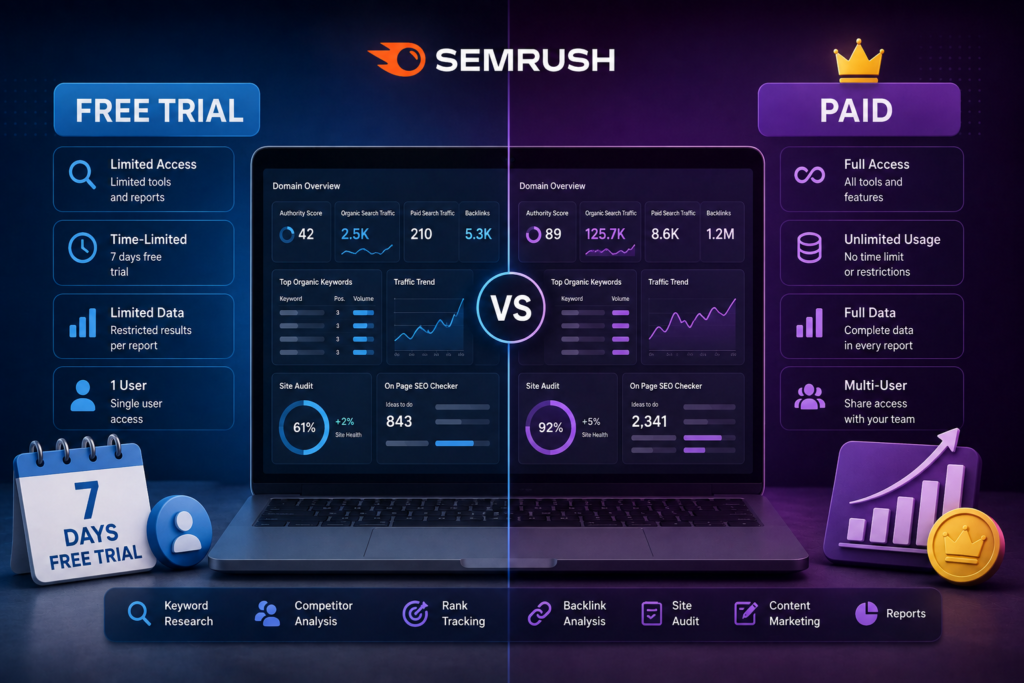
A paid subscription is the free account’s daily limits, permanently removed — scaled to whichever tier you choose. Semrush’s SEO Toolkit currently comes in three tiers, each expanding usage limits and unlocking additional features:
| Pro | Guru | Business | |
| Monthly price | $139.95 | $249.95 | $499.95 |
| Websites to monitor | 5 | 15 | 40 |
| Keywords tracked | 500 | 1,500 | 5,000 |
| Pages crawled/month | 100,000 | 300,000 | 1,000,000 |
| Results per report | 10,000 | 30,000 | 50,000 |
| Historical data | Not included | Included | Included |
| Content marketing tools | Not included | Included | Included |
| API access | Not included | Not included | Included |
A few things a paid plan generally adds beyond just “more of the same”:
- Higher daily and monthly usage limits across nearly every tool
- More projects, so you can monitor multiple websites at once
- Larger keyword and results allowances per report
- More frequent and detailed rank tracking
- Access to advanced features like historical data, content marketing tools, and (on Business) API access
- The option to add paid teammate seats, though this isn’t automatic — every tier still includes just one user by default
It’s worth being precise here: not every paid plan includes every feature. Pro leaves out historical data and the content marketing toolkit entirely; only Business includes API access. Picking a tier based on the specific features you need matters more than just picking the most expensive option.
Ready to take your SEO to the next level!
Ready to see what SEMrush can do for your website? Explore its SEO, keyword research, competitor analysis, and content tools today—and start turning better data into better search results.
Semrush Free Trial vs Paid: Feature Comparison
Zooming out from specific numbers, here’s how the three access levels compare on the features that actually change how usable Semrush feels day to day:
| Feature | Free | 7-Day Trial | Paid |
| Credit card required | No | Yes | Yes |
| Daily query limits | Yes, ~10/day per tool | No, full plan limits | No, full plan limits |
| Keyword Magic Tool | Limited results | Full access | Full access |
| Site Audit page limit | 100 pages/month | Plan limit (100k+) | Plan limit (100k+) |
| Historical ranking data | No | Only if trialing Guru/Business | Guru and Business only |
| Scheduled PDF reports | No | Yes | Yes |
| API access | No | Only if trialing Business | Business only |
| Multiple projects/sites | No, 1 site only | Yes, per plan limit | Yes, per plan limit |
| Additional paid users | Not available | Not applicable during trial | Available for an extra fee |
Is the Semrush Free Trial Enough for SEO Beginners?
For getting oriented, yes — a week of full access is enough to genuinely understand what Semrush does and whether it fits how you work. Beginners can reasonably use the trial to:
- Test keyword research on their actual niche, without hitting the free account’s daily cap mid-session
- Analyze two or three real competitors in depth
- Run a full Site Audit and see the complete list of technical issues, not just a 100-page sample
- Explore content opportunities using tools like Topic Research or Keyword Gap
- Get comfortable navigating the interface and understanding what each report actually shows
Where the trial falls short is anything that plays out over time. Seven days isn’t long enough to see meaningful ranking movement, evaluate a real content strategy, or judge how well Position Tracking works as an ongoing habit rather than a one-time check. For an actual SEO campaign — the kind that runs for months and needs consistent tracking — a paid plan is closer to a requirement than a nice-to-have.
Who Should Pay for Semrush?
Whether a paid plan makes sense really comes down to how much SEO work you’re doing and how often.
Bloggers
A hobby blog with one or two posts a month can often get by on the free tier. A blog treated as a real content business — publishing regularly and tracking growth — will likely outgrow it within the first few weeks.
Affiliate marketers
Managing multiple niche sites and researching competitive keywords at scale is exactly what the free tier’s 10-query cap makes difficult. Most affiliate marketers running more than one site benefit from at least the Pro plan.
Freelancers
If you’re doing SEO work for clients, even occasionally, a paid plan pays for itself quickly through the ability to run multiple projects and produce professional, exportable reports.
SEO professionals
Working in SEO day to day means the free tier’s limits become a daily obstacle almost immediately. Guru is a common starting point here, mainly for historical data and content tools.
Marketing agencies
Agencies managing several client accounts typically need Business for its higher project capacity and API access, plus purchased user seats for each team member who needs direct access.
Small businesses
A single-location business focused on one website might do fine on Pro, or even stretch the free tier further than most. It depends on how competitive the niche is and how much ongoing tracking matters.
Large teams
Bigger in-house teams usually need Business for the usage limits, plus a realistic budget for additional user seats, since every tier includes just one seat by default.
Is Semrush Worth Paying For?
There’s no single right answer here — it depends on how much you’d actually use it. For someone running one small site casually, the free tier’s daily limits might genuinely be enough, and paying $139.95 a month or more wouldn’t make financial sense.
For anyone doing SEO as a real part of their work — tracking rankings over months, researching keywords at scale, managing more than one site, or reporting to clients or stakeholders — the free tier’s limits turn into a daily bottleneck fast. In that case, the time saved by not hitting caps and re-running searches usually outweighs the subscription cost.
A reasonable way to decide: if you’re regularly running out of your free daily queries, managing more than one website, or needing historical data to show progress, that’s a fairly clear signal it’s time to look at a paid tier. If none of that applies yet, there’s no rush — the free account isn’t going anywhere.
How to Get the Most From a Semrush Trial?
A 7-day trial goes by fast, especially if you spend the first couple of days just exploring the interface. A little prep makes a real difference.
- Prepare a list of target keywords before you start, so day one is spent researching instead of brainstorming
- Identify 2–3 real competitors ahead of time and analyze their keyword and content strategy
- Run a full Site Audit early, since technical fixes often take the longest to act on
- Use Keyword Gap or Topic Research to find content opportunities you can act on later
- Check your backlink profile and note any obvious gaps or opportunities
- Set up Position Tracking for your priority keywords, even if a week isn’t long enough to see meaningful movement
- Export the reports you’ll actually reference later, before your access reverts
- Decide, honestly, which specific features you used enough to justify paying for them
Before you sign up, take a few minutes to check the current trial’s exact terms: the length being offered, what happens automatically when it ends, and how to cancel. Trial terms are the kind of detail Semrush updates from time to time, so confirming them on the actual sign-up page is worth the extra minute.
Frequently Asked Questions
Is Semrush free to use?
Yes, in a limited way. Semrush offers a free account with no credit card required, though daily usage caps (around 10 queries per tool) and a 100-page site audit limit apply.
Does Semrush offer a free trial?
Yes. Semrush offers a 7-day free trial that gives full access to a selected paid plan, separate from the permanent free account.
How long is the Semrush free trial?
The standard trial is 7 days. Longer trials, such as 14 days, sometimes appear through specific official partner offers, but these aren’t the default and should be confirmed on the actual signup page.
What is included in the Semrush free trial?
Full access to whichever plan you select for the trial — typically Pro, Guru, or Business — including that plan’s keyword tracking, site audit, position tracking, and reporting limits.
Is the Semrush free trial better than the free version?
For depth of access, yes — the trial removes the daily caps that limit the free account. But it only lasts 7 days, while the free account remains available indefinitely at a lower usage level.
Can I use Semrush without a credit card?
Yes, for the free account. A credit card is required to start the 7-day free trial, even though you won’t be charged unless you let the trial run out.
What happens when the Semrush trial ends?
If you don’t cancel before the 7 days are up, your card is charged automatically and your account converts to a paid subscription at the standard rate for the plan you trialed.
Is Semrush worth paying for?
It depends on your usage. For regular, ongoing SEO work — multiple sites, competitive research, or client reporting — the paid limits are usually worth it. For occasional, light use, the free account may be enough.
Which Semrush plan is best for beginners?
Many beginners start with the free account to learn the interface, then move to Pro if they need higher keyword and project limits. Pro is generally Semrush’s entry-level paid tier.
Can I cancel Semrush after the free trial?
Yes. You can cancel at any point during the 7-day trial with no charge. If you’re already past the trial and on a paid plan, cancellation is handled through your account’s billing settings or Semrush support.
Which Option Fits Where You Are Right Now?
None of this has to be an all-or-nothing decision. If you’re still figuring out whether Semrush fits how you work, the free account is a genuinely useful place to start — no card, no clock, no pressure to decide anything yet.
Once you’re ready to see what the platform looks like without the daily limits, the 7-day trial is the honest way to find out, especially if you go in with a clear plan for what you want to test. From there, whether a paid plan makes sense comes down to one practical question: are you hitting the free tier’s limits often enough that removing them would actually save you time?