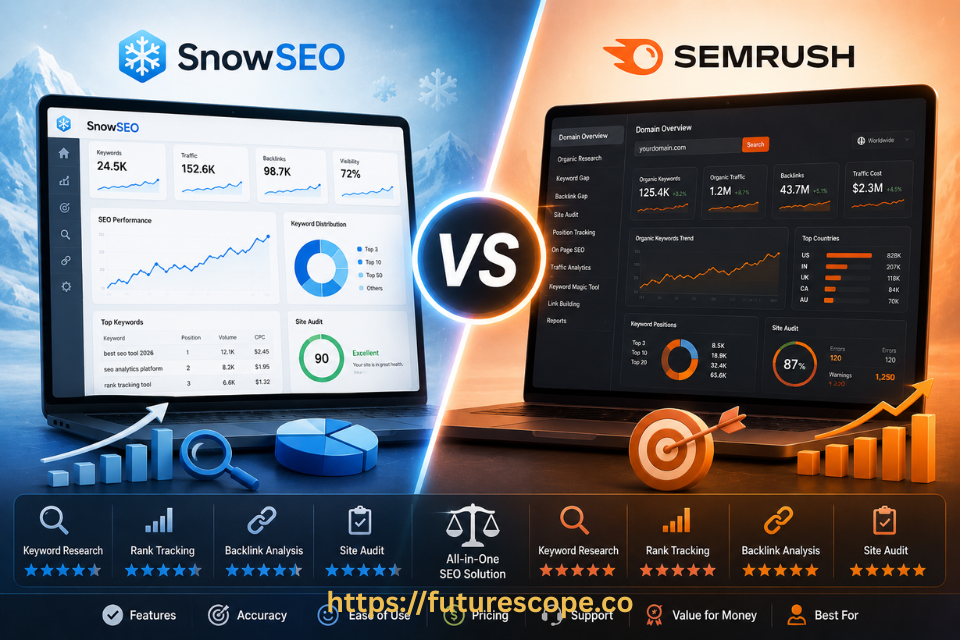

Both SnowSEO and Semrush promise to help you rank better, but they’re built around fairly different ideas of what “SEO” means in 2026. SnowSEO is a newer entrant that treats SEO and GEO (Generative Engine Optimization) as one job: it tracks whether you’re cited by ChatGPT, Perplexity, and Google AI Overviews right alongside your classic keyword rankings, and wraps that in an automated content and publishing workflow. Semrush is the veteran of the two — a well-established platform with one of the larger keyword and backlink databases in the industry, plus tools that stretch well beyond SEO into PPC research, social media, and local listings.
People end up comparing the two because they approach overlapping problems from opposite directions. SnowSEO tries to bundle keyword research, content creation, and AI-visibility tracking into one lean, credit-based subscription. Semrush tries to be the single source of truth for almost every kind of competitive and market research a marketing team might need. Bloggers, solo creators, and lean content teams tend to lean toward SnowSEO’s automation and lower entry price. Agencies, larger in-house teams, and anyone doing heavy competitive or backlink research tend to lean toward Semrush’s depth.
So which one actually deserves your budget? Is SnowSEO a practical alternative to Semrush, or does Semrush offer enough additional depth to justify its higher cost? This SnowSEO vs Semrush comparison walks through both tools feature by feature so you can decide based on how you actually work, not just a features list.
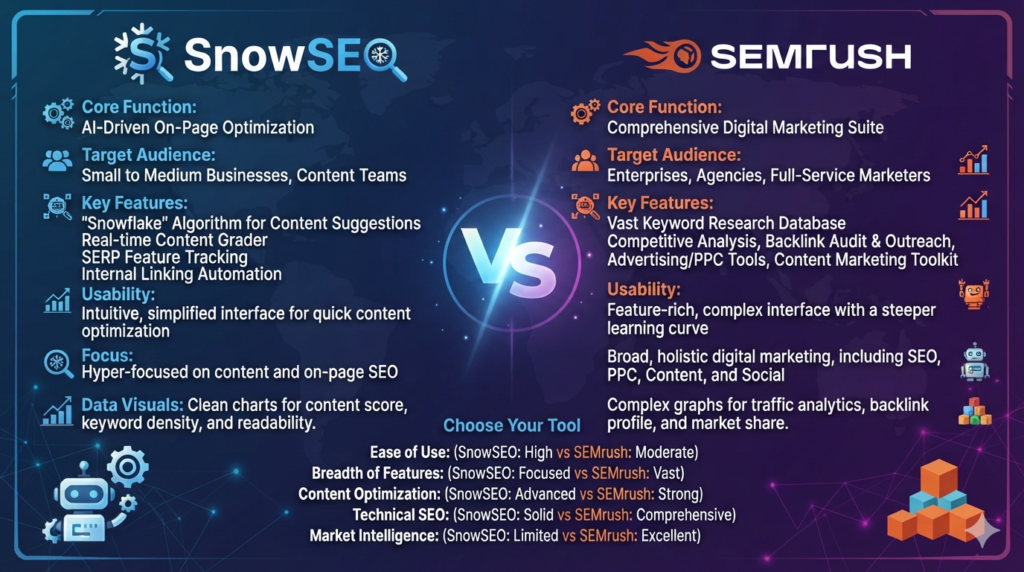
Quick Comparison: SnowSEO and SEMRush
| Category | SnowSEO | Semrush |
| SEO focus | Search + AI/generative search (GEO/AEO) in one workflow | Traditional SEO plus a broader digital marketing suite |
| Keyword research | Unlimited keyword research and auto-clustering on paid plans | Very large keyword database (Keyword Magic Tool) with deep filtering |
| Content optimization | AI content generation, brand-voice memory, auto-publish | Content Marketing Toolkit: briefs, guidance, originality checks |
| Competitor research | Competitor tracking across search and AI platforms | Traffic Analytics, Market Explorer, Keyword Gap |
| Rank tracking | Keyword tracking plus AI-prompt/citation tracking | Position tracking with deep historical data |
| Site/technical SEO | Built-in audits and page crawls, scaled by plan | Mature Site Audit with a large error/check library |
| Backlink analysis | Backlink outreach tools from the Pro tier up | One of the industry’s larger, more established backlink indexes |
| AI features | AI-visibility tracking built into the core product | Semrush One / AI Visibility toolkit, largely add-on |
| Ease of use | Modern UI, guided workflow, light learning curve | Powerful but sprawling; real onboarding period needed |
| Pricing | Starts around $39/month | Starts around $139.95/month |
| Best suited for | Bloggers, creators, lean content and marketing teams | Agencies, larger teams, heavy competitive research |
| Overall value | Strong value for content + AI-search visibility | Strong value for comprehensive, all-purpose SEO research |
SnowSEO Overview
SnowSEO positions itself less as a pure keyword tool and more as an execution platform: connect your website, and it audits your content, researches keywords, writes and publishes articles, and tracks how you show up in both Google and AI answer engines like ChatGPT and Perplexity.
Its core feature set includes an SEO audit with prioritized fixes, unlimited keyword research with automatic topic clustering, and an AI content-writing engine that learns your brand voice (SnowSEO calls this “Brand Memory”) and can auto-publish articles to WordPress or other CMS platforms. It also handles keyword rank tracking and competitor tracking, and — its most distinctive piece — AI-visibility tracking that monitors how often, and how favorably, your brand gets mentioned across AI platforms such as ChatGPT, Gemini, DeepSeek, Perplexity, and Claude, depending on your plan.
The content workflow runs on a monthly credit system: each plan includes an allotment of AI credits, article generations, and tracked prompts, and higher tiers unlock more AI providers, faster content generation, backlink outreach, and API access. SnowSEO also supports MCP (Model Context Protocol), which lets you connect it to agentic AI workflows rather than only using its dashboard — a genuinely distinctive touch for an SEO tool.
Ease of use is generally a strong point: reviewers consistently describe the interface as clean and modern, though the sheer number of modules can feel like a lot in your first week, especially without prior SEO experience.
Get the Deal Before It’s Gone!
Why pay hundreds of dollars every year for SEO software? Secure the SnowSEO lifetime deal today and save thousands in long-term subscription costs.
Who should consider SnowSEO: bloggers, solo creators, small content teams, and startups that want one subscription to handle keyword research, article production, and AI-search monitoring without stitching together several separate tools.
Main advantages: a lower starting price, strong AI-visibility tracking, genuinely useful content automation, and a workflow built around today’s mixed Google-plus-AI search landscape.
Potential limitations: it’s a newer product, so its backlink index and long-term historical data aren’t as deep as more established platforms, and heavier usage — more articles, more tracked prompts, more AI providers — requires moving up to pricier tiers.
SEMRush Overview
Semrush has been a fixture in SEO for well over a decade, and it shows in the depth of its data. Rather than one linear workflow, it’s a collection of toolkits — SEO, content marketing, competitive research, advertising, social media, and local — that a business can mix and match depending on what it actually needs.
For keyword research, the Keyword Magic Tool draws on a very large keyword database and lets you filter by intent, volume, difficulty, and SERP features. Competitor analysis is arguably Semrush’s strongest area: tools like Traffic Analytics, Market Explorer, and the Keyword Gap report make it easy to see where a competitor’s traffic comes from and which keywords they rank for that you don’t. Backlink Analytics draws on one of the larger backlink indexes in the industry, useful for both auditing your own link profile and sizing up competitors. Site Audit is mature and thorough, flagging technical issues even across large sites, and Position Tracking covers rank tracking with historical data and SERP feature visibility. The Content Marketing Toolkit provides SEO content briefs and topic research, though it’s more of a guidance layer than the full generation-and-publish workflow SnowSEO offers.
More recently, Semrush introduced a Semrush One track and a separate AI Visibility toolkit to track brand mentions across AI platforms — a credible response to the shift toward AI search, though it’s positioned as an addition rather than the foundation of the product. Semrush also stretches into local SEO listing management, PPC keyword research, and social media tracking, which matters if your team handles more than organic search.
Ease of use is the trade-off for that breadth: new users often need a real onboarding period before the platform feels intuitive.
Ready to discover keywords your competitors are ranking for?
From keyword research to competitor analysis, SEMrush gives you the data you need to make better decisions. Try it now.
Who should consider Semrush: agencies managing multiple clients, larger in-house marketing teams, and anyone whose SEO work depends heavily on deep competitor and backlink research.
Main advantages: mature, extensive data; a broad toolset that goes beyond SEO; and strong reporting with client-facing exports.
Potential limitations: a meaningfully higher price, a steeper learning curve, and AI-visibility features that currently live in a newer add-on rather than the core toolkits.
SnowSEO vs SEMRush: Feature-by-Feature Comparison
Keyword Research
Both tools can surface keywords and estimate opportunity, but they approach it differently. SnowSEO offers unlimited keyword research and automatic clustering on every paid plan, which is convenient for content planning without worrying about search caps. Semrush’s Keyword Magic Tool draws on a larger, more granular database with more filtering options — search intent, SERP features, related questions — and a longer track record of data accuracy. For fast content-calendar building, SnowSEO’s clustering is genuinely time-saving. For deep, nuanced keyword strategy, especially in competitive or unfamiliar niches, Semrush’s database depth tends to inspire more confidence in the numbers.
Content Optimization
This is where SnowSEO’s execution-first approach stands out. It generates full articles in your brand voice, can auto-publish them to your CMS, and includes a “humanizer” pass meant to make AI writing read less roboticly. Semrush’s Content Marketing Toolkit is more about guidance than generation — it gives you SEO content briefs, readability and originality checks, and topic ideas, but a human writer still produces the draft. If you want a tool that writes and publishes content for you, SnowSEO does more of the heavy lifting. If you want a tool that helps human writers produce better-optimized content, Semrush’s toolkit fits that role better.
Competitor Analysis
Semrush has the edge here. Traffic Analytics, Market Explorer, and Keyword Gap give a detailed picture of a competitor’s traffic sources, keyword overlap, and content strategy, built on years of crawled data. SnowSEO’s competitor tracking is more scoped to keyword and AI-visibility overlap — which competitors are ranking or getting cited for the same terms and prompts. That’s genuinely useful for understanding AI-search competition, but it isn’t a substitute for Semrush’s broader traffic and market-share estimates if that’s what your research calls for.
Rank Tracking
Both track keyword positions, with refresh intervals tied to plan tier — weekly on SnowSEO’s Starter plan, moving toward daily on higher tiers — and Semrush offers similarly detailed historical tracking. The meaningful difference is that SnowSEO also treats “AI-prompt” rankings as a first-class metric: whether and how often your brand shows up in AI-generated answers, tracked right alongside traditional keyword rank. Semrush offers this through its newer AI Visibility toolkit, but it functions more as an add-on layer than a metric built into the core rank-tracking workflow.
Technical SEO
Semrush’s Site Audit has been refined over many years and suits large, complex sites well, with a wide library of checks and prioritization guidance. SnowSEO includes site auditing and page crawling as part of its core plans too, with crawl limits that scale by tier, and it’s generally sufficient for small-to-midsize sites. For agencies auditing large enterprise sites with thousands of pages, Semrush’s audit tooling is the more battle-tested option.
Backlink Analysis
This is one of Semrush’s clearest strengths: its backlink index is large and well established, useful for both link-building prospecting and competitor backlink research. SnowSEO includes backlink outreach tools starting at its Pro tier, aimed more at building new links through outreach campaigns than at deep historical backlink analysis. If serious link-building intelligence is central to your strategy, keeping — or adding — a tool with a mature backlink index, Semrush included, is worth it.
Ready to take your SEO to the next level!
Ready to see what SEMrush can do for your website? Explore its SEO, keyword research, competitor analysis, and content tools today—and start turning better data into better search results.
AI SEO Features
AI is where SnowSEO was built from the ground up rather than bolted on. Its AI-visibility tracking spans multiple AI platforms depending on plan, and it treats being cited by AI answer engines as a core success metric, alongside AI-assisted content generation. Semrush has responded with its own AI Visibility toolkit and Semrush One bundles, a credible offering, but one that’s priced and positioned as an addition to its classic SEO toolkits rather than the foundation of the product. Worth remembering either way: neither tool can guarantee inclusion in AI answers or Google rankings — both are measurement and optimization aids, not guarantees.
Ease of Use
SnowSEO’s interface tends to get praised for being clean and modern, and its guided workflow — audit, then recommendations, then content, then tracking — is easier for beginners to follow start to finish. Semrush is more powerful but more sprawling; new users often need a real onboarding period to find their way around its many toolkits. Experienced SEO professionals who already know what they’re looking for tend to appreciate Semrush’s depth once they’re past the learning curve; beginners generally find SnowSEO faster to get comfortable with.
Pricing and Value
SnowSEO’s plans start at $39/month for Starter, $94/month for Pro, and scale up toward $999/month for its largest Scale tier, with a 7-day free trial. Semrush’s core SEO plans run $139.95/month for Pro, $249.95/month for Guru, and $499.95/month for Business, with roughly 17% savings on annual billing; its newer Semrush One bundles, which add AI-visibility tracking, start around $199/month. On price alone, SnowSEO is the cheaper way in, and its credit-based model lets you start small and scale usage as you grow. Semrush costs more at every tier, but that cost buys a broader, more mature toolset — for teams that need PPC research, social tracking, or enterprise-grade backlink data, that added scope can justify the difference. As with any SaaS pricing, check both companies’ current pricing pages before buying, since plans, credits, and limits do change over time.
Read More, Is SnowSEO a Cheaper Alternative to SEMRush?
Which Tool Is Better for Different Users?
- Best for beginners: SnowSEO. Its guided, audit-to-content workflow is easier to follow without prior SEO experience, and the lower entry price makes it less risky to try.
- Best for bloggers: SnowSEO. Unlimited keyword research, topic clustering, and auto-published content are built almost exactly for a solo or small-team blogging workflow.
- Best for affiliate marketers: it depends on scale. SnowSEO’s content automation and AI-visibility tracking help earlier-stage affiliate sites publish faster, while Semrush’s deeper competitor and keyword data becomes more valuable once you’re managing several sites competitively.
- Best for small businesses: SnowSEO. Its lower cost and all-in-one workflow — audit, keywords, content, tracking — cover most of what a small business needs without paying for enterprise-scale tools it won’t use.
- Best for SEO agencies: Semrush, thanks to multi-client reporting, white-label options, and deep competitor and backlink data built for managing many accounts at once. SnowSEO’s higher Scale tiers do add whitelabeled reports and unlimited brands, so it’s not off the table for smaller agencies.
Ready to simplify your SEO workflow?
Get SnowSEO on AppSumo and enjoy powerful AI-driven SEO tools with a one-time payment instead of recurring monthly fees.
- Best for advanced SEO professionals: Semrush. Its data depth and toolkit breadth reward users who already know how to work with advanced competitive and backlink research.
- Best for content-focused SEO: SnowSEO. If your main goal is producing and publishing optimized content efficiently, its generation and auto-publish workflow does more of that work for you.
- Best for comprehensive SEO research: Semrush. It remains the more complete platform when your needs stretch across SEO, PPC, social, and local research.
- Best budget-friendly option: SnowSEO, both in starting price and in how much is bundled into each tier.
- Best overall SEO platform: there isn’t a single winner — it depends on whether “overall” means the broadest capability (Semrush) or the best value for an integrated search-plus-AI-visibility workflow (SnowSEO).
Pros and Cons
SnowSEO Pros
- Lower starting price with a straightforward, credit-based structure
- Strong built-in AI-visibility tracking across multiple AI platforms
- Content generation and auto-publishing save real time for regular publishers
- Clean, modern interface that’s easier for beginners to pick up
- Native MCP support for plugging into AI-agent workflows
SnowSEO Cons
- Smaller, newer backlink index than more established competitors
- Article generations, tracked prompts, and AI providers are capped by plan tier
- Less proven track record on very large or enterprise-scale sites
- AI-generated content still needs human review before publishing
Semrush Pros
- One of the largest and most mature keyword and backlink databases in the industry
- Strong competitor and market research tools: traffic estimates, market share, gap analysis
- Broad toolset beyond SEO, including PPC, social, and local
- Well established and widely trusted by agencies and enterprise teams
Semrush Cons
- Meaningfully higher price at every tier
- Steeper learning curve for new users
- AI-visibility tracking is a newer add-on rather than a built-in core feature
- Full functionality often requires combining multiple toolkits or add-ons, which adds cost
Claim Your Lifetime Deal Now!
Every day you wait is another opportunity your competitors can capture. Start optimizing your website with SnowSEO today and take advantage of the lifetime AppSumo deal while it’s available.
SnowSEO vs SEMRush | Conclusion
There isn’t a universal winner here — the right choice depends on what you’re actually trying to do.
Choose SnowSEO if: you’re a blogger, solo creator, startup, or small business that wants one affordable, easy-to-learn platform to handle keyword research, content production, and AI-search visibility tracking without piecing together several separate tools.
Choose Semrush if: you need the deepest possible keyword and backlink data, run competitive research across multiple markets or clients, or need tools that go beyond SEO into PPC, social, and local — and you have the budget for a premium platform.
If you’re weighing cost against completeness: SnowSEO is the more practical, budget-conscious alternative for content-driven SEO and the emerging AI-search landscape. Semrush is still the more comprehensive platform overall, and that comprehensiveness is what you’re paying the premium for.
Frequently Asked Questions
Is SnowSEO better than Semrush?
Neither is universally “better.” SnowSEO tends to win on price, content automation, and AI-visibility tracking, while Semrush wins on data depth and overall toolset breadth.
Can SnowSEO replace Semrush?
For bloggers and small content teams focused on keyword research, content production, and AI-search tracking, often yes. For agencies or businesses that rely heavily on deep backlink and competitive data, Semrush is harder to fully replace.
Is SnowSEO good for keyword research?
Yes — it offers unlimited keyword research and automatic topic clustering on its paid plans, which works well for planning content around clear opportunities.
Is Semrush worth paying for?
For businesses that need broad, reliable competitive and market data across SEO, PPC, and more, most users find the cost justified. For a single blog or small site, it may be more tool than you need.
Which is better for beginners, SnowSEO or Semrush?
SnowSEO, thanks to its guided workflow and simpler interface. Semrush has more of a learning curve.
Which SEO tool is better for bloggers?
SnowSEO, mainly because of its content generation, auto-publishing, and lower price point.
Which tool is better for affiliate SEO?
It depends on scale: SnowSEO suits early-stage or lean affiliate sites, while Semrush’s deeper competitor data helps once you’re managing multiple sites competitively.
Is SnowSEO cheaper than Semrush?
Yes — at every comparable tier, SnowSEO’s published pricing is lower than Semrush’s core plans.
Which tool has better competitor analysis?
Semrush, thanks to Traffic Analytics, Market Explorer, and Keyword Gap tools built on a larger historical dataset.
Which tool is better for content optimization?
SnowSEO if you want a tool that generates and publishes content for you; Semrush if you want briefs and guidance for human writers.
Ready to Decide?
The best way to choose isn’t a features list — it’s your own workflow. Map out what you actually do every week: researching keywords, writing and publishing content, tracking rankings, chasing backlinks, or reporting to clients. Try SnowSEO’s free trial and Semrush’s trial side by side against that real workflow, double-check each company’s current pricing and plan limits before you commit, and pick whichever tool removes the most friction from how you actually work — not just the one with the longe