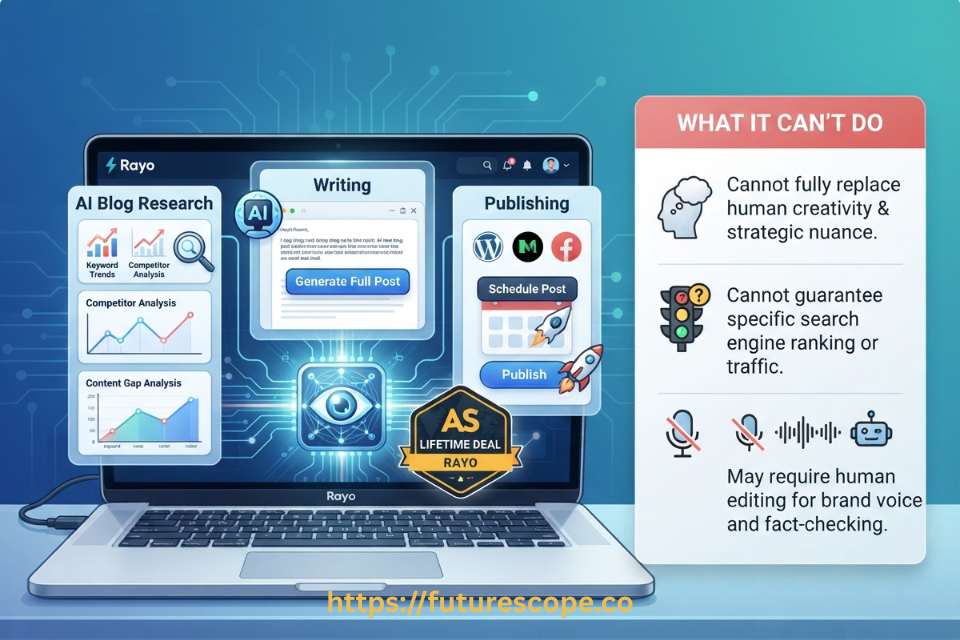

Disclosure: This review is based on Rayo’s current AppSumo listing and its founder’s public updates, checked directly as of August 2026 – not hands-on testing. One current-status note that affects the whole review: at the time of writing, the AppSumo deal is showing as sold out, with a “notify me when it returns” option instead of an active purchase button. This is addressed directly throughout rather than glossed over.
Writing one genuinely good SEO article involves a lot more than typing a prompt into a chatbot. There’s keyword research, understanding what someone actually wants when they search that term, building an outline that covers the topic properly, finding real sources to back up claims, writing the thing, editing it, sourcing images, publishing it correctly, and then checking whether any of it worked.
Rayo is built to bring that whole chain into one workspace: keyword research, AI-driven web research at the section level, long-form writing, an editing tool called Magic Edit, image generation, direct WordPress publishing, and performance tracking through Google Search Console – all positioned around a “research-first” approach rather than just generating text from a prompt.
It’s been available on AppSumo as a lifetime deal across three tiers. This review covers what it actually does, how its credit system works, what customers have said, and – importantly – whether you can actually buy it right now.
What Is Rayo?
Per its current AppSumo listing, Rayo’s tagline is direct: “Write SEO content on autopilot,” positioned as a way to “create, publish, and track SEO blogs with AI-powered research and WordPress publishing.“
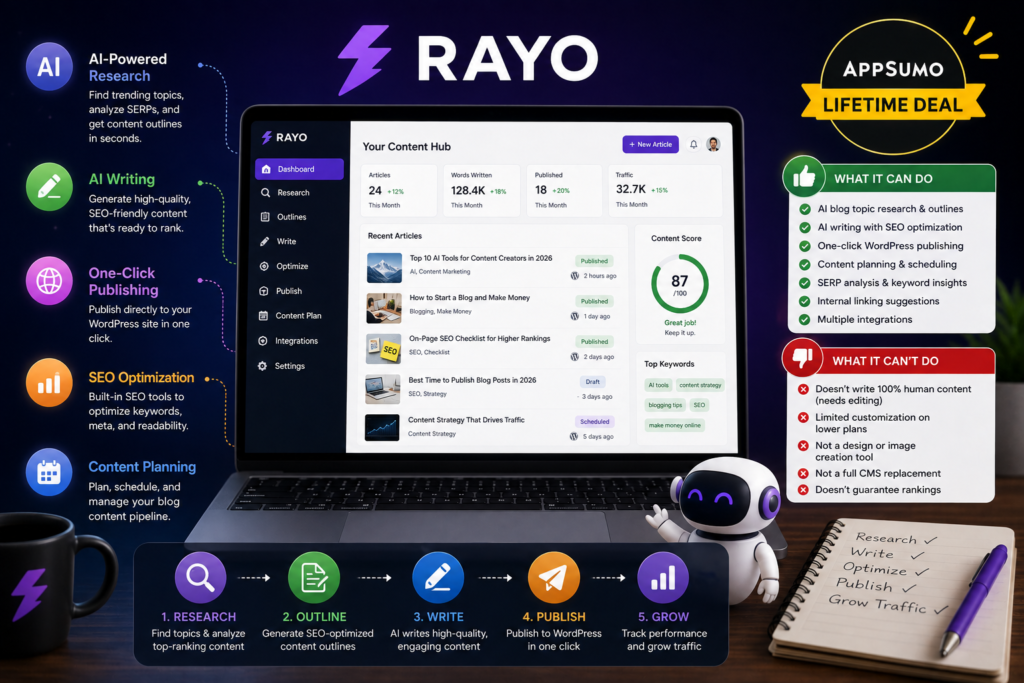
The core workflow, per the listing and founder updates: enter a keyword or topic → Rayo researches search intent and related terms → generate a title and outline based on top-ranking content → research streams in at the subheading level, pulling from what the founder describes as 100+ sources per article → the article is written → you review sources, edit with Magic Edit, and add or generate images → optimize for SEO → publish directly to WordPress → track performance.
The distinction Rayo draws against a plain chatbot is specifically the research step happening before and during writing, rather than an AI generating content purely from its own training data. Per the founder’s own framing, this doesn’t happen for free: each generated article is described as pulling from over 100 sources and carrying a real compute cost, which is also the stated reason the product runs on a credit system rather than unlimited generation.
Rayo at a Glance
| Category | Details |
| Product | Rayo |
| Category | AI SEO blogging platform – research, writing, editing, images, and publishing in one workflow |
| Best for | Bloggers, content creators, copywriters (per AppSumo’s own tags) |
| Keyword research | Yes – automated keyword research, included on every tier |
| AI research | Yes – described as streaming real-time research at the subheading level, pulling from 100+ sources per article |
| AI blog writing | Yes – “Magic Write” generates long-form posts from researched outlines |
| Source/citation review | Yes – built-in source and citation tabs; customer feedback (below) indicates verification still matters |
| AI image generation | Yes – automatic thumbnail and article image generation, styled to brand |
| AI editing (Magic Edit) | Yes – instant paragraph-level editing and tone adjustment |
| Brand voice | Yes – brand voice learning is a listed, included feature on every tier |
| WordPress integration | Yes – direct CMS publishing is a core, named feature |
| Google Search Console | Yes – listed as a confirmed integration |
| Performance analytics | Yes – included on every tier |
| Multiple projects | Yes – unlimited projects on every tier |
| Credits | Yes – a credit-based usage system (full breakdown below) |
| Language support | English only at present, per a founder update; expansion to 36 languages planned over roughly six months on a phased basis |
| Lifetime deal | Yes, across three license tiers – currently sold out |
| Refund period | 60 days |
| Current customer rating | 4.38 out of 5 stars from 8 AppSumo reviews at the time of writing |
This is an AppSumo “Launchpad” listing – described as “chosen by AppSumo for their potential and innovation.” Plus members purchasing this deal are covered by AppSumo’s standard “We Got Your Back” guarantee; the listing doesn’t specify that non-Plus members receive the same coverage, so it’s worth checking your own membership status against the current terms.
How Does Rayo Work?
Based on the listing and founder updates, the general workflow looks like this:
- Start a new project – unlimited projects are included on every tier, so managing multiple blogs or sites from one workspace isn’t a constraint
- Enter a target keyword or topic
- Rayo researches search intent and related terms using its automated keyword research
- An outline is generated based on analysis of top-ranking content for that topic
- Research streams in at the subheading level as the article is built, pulling from what the founder describes as 100+ sources
- Review sources through built-in citation tabs before or while writing
- The article is generated (“Magic Write”)
- Edit and refine using Magic Edit, adjusting tone to match brand voice
- Add or generate images styled to match your brand
- Optimize structure (headings, lists, tables) for both readability and SEO
- Publish directly to WordPress
- Track performance through the Google Search Console integration
The meaningful difference from just prompting ChatGPT to write an article is the research and sourcing step happening as part of the workflow, rather than an AI generating plausible-sounding content purely from its training data with no live source-checking built in. That’s a genuinely useful structural difference – it doesn’t, on its own, guarantee the research is accurate or that the resulting article will rank.
Rayo AppSumo Lifetime Deal
No Monthly Bills. Pay Once. Use Forever-Lifetime Access
This needs to be stated clearly upfront: as of this writing, the deal is sold out. The listing shows a “Notify me when it returns” option rather than an active purchase button.
Based on the most recently available listing information, Rayo’s AppSumo deal offered three license tiers:
| Feature | Tier 1 ($79) | Tier 2 ($169) | Tier 3 ($329) |
| List price (before discount) | $600 | $1,200 | $1,800 |
| Credits | 90 | 200 | 400 |
| Performance analytics | Yes | Yes | Yes |
| Unlimited projects | Yes | Yes | Yes |
| SEO blog generation | Yes | Yes | Yes |
| Magic Edit | Yes | Yes | Yes |
| Image generation | Yes | Yes | Yes |
| Regenerate blog | Yes | Yes | Yes |
| Brand voice learning | Yes | Yes | Yes |
| Direct CMS integration | Yes | Yes | Yes |
| Built-in SEO optimization | Yes | Yes | Yes |
| Automated keyword research | Yes | Yes | Yes |
As with several other lifetime deals covered in this review series: the feature set is identical across all three tiers. The only thing that changes between Tier 1, Tier 2, and Tier 3 is the number of credits included (90, 200, or 400).
A few deal-term details worth understanding, per the listing:
- The license includes all future updates to what’s currently called the Pro Workspace Plan
- If the plan name changes, the deal automatically maps to the renamed plan with its updates
- This deal is not stackable – there’s no code-combining, you choose one of the three tiers directly
- You must activate your license within 60 days of purchase
- You can upgrade between the three tiers while the deal remains available
- You can downgrade between tiers within 60 days of purchase
- Lifetime access is included, with a 60-day refund window
Because the deal is currently sold out, treat these figures as the most recently available snapshot rather than a guarantee of what will be offered if and when it returns.
Rayo’s Research-First Approach
This is worth treating as the platform’s central idea rather than just one feature among many. The logic, per the founder’s own framing: most AI content fails not because it reads poorly, but because it’s generic – it doesn’t reflect real research, doesn’t cite real sources, and doesn’t cover a topic with the depth a genuinely well-researched article would.
Rayo’s approach – keyword → intent → live research → sourced structure → writing – is designed to front-load that research step so the resulting article is built on something more substantial than the model’s own training data alone. That’s a reasonable, defensible approach to reducing generic AI content.
It’s important to be precise about what this does and doesn’t guarantee: automating the research step means sources get pulled in systematically, not that every pulled source, quote, or statistic is automatically accurate or being represented correctly. Automated research is a starting point for verification, not a substitute for it – a theme that shows up directly in customer feedback, covered in detail below.
Key Rayo Features
AI Keyword Research
Automated keyword research is included on every tier, described as surfacing topics with real search demand. The listing doesn’t break down the specific filters or database size behind this research, so exact keyword research depth (compared to a dedicated tool like Ahrefs or Semrush) isn’t something this review can confirm without direct testing.
AI-Powered Research
Research streams in at the subheading level as an article is built, with the founder describing articles as drawing from 100+ sources. Built-in citation tabs let you review sources as you write. This is a genuinely more structured approach than a general chatbot, which typically doesn’t show its work or cite live sources at all.
AI Blog Writing (Magic Write)
Long-form articles are generated with structured headings, lists, and tables, aimed at natural, SEO-focused writing. It’s worth being direct: no AI writing tool, including this one, can guarantee that a generated article will rank – ranking depends on far more than the article’s structure or writing quality alone, a point covered in more detail later in this review.
Source and Citation Verification
Rayo provides source and citation tabs specifically so users can check facts as they write. This matters more than it might seem: per AppSumo’s own AI-generated summary of customer feedback, some users have raised concerns about quote verification and, in at least one case, broken or incorrect source links. The built-in citation review tools exist precisely because this kind of checking is necessary – not because the platform guarantees every citation is already correct. Treat every AI-surfaced quote, statistic, and URL as something to verify yourself before publishing, not as pre-confirmed fact.
Magic Edit
Described as enabling instant, paragraph-level editing to produce more natural, human-sounding writing, with tone adjustment to match brand voice. The listing doesn’t detail specific editing commands beyond this general description.
AI Image Generation
Thumbnails and article images can be generated automatically, styled to match a brand’s visual style, and inserted directly in the editor. Per the pricing table, image generation is included as a feature across all three tiers, though (like blog generation) it draws from the shared credit pool – exact per-image credit cost isn’t broken out in what’s publicly documented.
Brand Voice
Brand voice learning is listed as an included feature on every tier, aimed at keeping tone and style consistent across posts. As with any AI voice-matching feature, treat this as a genuine aid to consistency rather than a promise of perfect, indistinguishable replication of a specific writer’s voice.
AI Detection Bypass
This is listed as an included feature on every tier. It’s worth a brief, neutral flag: features positioned around evading AI-content detection are a genuinely contested area – some publishers, platforms, or clients have policies specifically about AI-generated content disclosure, and bypassing detection doesn’t change whether the underlying content is accurate, original, or genuinely useful. Whether or how to use this feature is a judgment call worth thinking through against your own publishing context and any relevant platform policies, rather than treating it as a straightforwardly positive capability.
Direct WordPress Publishing
Confirmed as a core integration, letting finished articles publish directly to WordPress rather than requiring manual copy-paste and reformatting.
Google Search Console Integration
Confirmed as a core integration, feeding into the platform’s performance analytics. The listing doesn’t detail exactly which specific Search Console metrics are surfaced or how, so exact analytics depth isn’t fully confirmed here.
Performance Analytics
Included on every tier, tied to the Google Search Console integration for tracking how published content performs over time.
Rayo’s AI Agent Approach
Rayo’s workflow is better described as agentic than as a simple chatbot – it performs multiple connected steps (research, outlining, writing, editing, image generation, publishing) as part of one continuous process, rather than answering isolated prompts one at a time with no memory of the broader workflow.
It’s worth being careful not to overstate autonomy here: this is a structured, multi-step workflow with human checkpoints built in (reviewing sources, editing with Magic Edit, choosing what to publish), not a fully autonomous system that researches, writes, and publishes without any human involvement. The workflow reduces manual effort at each step; it doesn’t remove the need for human judgment throughout.
Rayo for Bloggers
For someone publishing regularly, the combination of research, outlining, writing, image generation, and direct WordPress publishing addresses most of the individually time-consuming steps in one workspace, rather than switching between a keyword tool, a writing tool, an image tool, and WordPress separately.
Rayo for Affiliate Marketers
Commercial-intent topics – product comparisons, buying guides, and supporting informational content – fit naturally into Rayo’s keyword-to-article workflow. It’s worth a direct caution here: publishing large volumes of AI-generated affiliate content without adding genuine original value (personal testing, unique insight, real experience) is a pattern search engines have specifically targeted with quality updates in recent years. Rayo can speed up production; it can’t substitute for actually having something original to say.
Rayo for SEO Agencies
Unlimited projects on every tier support managing multiple client blogs from one account. Whether the current tiers support genuinely separate multi-user, multi-client account structures (as opposed to one person managing many projects) isn’t detailed in the current listing – agencies with multiple team members needing simultaneous access should confirm user-seat specifics directly before assuming full multi-user support.
Rayo for SaaS Companies
Product-related educational content, comparison keywords, and problem-solving articles are a reasonable fit for Rayo’s workflow, particularly for a SaaS team without a dedicated in-house content writer. As with affiliate content, the value depends on the underlying topics and expertise being genuinely useful to readers, not just on publishing volume.
Understanding Rayo’s Credit System
This deserves its own dedicated section, since credit-based pricing is often the part of an AI tool deal that’s hardest to evaluate upfront – and Rayo’s founder has been unusually direct about how it works, in a detailed public update posted in February 2026.
What consumes credits?
New AI blog generation consumes credits. Based on the founder’s explanation of cost (each article pulling from 100+ sources with real compute cost, cited at roughly $3 per article), image generation tied to a blog likely factors into that same generation cost, though the listing doesn’t provide a precise, separate per-action credit breakdown (for example, exactly how many credits a single blog generation, a single image, or a single Magic Edit action costs individually).
What happens when credits run out?
Per the founder’s own direct explanation: nothing breaks. You keep full access to your existing workspace, all previously generated blogs remain fully editable, and Magic Edit, SEO tools, AI images, analytics, and the Regenerate function all remain available. The only thing that pauses is generating new AI blog content from scratch. As soon as you top up credits, generation resumes immediately.
Do credits expire?
No, per the founder’s update – credits don’t expire, there’s no forced upgrade, and no monthly renewal requirement.
Can you buy more credits?
Yes. Per the pricing table, additional credits are available as an add-on at $45 for 50 credits, with a stated maximum of 1,000 credits. This add-on pricing is listed identically across all three tiers.
Why not just offer unlimited credits?
The founder addresses this directly: because “unlimited” models elsewhere in the industry typically aren’t really unlimited – they tend to hide caps, throttle performance, reduce research depth, or lower output quality once usage gets heavy. Rayo’s stated reasoning for a transparent credit system instead: consistent output quality for every user, predictable pricing, and avoiding a situation where light users effectively subsidize heavy users (or vice versa).
This is a reasonable explanation, and it’s worth crediting the founder for being this specific about it publicly rather than leaving credit costs vague. That said, it’s still the vendor’s own framing of their pricing model, not an independently audited cost breakdown – a genuinely fair way to read it is as a transparent, defensible pricing philosophy, not as proof the credit costs are optimally calibrated for every possible use case.
One remaining gap worth naming directly: even with this level of transparency about the overall system, the listing doesn’t provide an exact, itemized credit cost per specific action (one blog generation vs. one image vs. one Magic Edit pass), which matches a concern raised in customer feedback, discussed next.
Which Rayo Plan Should You Choose?
Tier 1 – 90 credits ($79)
With the full feature set and 90 credits, this suits individual bloggers, freelancers, small websites, or occasional publishers who don’t need to generate a high volume of new articles every month, and who are comfortable topping up credits as an add-on if they occasionally exceed this allowance.
Tier 2 – 200 credits ($169)
More than double Tier 1’s credit allowance, at roughly double the price – a reasonable middle ground for regular publishers, affiliate marketers, SEO freelancers, or small agencies generating content more consistently.
Tier 3 – 400 credits ($329)
The largest credit allowance suits content agencies, larger websites, or high-volume SEO teams publishing frequently across multiple projects, where running out of credits regularly would otherwise mean frequent add-on purchases.
The honest recommendation: since the feature set is identical across tiers, this decision comes down entirely to realistically estimating your monthly content volume against the credit allowance – and since credits don’t expire, starting with a smaller tier and adding credits as needed is a reasonably low-risk approach if you’re unsure how much you’ll actually use.
Rayo Pros and Cons
Pros
- A genuinely structured research-first workflow, not just prompt-to-text generation
- Real-time, subheading-level research citing multiple sources per article
- Direct WordPress publishing removes manual copy-paste and reformatting
- Image generation, brand voice, and Magic Edit are bundled into every tier, not gated behind higher pricing
- Unlimited projects on every tier
- Unusually transparent founder communication specifically about how the credit system works and why
- Credits don’t expire, and running out doesn’t lock you out of your existing content or non-generation tools
- Customer feedback specifically praises the research-first workflow, natural-sounding content, and WordPress publishing
Cons
- The AppSumo deal is currently sold out
- AI-generated citations, quotes, and links still require human verification – per customer feedback, this hasn’t always been reliable out of the box
- Exact, itemized credit cost per specific action isn’t fully documented publicly
- English-only content generation at present, with broader language support still on a multi-month rollout
- A very young company – founded October 2025, pre-seed stage, with only 8 public reviews at the time of writing
- Includes an “AI detection bypass” feature worth thinking through carefully against your own publishing context rather than treating as a straightforward positive
- At least one reviewer reported activation or support difficulties, and another reported issues with keyword research, country settings, images, references, and CMS support – see the next section for detail
What Are Customers Saying About Rayo?
At the time of writing, Rayo’s AppSumo listing shows 8 customer reviews with an average rating of 4.38 out of 5 stars. The taco breakdown:
| Rating | Number of reviews |
| 5 tacos | 6 |
| 4 tacos | 1 |
| 3 tacos | 0 |
| 2 tacos | 0 |
| 1 taco | 1 |
With only 8 reviews, this is a small sample – genuinely more informative than a 1-2 review listing, but still not enough to draw sweeping conclusions from. The pattern (6 five-star, 1 four-star, 1 one-star, nothing in between) leans strongly positive with one notable outlier.
AppSumo’s AI-generated summary of the review content describes customers as appreciating Rayo’s efficient AI-powered research, seamless WordPress publishing, and natural-sounding content generation. It also notes some concerns about unclear credit usage and minor issues with quote verification.
- Positive themes, per AppSumo’s summary and individual review content: the research-first workflow, natural-sounding writing, WordPress publishing, and the ability to turn outlines into articles with relatively little additional editing
- Negative/mixed themes: one reviewer specifically reported difficulties with credit transparency, quote verification, and activation or support responsiveness; another reported issues involving keyword research accuracy, country/location settings, images, references, and CMS support
These are individual customer experiences, not universal product failures – but they’re worth taking seriously precisely because they echo the same credit-transparency and citation-verification themes flagged elsewhere in this review, including in the founder’s own public response addressing credit transparency directly. That the founder proactively addressed these concerns in a detailed public update is a reasonably good sign of responsiveness, even though it doesn’t retroactively resolve every individual reviewer’s specific experience.
Rayo vs ChatGPT
| Feature | Rayo | ChatGPT |
| SEO blog workflow | Yes – purpose-built, end-to-end | No – a general assistant, not a dedicated SEO workflow |
| Keyword research | Yes, built in | No native keyword research; would require a separate tool |
| Web research | Yes – streamed at the subheading level, citing sources | Varies by ChatGPT version/plan; not built around structured, per-article sourcing the same way |
| Source workflow | Yes – dedicated citation review tabs | No dedicated citation review interface |
| AI writing | Yes, SEO-structured by design | Yes, general-purpose, not SEO-structured by default |
| Editing | Yes – Magic Edit, purpose-built for content refinement | Possible via prompting, not a dedicated editing tool |
| Image generation | Yes, brand-styled, built into the workflow | Possible depending on plan/version, not blog-workflow-integrated |
| WordPress publishing | Yes, direct integration | No native publishing integration |
| SEO tracking | Yes, via Google Search Console integration | No native SEO tracking |
| Ease of use | Purpose-built workflow, more structured | Flexible, general-purpose, requires more manual assembly for SEO content specifically |
| Best for | End-to-end SEO blog production specifically | General-purpose writing, brainstorming, and a very wide range of other tasks |
This isn’t a case of one tool being better than the other – they’re built for different scopes. ChatGPT is a broad, general-purpose AI assistant capable of many things beyond content writing. Rayo is narrowly built around the specific SEO blogging workflow, bundling research, writing, editing, images, and publishing into one connected process. For SEO content production specifically, Rayo’s purpose-built workflow does more of the surrounding work; for anything outside that specific scope, ChatGPT’s flexibility is the advantage. TRY ONCE WITH RAYO!
Rayo vs Jasper
- SEO workflow: Rayo is built specifically around end-to-end SEO blog production; Jasper is a broader AI marketing content platform covering more content types beyond SEO blogging specifically
- Research: Rayo’s subheading-level, multi-source research is a distinctive, central feature; Jasper’s research capabilities are less central to its core positioning
- AI writing: both offer strong long-form AI writing capability
- Brand voice: both platforms support brand voice/tone consistency features
- Editing: Rayo’s Magic Edit is purpose-built for content refinement within its workflow; Jasper offers its own editing tools within a broader platform
- Images: both support AI image generation
- Publishing: Rayo’s direct WordPress integration is a core, named feature; verify Jasper’s current publishing integrations directly, as this wasn’t independently confirmed as part of this review’s sourcing
- Pricing: Rayo’s one-time AppSumo lifetime cost (when available) contrasts with Jasper’s typical ongoing subscription model
- Lifetime deal: Rayo has offered one via AppSumo; Jasper isn’t typically offered this way
Users specifically prioritizing an end-to-end SEO blogging workflow with research and publishing bundled in may prefer Rayo’s more focused approach; users wanting a broader marketing content platform covering more formats beyond blog posts may find Jasper’s wider scope better suited. TRY ONCE WITH RAYO!
Rayo vs Copy.ai
- Blog creation: Rayo is purpose-built around long-form SEO blog production specifically; Copy.ai historically covers a broader range of shorter-form marketing copy alongside longer content
- Research: Rayo’s structured, source-citing research workflow is a distinctive differentiator
- SEO workflow: Rayo’s keyword research, outline generation, and SEO optimization are built specifically around ranking-focused blog content
- Automation: both platforms offer workflow automation features, though scoped differently given their different core focuses
- Integrations: Rayo’s confirmed integrations are Google Search Console and WordPress specifically; verify Copy.ai’s current integration list directly, as this wasn’t independently confirmed here
- Publishing: direct WordPress publishing is a named Rayo feature; confirm Copy.ai’s current publishing capabilities directly
- Pricing: Rayo’s AppSumo lifetime cost versus Copy.ai’s typical ongoing subscription reflects different pricing philosophies
The clearest distinction: Rayo is narrowly focused on the SEO blog production pipeline specifically, while Copy.ai has historically positioned itself across a broader range of marketing copy use cases. Which is the better fit depends on whether your primary need is specifically long-form SEO blogging or broader marketing content generation. TRY ONCE WITH RAYO!
Rayo vs Surfer SEO / Clearscope
These platforms overlap with Rayo in the content optimization space but come at it from a different angle – worth understanding clearly, since AppSumo’s own listing names Clearscope as a direct “alternative to” comparison, and Rayo’s own FAQ specifically addresses the Surfer SEO comparison (though the answer text itself wasn’t accessible as part of this review’s sourcing).
- Keyword analysis: Surfer SEO and Clearscope are both built specifically around content optimization scoring against top-ranking pages for a target keyword; Rayo’s keyword research is more focused on discovery and search intent as an input to its own writing workflow
- Content optimization: Surfer and Clearscope are traditionally used to optimize content you (or another AI tool) already wrote, scoring it against competitor content; Rayo builds the article from research through to a finished draft within its own workflow
- AI writing: Rayo includes full AI article generation as a core feature; Surfer and Clearscope have historically been more optimization-and-scoring tools than full AI writing platforms, though both have added AI writing capabilities over time
- Publishing: Rayo’s direct WordPress integration is a distinctive advantage if built-in publishing matters to your workflow
- Pricing: Rayo’s AppSumo lifetime deal (when available) contrasts with Surfer and Clearscope’s typical ongoing subscription pricing
The practical difference: Surfer SEO and Clearscope are traditionally optimization tools you’d use alongside your own writing process (or another writing tool), scoring content against what’s already ranking. Rayo positions itself as covering the entire pipeline – research, writing, optimization, and publishing – in one workflow, which is a genuinely different scope even where the tools’ outputs might occasionally overlap. TRY ONCE WITH RAYO!
Is Rayo Easy to Use?
Based on the listing and customer feedback themes, the core workflow – keyword to outline to article to publish – appears reasonably structured and guided, which should help a beginner move through the process without needing deep prior SEO expertise.
- Creating a project – straightforward, with unlimited projects available on every tier
- Finding keywords – built-in, automated keyword research
- Building an outline – generated automatically based on top-ranking content analysis
- Reviewing sources – supported through dedicated citation tabs, though customer feedback suggests this step deserves real attention, not just a quick glance
- Generating content – the core Magic Write function
- Editing – Magic Edit is purpose-built for this
- Adding images – automated generation, styled to brand, inserted directly in the editor
- Publishing – direct WordPress integration
- Tracking results – through the Google Search Console integration
A complete beginner should be able to move through this workflow without extensive training, based on how it’s structured. Experienced SEO writers may find real value in the granular control (reviewing sources, adjusting outlines, refining tone) rather than accepting AI output wholesale – though at least one customer reported activation or support friction, worth keeping in mind as a genuine, if isolated, data point.
Does Rayo Create SEO-Friendly Content?
Rayo can genuinely help with several inputs to SEO performance: understanding search intent, building well-structured content around a topic, planning keywords systematically, conducting research, organizing headings logically, and producing readable long-form writing.
It’s important to be equally clear about what SEO success also depends on, none of which any content tool can fully control:
- Genuine search intent match, not just keyword presence
- Originality and real expertise, not just comprehensive coverage
- Overall site authority, which builds over time
- Backlinks pointing to the content
- Technical SEO health of the broader site
- How competitive the specific keyword or topic is
- Actual user satisfaction once someone lands on the page
- Ongoing optimization and updates over time, not a one-time publish-and-forget approach
No AI tool, including Rayo, can guarantee that content it helps produce will rank. It can help you produce better-structured, more thoroughly researched content faster – what happens after publishing depends on a much wider set of factors outside any single tool’s control.
Can Rayo Replace a Human SEO Writer?
Rayo can genuinely reduce workload in several areas: research, outlining, first drafts, editing assistance, image creation, formatting, and publishing mechanics.
Humans remain essential for:
- Overall content strategy and prioritization
- Original insight or expertise that goes beyond what’s already published elsewhere
- Fact-checking, especially for claims, statistics, and quotes
- Genuine expert opinion, where relevant
- Brand positioning and messaging judgment
- Overall editorial judgment about what’s actually worth publishing
- Final quality control before anything goes live
The realistic framing: Rayo can meaningfully reduce the mechanical workload of SEO content production, but it doesn’t remove the need for a human making strategic and editorial decisions, especially around fact-checking and originality.
How Good Is Rayo’s AI Content?
Based on available customer feedback, natural-sounding writing and the research-first structure are specifically praised themes. That’s a genuinely positive signal, though it comes from a small sample (8 reviews) and this review hasn’t independently tested content quality firsthand.
Content quality from any AI writing tool, including Rayo, will vary depending on the topic, the quality of available source material, and how carefully the user reviews and refines the output. Research depth, structure, and natural tone appear to be genuine strengths based on the available feedback; factual accuracy and source reliability specifically require human verification, per both the platform’s own citation-review tools and customer feedback flagging this as an area needing attention.
Is Rayo’s Research Reliable?
This is worth answering carefully rather than optimistically. Rayo’s research-first approach is a genuine structural improvement over content generated purely from a model’s training data – it means sources exist and can be checked. It does not mean every source, quote, statistic, or claim surfaced is automatically accurate.
Users should specifically verify, before publishing anything:
- Statistics and numbers cited
- Direct quotes attributed to any source
- Broader factual claims
- That source URLs actually work and lead where expected
- Publication dates, to confirm information isn’t outdated
- Product or company information specifically, which changes frequently and is easy to get wrong
The key distinction worth internalizing: having citations is not the same as having accurate citations. Rayo’s tools make the verification step easier by surfacing sources directly in the editor – they don’t eliminate the need to actually do that verification.
Is Rayo Worth the AppSumo Lifetime Deal?
Yes, Rayo is worth considering for users who want a cost-effective tool without adding another monthly subscription. Its AppSumo lifetime deal can be especially valuable for freelancers, marketers, creators, and small businesses that plan to use the platform regularly.
The main advantage is the long-term savings compared with paying for a recurring plan. If Rayo’s features fit your workflow and you expect to use it consistently, the lifetime deal can be a smart investment. However, occasional users should compare its features, limitations, and alternatives before purchasing.
Who Should Buy Rayo?
- SEO bloggers who publish regularly and want research, writing, and publishing consolidated into one tool
- Affiliate marketers producing commercial-intent content, provided they add genuine original value rather than relying purely on AI-generated volume
- Content creators and copywriters wanting a structured, research-backed workflow rather than starting from a blank prompt
- SEO freelancers managing content production for themselves or clients
- Agencies producing blog content across multiple projects, provided current user-seat and multi-client specifics fit their team structure
- SaaS companies wanting to build out educational and comparison content without a dedicated in-house writer
- WordPress publishers specifically, given the direct publishing integration
- Businesses producing long-form content who are comfortable with a credit-based usage model
Who Should Avoid Rayo?
- Users who only need a general-purpose AI chatbot for varied tasks – ChatGPT or a similar general assistant is the more appropriate, flexible tool
- Businesses requiring advanced, enterprise-grade SEO research beyond what a young platform’s built-in keyword tools currently offer
- Teams needing extensive CMS integrations beyond WordPress specifically
- Users who specifically dislike credit-based AI usage models and want a flat, unlimited-generation structure
- Publishers requiring completely automated publishing without any human review step – given the emphasis on citation verification, this isn’t a fully hands-off tool
- Anyone needing content in a language other than English right now, given the current English-only limitation
Conclusion | Rayo Review
Can Rayo realistically make SEO content production faster without sacrificing the research and editorial control that quality content requires? Largely yes, based on how the platform is built and the available customer feedback – the research-first workflow, source citation tools, and consolidated editing/image/publishing features genuinely address the fragmented, multi-tool nature of proper SEO content production.
The honest caveats: citation and quote accuracy still requires real human verification, not passive trust; the credit system, while transparently explained at a high level, doesn’t publish exact per-action costs; this is a young, pre-seed company with a small review sample; and – most immediately relevant to any purchase decision – the deal is currently sold out.
Who should buy it, when available: SEO bloggers, affiliate marketers, content creators, freelancers, agencies, and SaaS companies producing regular WordPress content who want research, writing, editing, and publishing in one workflow, and who commit to actually verifying AI-generated citations before publishing. Who should consider alternatives: anyone wanting a general-purpose AI assistant instead of an SEO-specific workflow, anyone needing non-English content right now, or anyone uncomfortable with credit-based pricing.
Frequently Asked Questions
What is Rayo?
Rayo is an AI SEO blogging platform combining keyword research, AI-powered web research, long-form writing, editing, image generation, and direct WordPress publishing into one workflow.
What does Rayo do?
It takes a keyword or topic through research, outline generation, source-cited writing, editing, image creation, SEO optimization, and publishing, aiming to reduce the number of separate tools needed to produce an SEO blog post.
Is Rayo an AI SEO writing tool?
Yes, specifically positioned around end-to-end SEO blog content production, not general-purpose writing.
Can Rayo write full blog posts?
Yes, via its Magic Write feature, generating long-form, structured articles from a researched outline.
Does Rayo perform keyword research?
Yes, automated keyword research is included on every tier, aimed at surfacing topics with real search demand.
Does Rayo research sources before writing?
Yes – research streams in at the subheading level as an article is built, with the founder describing articles as drawing from 100+ sources.
Does Rayo verify citations?
It provides tools (citation tabs) to help you review sources, but it does not guarantee citation accuracy – customer feedback has specifically flagged quote and link verification as an area requiring human review.
Can Rayo generate images?
Yes, automated thumbnail and article image generation, styled to brand, is included on every tier.
Does Rayo support WordPress?
Yes, direct CMS publishing to WordPress is a core, confirmed integration.
Does Rayo integrate with Google Search Console?
Yes, this is a confirmed integration, feeding into the platform’s performance analytics.
Can Rayo track SEO performance?
Yes, via performance analytics tied to the Google Search Console integration, included on every tier.
Does Rayo use credits?
Yes, new AI blog generation consumes credits, with each tier including a set allowance (90, 200, or 400) and additional credits available as an add-on.
What happens when Rayo credits run out?
As Per the founder’s own explanation, nothing breaks – your workspace, existing blogs, and non-generation tools (Magic Edit, SEO tools, analytics, Regenerate) all remain fully accessible. Only new AI blog generation pauses until you top up.
Do Rayo credits expire?
No, per the founder’s update – credits don’t expire and there’s no forced upgrade or monthly renewal.
Can Rayo replace an SEO writer?
Not fully – it can reduce workload on research, drafting, editing, and formatting, but strategy, original expertise, fact-checking, and final editorial judgment still require a human.
Is Rayo better than ChatGPT for SEO content?
For end-to-end SEO blog production specifically, Rayo’s purpose-built workflow (research, keyword tools, publishing) offers more built-in structure. ChatGPT remains more flexible for general-purpose tasks outside that specific scope.
Is Rayo better than Jasper?
Not universally – Rayo is more narrowly focused on SEO blog production with integrated research and publishing; Jasper covers a broader range of marketing content types. The better fit depends on your specific content needs.
Is Rayo better than Copy.ai?
Not universally – Rayo is specifically built around long-form SEO blogging; Copy.ai has historically covered a wider range of shorter-form marketing copy. Choose based on which scope matches your actual content needs.
Does Rayo offer an AppSumo lifetime deal?
Yes, historically across three tiers with lifetime access – but as of this writing, the deal is sold out. Check the current listing for availability.
How much does Rayo cost?
When available on AppSumo, pricing has run from $79 (90 credits) to $329 (400 credits) for lifetime access, with additional credits purchasable at $45 for 50. Confirm current pricing and availability directly, since the deal is currently sold out.
Is Rayo worth buying?
For SEO bloggers, affiliate marketers, content creators, and agencies who publish regularly on WordPress and want research, writing, and publishing consolidated into one workflow, yes, based on available customer feedback and the platform’s transparent credit policy – provided you commit to verifying AI-generated citations. Check current AppSumo availability before making a purchase decision, since the deal is currently sold out.
Check Current Availability Before You Decide
Rayo’s research-first approach to AI SEO blogging is a genuinely thoughtful answer to a real problem – generic AI content that doesn’t reflect actual research or citable sources. For SEO bloggers, affiliate marketers, WordPress publishers, agencies, and content teams wanting research, writing, editing, images, and publishing combined into one workflow, that’s a compelling pitch, backed by consistent (if limited) positive customer feedback and an unusually transparent founder.
The immediate practical step is different than usual: since the deal is currently sold out, check the live AppSumo listing for current availability, or join the notification list if it remains unavailable. If and when it returns, compare the three tiers based on your realistic monthly content volume against the credit allowances, not just sticker price. And whatever workflow you use – Rayo or otherwise – remember that even research-first AI tools still need a human checking the important claims, citations, quotes, and final content before anything goes live. Try Rayo Lifetime Deal on Appsumo
Related posts:
 Secure Your Digital Life Forever with the FileJump 2TB Cloud Storage Lifetime Deal
 SiteGuru Lifetime Deal Review – Simplify Your SEO & Website Audits Forever
 Zipchat AI Review AppSumo 2026: Lifetime Deal, Pricing, Features & Is It Worth It?
 SnowSEO Lifetime Deal Review: Is the AppSumo Lifetime Deal Worth It?