
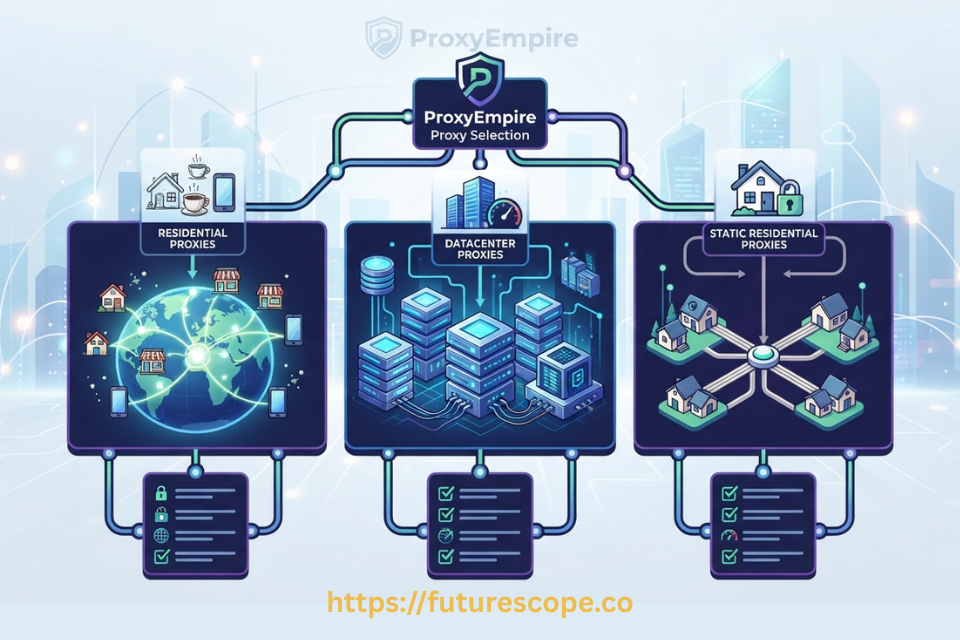

So you’ve decided to try ProxyEmpire. Smart move. But then you land on the pricing page and see options like rotating residential, static residential, mobile, and datacenter proxies — and suddenly you’re not sure which one actually fits your project. You’re not alone. This is the single most common question new users ask before they buy: how do I choose the right ProxyEmpire proxy type for what I’m trying to do?
The good news is that picking the right proxy type isn’t complicated once you understand what each one is built for. In this guide, we’ll break down every proxy type ProxyEmpire offers, show you exactly when to use each one, and hand you a simple framework so you never have to guess again.
Why the Proxy Type You Choose Actually Matters!
A proxy is just an IP address that stands between you and the website you’re visiting. But not all IPs are treated equally by the sites you’re targeting. Some websites flag datacenter IPs instantly. Others are lenient with almost anything. Some tasks need an IP that looks exactly like a real phone on a mobile network, while others just need a fast, cheap, disposable connection.
Choosing the wrong proxy type can mean wasted bandwidth, more CAPTCHAs, higher ban rates, or paying for features you never actually use. Choosing the right one means smoother scraping, better success rates, and a proxy plan that actually matches your budget. That’s the whole game.
Compare the Plans and See If ProxyEmpire Fits Your Budget. Try ProxyEmpire!
Get Reliable Proxies With ProxyEmpire
If ProxyEmpire looks like a good fit, check the current plans and start with the option that suits your traffic needs.
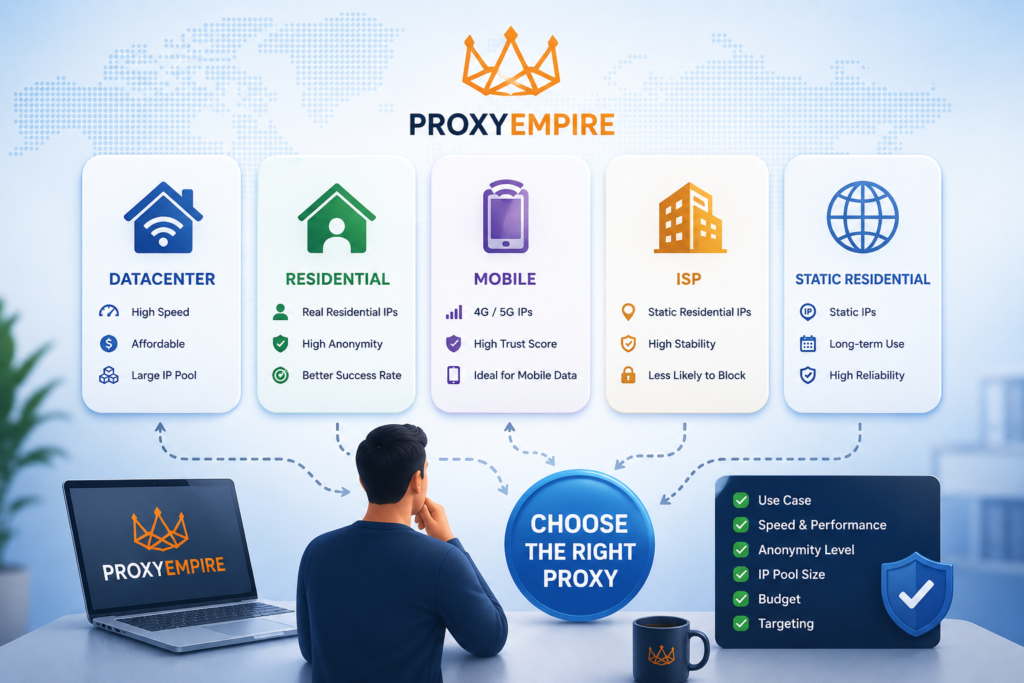
The Proxy Types ProxyEmpire Offers
ProxyEmpire runs a broad proxy portfolio, so let’s go through each type one at a time before we talk about how to match them to your use case.
Rotating Residential Proxies
These are ProxyEmpire’s flagship product, and for good reason. Rotating residential proxies use real IP addresses assigned by internet service providers to actual home devices, so they look completely legitimate to the websites you visit. The pool rotates automatically, meaning your IP changes with every request or every few minutes, depending on your session settings. You also get granular targeting by country, region, city, and ISP, which is handy when you need location-specific results.
Static Residential (ISP) Proxies
Static residential proxies, sometimes called ISP proxies, combine the trust of a residential IP with the stability of a fixed connection. Instead of rotating, the same IP stays assigned to you for an extended period, often a month or longer. This is the type to reach for when a task needs a consistent identity across many requests, rather than a fresh IP every time.
Mobile Proxies (Rotating and Dedicated)
Mobile proxies route traffic through real 3G, 4G, and 5G connections tied to actual mobile carriers. Because carrier-grade networks share IPs across huge numbers of real users, mobile IPs carry an unusually high trust level, and platforms are far more reluctant to block them. ProxyEmpire offers both a rotating mobile pool for large-scale tasks and dedicated mobile proxies for people who only need a handful of IPs but want heavy, uninterrupted bandwidth.
Datacenter Proxies
Datacenter proxies come from servers in commercial data centers rather than real residential or mobile connections. They’re the fastest and cheapest option in the lineup, but they’re also the easiest for websites to detect and block, since the IP ranges are publicly associated with hosting providers rather than everyday consumers.
How to Choose ProxyEmpire Proxy Type Based on Your Use Case?
Here’s where theory turns into a decision. Match your project to the list below and you’ll usually land on the right proxy type in seconds.
- Rotating residential proxies — Best for large-scale web scraping, price monitoring, and SEO rank tracking where you need thousands of fresh IPs and don’t mind them changing constantly.
- Static residential (ISP) proxies — Best for account management, banking-style sessions, or any workflow where the site expects to see the same visitor coming back over days or weeks.
- Mobile proxies — Best for managing social media accounts, app testing, or accessing mobile-first platforms that are notoriously strict about IP reputation.
- Datacenter proxies — Best for simple, high-volume, low-sensitivity tasks like bulk data pulls from sites with weak bot protection, where speed and cost matter more than stealth.
- Dedicated mobile proxies — Best when you need a small number of IPs but want to hammer them with heavy, non-stop bandwidth without worrying about session limits.
Key Factors to Weigh Before You Decide
Beyond matching a use case to a proxy type, a few practical factors should shape your final decision.
- Anonymity and detection risk — How likely is the target website to fingerprint or block suspicious traffic? The stricter the site, the more you should lean toward residential or mobile IPs.
- Speed requirements — Datacenter proxies are the fastest, followed by residential, with mobile sometimes trailing slightly due to carrier network conditions.
- Budget — Datacenter and rotating residential proxies tend to be the most cost-efficient per gigabyte, while mobile and static residential proxies usually cost more because of their higher trust level.
- Session persistence — If your task needs the exact same IP throughout a session, static or dedicated options make more sense than a rotating pool.
- Geo-targeting Proxy needs — If your project depends on hitting a specific city, state, or carrier, check that the proxy type you’re considering supports that level of targeting before you commit.
- Scale of the project — Scraping millions of pages calls for a large rotating pool, while managing a handful of accounts calls for a small set of stable IPs.
Ready to See If ProxyEmpire Is Worth It for You? Try ProxyEmpire Today
Still Not Sure? Test ProxyEmpire Before You Commit. Try ProxyEmpire for $1.97
Is ProxyEmpire worth it? The best way to find out is to test it yourself. Check the latest plans and see whether ProxyEmpire fits your needs.
A Quick Decision Cheatsheet
- Scraping at scale, don’t care which IP shows up each time? Go rotating residential.
- Need the same identity for weeks at a time? Go static residential (ISP).
- Managing mobile apps or social accounts that scrutinize IPs closely? Go mobile.
- Running simple, high-volume, low-risk tasks on a tight budget? Go datacenter.
- Still not sure? Start with a small rotating residential plan, since it’s the most flexible all-rounder, then adjust once you see your success rate.
Common Mistakes to Avoid
- Choosing datacenter proxies purely because they’re cheap, then getting blocked constantly on a site that fingerprints aggressively.
- Buying a huge rotating pool for a task that actually needs a handful of stable, long-lived IPs.
- Ignoring geo-targeting requirements and discovering too late that your chosen proxy type doesn’t support the city or carrier you need.
- Overpaying for mobile proxies on a task that datacenter or residential IPs could have handled just fine.
Final Thoughts
There’s no single “best” ProxyEmpire proxy type — only the type that’s best for what you’re actually trying to accomplish. Once you’re clear on your use case, your budget, and how sensitive your target site is to suspicious traffic, the decision practically makes itself. Start with the cheatsheet above, test on a small plan, and scale up once you know the proxy type is doing its job.
Frequently Asked Questions
1. What’s the fastest way to choose a proxy type if I’m short on time?
Think about two things first: how strict is the target website, and do you need the same IP over time or a constantly changing one. If the site is strict and you need consistency, static residential or mobile is your answer. If the site is strict but you’re fine with rotation, go rotating residential. If the site is lenient, datacenter proxies will save you money.
2. Can I mix proxy types across one project?
Yes, and many experienced users do exactly that. It’s common to use rotating residential proxies for broad scraping while reserving static residential or mobile proxies for the accounts or sessions that need extra stability and trust.
3. Are mobile proxies really worth the extra cost?
For mobile-first platforms and heavily monitored apps, yes. Carrier-grade IPs are shared by real phone users, which makes them far harder for platforms to flag, so the premium price often pays for itself in fewer blocks and CAPTCHAs.
4. Do datacenter proxies still have a place in 2026?
Absolutely, especially for internal tools, lightly protected sites, and high-volume tasks where speed and cost matter more than stealth. They’re just not the right pick for platforms with sophisticated bot detection.
5. How do I know if I should switch proxy types later?
Watch your success rate and ban rate. If you’re seeing frequent CAPTCHAs, blocks, or failed requests on your current proxy type, that’s your signal to move up to a more trusted option like residential or mobile, even if it costs a bit more per gigabyte.
Ready to Pick Your Proxy Type?
You now know exactly how to choose the right ProxyEmpire proxy type for your project, whether that’s rotating residential, static residential, mobile, or datacenter. The next step is simple: head over to ProxyEmpire, start with a small plan that matches your use case, and put it to the test. If it’s not quite right, you can always adjust, but you’re no longer guessing. Go choose your proxy type and get your project moving today. Try ProxyEmpire Today →