
Somewhere in a planning meeting, a budget conversation, or a job interview, you have probably encountered this exact question: big data analysis or cloud computing — which one matters more, which one should we invest in, which one should I learn first?
It is a question that gets asked constantly, and it is also, in an important sense, the wrong question. Big data analysis and cloud computing are not two competing technologies fighting for the same job. They are two different layers of the modern data ecosystem that increasingly depend on each other to function at all.
But understanding the real relationship between them — what each one actually does, where they overlap, and where the genuine trade-offs lie — is essential knowledge whether you are building a career, choosing technology for your organization, or simply trying to make sense of two terms that get thrown around constantly in tech conversations. Let’s break it down properly.
The Difference Between Big Data and Cloud Computing
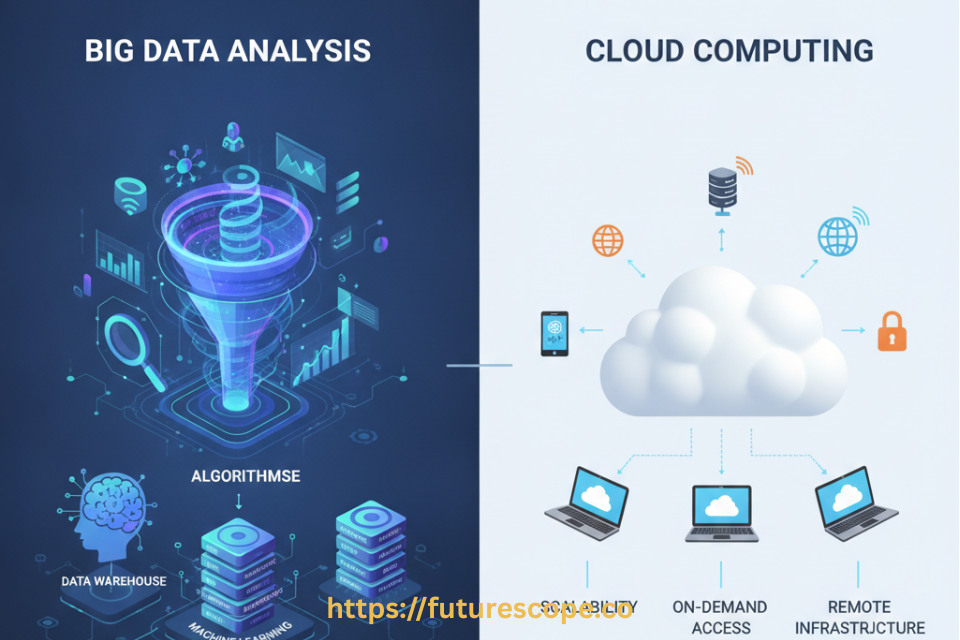
The clearest way to understand the difference is to recognise that big data is fundamentally about data, while cloud computing is fundamentally about infrastructure.
Big data refers to datasets that are too large, too fast-moving, or too complex for traditional data processing tools and methods to handle effectively. The concept is often described through the framework of the ‘Vs’ — volume, the sheer scale of data being generated; velocity, the speed at which new data arrives and needs processing; variety, the diversity of data types from structured database records to unstructured text, images, and sensor readings; and veracity, the challenge of ensuring data quality and reliability amid all this scale and diversity. Big data analysis is the discipline of extracting meaningful patterns, insights, and predictions from these massive, complex datasets using specialised tools, algorithms, and statistical methods.
Cloud computing, by contrast, refers to the delivery of computing resources — servers, storage, databases, networking, software — over the internet on an on-demand basis, rather than through infrastructure that an organisation owns and physically maintains. Cloud computing is the ‘how’ of modern computing infrastructure: how organisations rent processing power instead of buying it, how they scale capacity up or down based on real-time need, and how they access sophisticated computing capabilities without building data centres themselves.
| The Key Distinction: Big data is a category of problem — what do you do when your data has outgrown traditional processing methods? Cloud computing is a category of solution — how do you access the computing power needed to solve that problem (and countless others) without massive upfront infrastructure investment? They are not substitutes for each other. They operate on entirely different layers of the technology stack. |
Overview: How Big Data Analytics Actually Runs on Cloud Computing
Here is the part that resolves most of the confusion: in the overwhelming majority of modern organisations, big data analytics does not happen on traditional, organisation-owned infrastructure anymore. It happens on the cloud. The two technologies are not competitors — cloud computing is the platform on which most contemporary big data analysis is performed.
This convergence happened for clear practical reasons. Processing genuinely large datasets requires massive, often unpredictable, computing power — the kind of capacity that is prohibitively expensive to build and maintain on-premises for most organisations, particularly because big data workloads tend to be bursty rather than constant. An organisation might need to process a flood of data during a specific event, marketing campaign, or seasonal period, and then have dramatically lower processing needs the rest of the time. Building physical infrastructure for that peak capacity, only to leave it underused most of the time, is an extraordinarily inefficient use of capital.
Cloud computing solves exactly this problem. Major cloud providers — Amazon Web Services, Microsoft Azure, Google Cloud Platform — offer purpose-built big data services that allow organisations to provision massive computing power on demand, process their datasets, generate insights, and then scale back down, paying only for the resources actually consumed. Services like AWS EMR, Google BigQuery, and Azure Synapse Analytics exist specifically to run the distributed processing frameworks — Apache Hadoop, Apache Spark, and similar tools — that big data analysis depends on, without requiring the organisation to manage any of the underlying server infrastructure.
The practical reality in 2025 is that asking whether to choose big data analysis or cloud computing is similar to asking whether to choose a recipe or a kitchen. Big data analysis is the discipline and the techniques you apply to extract value from large datasets. Cloud computing is the kitchen — the infrastructure environment where that work actually gets done at scale, with the appliances, capacity, and flexibility that on-premises alternatives generally cannot match.
Challenges and Benefits: A Honest Look at Both Sides
Understanding the genuine trade-offs involved in big data analytics and cloud computing requires looking honestly at what each contributes and what each complicates.
Benefits of Big Data Analysis
The core value proposition of big data analysis is the ability to extract insights that would be invisible at smaller data scales or with simpler analytical methods. Organisations that successfully implement big data analytics can identify customer behaviour patterns across millions of interactions, detect fraud signals that only become statistically apparent across enormous transaction volumes, optimise supply chains using real-time data from thousands of sensors and sources, and build predictive models with accuracy levels that simply are not achievable with smaller, less comprehensive datasets.
- Deeper, more accurate insights from comprehensive rather than sampled data
- Real-time or near-real-time analysis of fast-moving data streams, from financial markets to IoT sensor networks
- Improved predictive accuracy for machine learning models trained on larger, more representative datasets
- Competitive advantage through data-driven decision-making that competitors using traditional analysis cannot match
Challenges of Big Data Analysis
The challenges of big data analysis are substantial and well-documented. Data quality and governance become exponentially more difficult at scale — ensuring that the data feeding into analysis is accurate, consistent, and properly structured requires sophisticated data engineering practices that many organisations underinvest in. The technical complexity of distributed processing frameworks, the specialised skill sets required to work with them effectively, and the genuine difficulty of finding qualified data engineers and data scientists all represent real organisational hurdles. Privacy and regulatory compliance, particularly with frameworks like GDPR and increasingly strict data protection laws worldwide, add another layer of complexity that grows more demanding as data volume and variety increase.
Benefits of Cloud Computing
Cloud computing’s core value proposition is flexibility, accessibility, and the elimination of massive upfront capital expenditure on physical infrastructure. Organisations can scale computing resources up or down in response to actual demand, paying only for what they use rather than over-provisioning for peak capacity that sits idle most of the time. Cloud platforms provide access to cutting-edge computing capabilities — including specialised hardware for machine learning, advanced security tooling, and global infrastructure networks — that would be prohibitively expensive for most organisations to build and maintain independently.
- Elimination of large capital expenditure on physical servers and data centre infrastructure
- Elastic scalability that matches resource consumption to actual real-time demand
- Access to managed services that reduce the operational burden of maintaining complex infrastructure
- Global infrastructure reach, enabling lower latency and better performance for geographically distributed users
Challenges of Cloud Computing
Cloud computing introduces its own set of genuine challenges. Cost management can become surprisingly complicated — organisations frequently underestimate cloud spending because the pay-as-you-go model, while flexible, can produce unexpectedly high bills when usage is not carefully monitored and optimised. Data security and compliance concerns persist, particularly for organisations in heavily regulated industries that must carefully evaluate where their data physically resides and how cloud providers handle data sovereignty requirements. Vendor lock-in is another significant consideration — building systems deeply integrated with a specific cloud provider’s proprietary services can make it difficult and expensive to migrate to a different provider later, reducing long-term negotiating leverage and flexibility.
Which One Should You Choose?
Given everything covered so far, the honest answer to ‘which one should I choose’ is that this is rarely a genuine either-or decision for most organisations and most career paths. But the question can be reframed productively depending on your specific situation.
If You Are Building a Career
For professionals deciding where to focus their skill development, the most strategic answer is to develop competence in both, because they are genuinely complementary skill sets that employers increasingly expect together. A data analyst or data scientist who only understands analytical techniques but cannot work within cloud environments will find themselves limited in an industry where cloud-based data platforms have become the dominant operating environment. Conversely, a cloud infrastructure specialist who does not understand the analytical workloads running on that infrastructure will struggle to make informed architecture decisions for data-intensive applications.
That said, if forced to prioritise a starting point, professionals oriented toward analytical thinking, statistics, and extracting insights from data should lean toward big data analysis skills first — tools like Python, SQL, Apache Spark, and statistical modelling. Professionals oriented toward systems, infrastructure, and operational management should lean toward cloud computing skills first — platform certifications from AWS, Azure, or Google Cloud, infrastructure-as-code tools, and networking fundamentals. Both paths converge eventually in any serious data career.
If You Are Making Organisational Technology Decisions
For organisations, the decision is even less of a binary choice. The realistic question is not whether to invest in big data analysis or cloud computing, but how to combine them effectively for your specific use case. A small organisation with modest data volumes may need very little dedicated big data infrastructure but will almost certainly benefit from cloud computing’s flexibility for general IT needs. A larger organisation handling substantial data volumes will very likely need both serious big data analytics capability and a cloud platform robust enough to support it economically and at scale.
The genuinely useful question to ask is about your data characteristics and your operational constraints. If your data volume, velocity, and variety have genuinely outgrown traditional database tools and spreadsheet-based analysis, you have a big data problem that requires investment in appropriate analytical tools and skills — and you will almost certainly want to run that analysis on cloud infrastructure rather than building physical capacity, given the bursty, unpredictable nature of most big data workloads. If your data needs remain modest but your organisation still benefits from flexible, scalable computing infrastructure for other reasons, cloud computing alone may meet your needs without requiring dedicated big data tooling.
Big Data Analysis vs Cloud Computing: Comparison Table
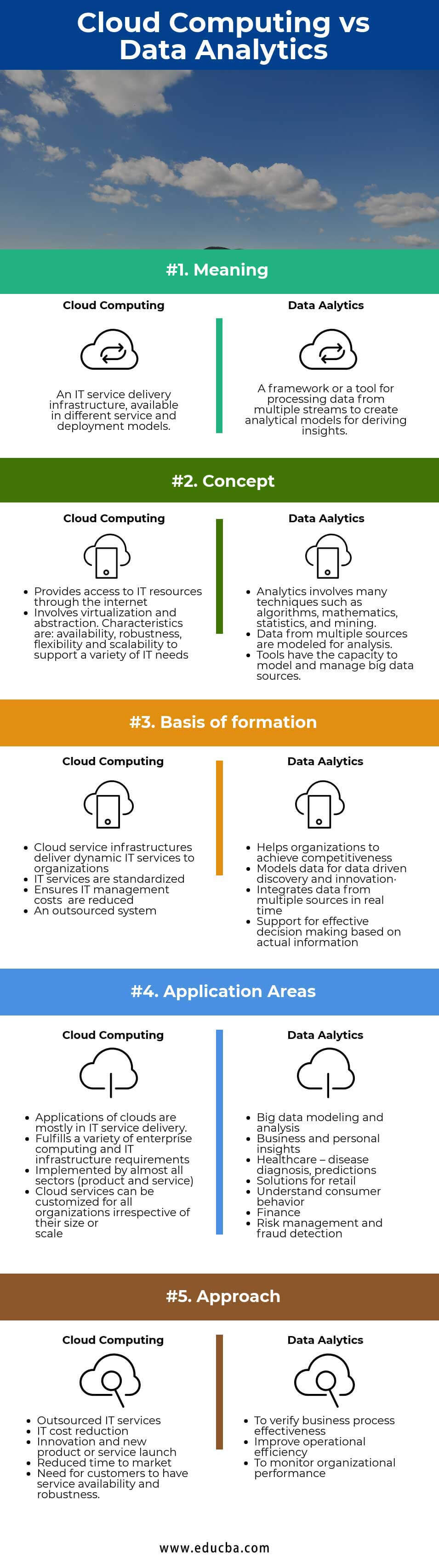
| Feature | Big Data Analysis | Cloud Computing |
|---|---|---|
| Definition | The process of collecting, processing, and analyzing large volumes of structured and unstructured data to extract insights. | Delivery of computing resources (servers, storage, databases, software, networking) over the internet. |
| Primary Purpose | Generate insights and support data-driven decisions. | Provide scalable IT infrastructure and services on demand. |
| Focus Area | Data processing, analytics, and visualization. | Computing power, storage, networking, and software delivery. |
| Main Components | Data collection, ETL, analytics tools, machine learning, visualization. | Virtual machines, storage, databases, networking, SaaS, PaaS, and IaaS services. |
| Typical Technologies | Hadoop, Spark, Kafka, Tableau, Power BI, Python, R. | AWS, Microsoft Azure, Google Cloud Platform, Oracle Cloud. |
| Deployment | On-premises, cloud-based, or hybrid. | Public cloud, private cloud, hybrid cloud, multi-cloud. |
| Data Volume | Handles petabytes and exabytes of data. | Handles computing and storage resources of any size. |
| Scalability | High, but depends on infrastructure. | Very high and elastic; resources can be scaled instantly. |
| Processing Speed | Batch processing and real-time analytics. | Depends on service and infrastructure used. |
| Users | Data scientists, analysts, researchers, business intelligence teams. | IT teams, developers, startups, enterprises, SaaS providers. |
| Business Goal | Discover trends, patterns, and predictions. | Reduce infrastructure costs and improve flexibility. |
| Pricing Model | Software licenses, infrastructure costs, data storage, and analytics tools. | Pay-as-you-go or subscription-based services. |
| Average Cost | Moderate to very high depending on data volume and tools. | Low to high depending on resource consumption. |
| Usability | Requires specialized knowledge in analytics and statistics. | Easier to adopt; many managed services require minimal expertise. |
| Benefits | Better decision-making, customer insights, fraud detection, predictive analytics. | Lower upfront investment, flexibility, global accessibility, disaster recovery. |
| Performance Dependency | Strongly depends on data quality and processing algorithms. | Strongly depends on internet connectivity and service provider reliability. |
| Security Concerns | Data privacy, governance, compliance. | Data security, access control, vendor lock-in. |
| Examples of Use | Market analysis, recommendation systems, healthcare analytics, fraud detection. | Website hosting, data storage, software delivery, backup and recovery. |
| Industries Using It | Finance, healthcare, retail, telecommunications, manufacturing. | Almost all industries including IT, banking, education, media, and government. |
Cost Comparison: Big Data Analysis and Cloud Computing
| Factor | Big Data Analysis | Cloud Computing |
|---|---|---|
| Initial Investment | High | Low |
| Maintenance Cost | Moderate to High | Low to Moderate |
| Scalability Cost | Expensive without cloud support | Pay only for resources used |
| Infrastructure Requirement | Often requires clusters and specialized hardware | No physical infrastructure required |
| Suitable for Startups | Moderate | Highly suitable |
Frequently Asked Questions
Q: Is cloud computing a type of big data technology?
A: No, cloud computing is not itself a big data technology — it is a broader infrastructure delivery model that supports many types of computing workloads, of which big data analysis is just one. Cloud computing also supports web hosting, application development, general business software, artificial intelligence model training, and countless other uses entirely unrelated to big data. However, cloud computing has become the dominant infrastructure platform on which big data analytics is performed, because of the scalability and cost efficiency it offers for the variable, resource-intensive workloads that big data processing typically requires.
Q: Can you do big data analysis without cloud computing?
A: Yes, technically — organisations can build and maintain on-premises infrastructure capable of running big data processing frameworks like Hadoop or Spark. Some organisations, particularly those with strict data sovereignty requirements, existing substantial data centre investments, or highly predictable and stable processing needs, do continue to run big data workloads on-premises. However, this approach typically requires significantly larger upfront capital investment, longer infrastructure deployment timelines, and ongoing maintenance overhead compared to using cloud-based big data services, which is why the overwhelming majority of new big data initiatives are built on cloud platforms from the outset.
Q: Which cloud platform is best for big data analytics?
A: The three major cloud providers — Amazon Web Services, Microsoft Azure, and Google Cloud Platform — all offer mature, capable big data analytics services, and the ‘best’ choice depends significantly on your organisation’s existing technology ecosystem, specific workload requirements, and team expertise. AWS offers the broadest range of big data services and the largest market share, with tools like EMR, Redshift, and Glue. Google Cloud is often favoured for analytics workloads due to BigQuery’s strong performance and its deep integration with machine learning tools. Azure tends to be the strongest choice for organisations already heavily invested in Microsoft’s enterprise software ecosystem. Most organisations evaluate based on existing vendor relationships, specific feature requirements, and pricing models rather than a universal ‘best’ answer.
Q: Do I need to learn cloud computing to become a data analyst or data scientist?
A: Increasingly, yes. While the core skills of data analysis — statistics, data manipulation, visualization, and domain expertise — remain platform-independent in principle, the practical reality of working in most modern data roles involves interacting with cloud-based data warehouses, cloud-hosted databases, and cloud-based analytics and machine learning platforms on a daily basis. Familiarity with at least one major cloud platform, understanding of cloud-based data warehouse tools like Snowflake, BigQuery, or Redshift, and basic cloud infrastructure concepts have become standard expectations in data analyst and data scientist job postings, even for roles that are primarily analytical rather than infrastructure-focused.
Q: Is big data analysis becoming obsolete because of AI and machine learning?
A: No — if anything, the relationship works in the opposite direction. Modern machine learning and artificial intelligence models, particularly large language models and deep learning systems, depend entirely on large, well-processed datasets for training, and big data analysis techniques are essential for preparing, cleaning, and structuring the massive datasets that power contemporary AI systems. Rather than making big data analysis obsolete, the AI boom has dramatically increased demand for big data skills, data engineering expertise, and the cloud infrastructure capable of supporting AI training and inference workloads at scale. Big data analysis and AI are increasingly intertwined disciplines rather than competing or sequential ones.
The Real Answer: Stop Choosing, Start Combining
If you have read this far hoping for a clean verdict declaring one technology the winner, here is the honest conclusion: big data analysis and cloud computing are not rivals competing for the same role in your technology stack or your career. They are complementary forces that, together, have fundamentally reshaped what is possible in modern data-driven decision-making.
Big data analysis gives you the techniques and tools to extract meaningful insight from datasets that have outgrown traditional methods. Cloud computing gives you the infrastructure flexibility and economic model to actually run that analysis at the scale and speed that modern data demands, without requiring the kind of capital investment that would put serious data analytics out of reach for all but the largest organisations.
The organisations and professionals who thrive in this environment are not the ones who pick a side in a false binary. They are the ones who understand both well enough to combine them effectively — using cloud infrastructure as the platform and big data techniques as the method, working together to turn raw information into genuine competitive advantage.
Build Skills in Both — Not Either
The data professionals winning today are fluent in both the analysis and the infrastructure. Start building that fluency now.
- Learn big data tools: Apache Spark, Hadoop, and Python for data analysis
- Get cloud-certified: AWS Certified Data Analytics, Google Cloud Professional Data Engineer, or Azure Data Engineer
- Practice with free tiers: BigQuery sandbox, AWS Free Tier, Azure free account
- Build a real project combining both: process a large public dataset using cloud infrastructure
The future belongs to those who combine the method with the machine.