
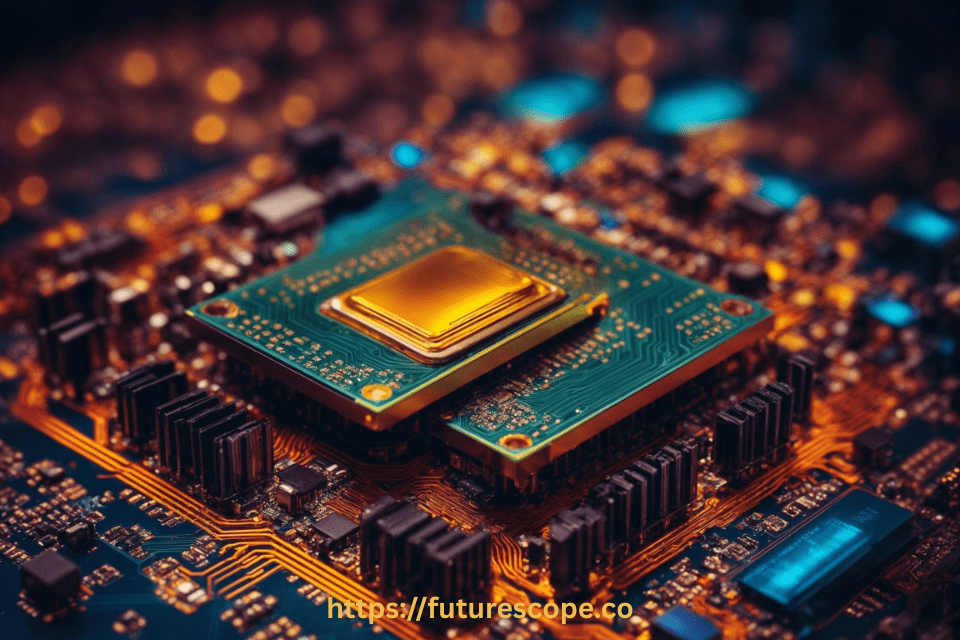

The world of technology has witnessed a historic moment with the exploring of the world’s first non-binary AI chip. For decades, computing has revolved around the binary system, where everything is represented as 0s and 1s. This model has powered the digital revolution, but it also comes with limitations. Now, researchers have successfully broken away from binary logic, creating a new chip that can process multiple states simultaneously, opening a new era for artificial intelligence (AI), machine learning, and advanced computing.
The Shift Beyond Binary
At the core of modern technology lies binary code, a two-state logic system that forms the foundation of all digital devices. Every smartphone, computer, and supercomputer depends on this model. However, binary computing often struggles to manage the increasingly complex demands of AI. Training large machine learning models consumes vast amounts of energy and time, and binary architecture has started to show its limits.
The newly developed non-binary AI chip changes this equation by introducing multi-value logic. Instead of being restricted to only 0 and 1, the chip can interpret multiple values in a single operation. This provides an entirely new way to compute, resembling how the human brain processes shades of meaning rather than absolute values.
What Makes the Non-Binary AI Chip Different?
Traditional computing relies on binary coding, which limits processing to two values. While this has powered decades of digital progress, it restricts the speed, flexibility, and intelligence of machines. The new non-binary AI chip breaks this barrier by supporting multi-value logic, enabling far more complex calculations in less time.
This means AI systems can process data with greater nuance and accuracy, closer to how the human brain works. Instead of interpreting only black and white, the chip can understand multiple shades of gray, improving machine learning, natural language processing, and advanced robotics.
How Does the Non-Binary AI Chip Work?
While traditional chips use transistors that flip between two states, the non-binary AI chip employs a design that supports more than two possible states per transistor. This allows for richer data encoding and drastically reduces the number of operations required for a given task.
In practice, this means the chip can analyze, learn, and adapt with greater efficiency. Complex problems such as natural language processing, predictive modeling, and image recognition become easier and faster to solve. With this innovation, AI can begin to operate with more nuance, handling ambiguity in a way much closer to human reasoning.

Key Benefits of Non-Binary AI Chips
The development of this new chip brings several major advantages that could transform the AI industry:
- Faster Processing – By allowing multiple states in a single operation, tasks that once required millions of steps can be executed in fewer cycles.
- Energy Efficiency – Lower power consumption makes these chips ideal for large-scale AI training, helping reduce the environmental footprint of data centers.
- Smarter Decision-Making – Multi-value logic enables AI to interpret data in richer ways, producing more accurate insights and predictions.
- Scalable Future Technology – This architecture is flexible, meaning it can adapt to more advanced AI models in the years ahead.
- Closer to Human-Like Thinking – The chip mirrors human cognitive flexibility by recognizing and processing multiple outcomes, rather than rigid binary choices.
Industry Impact: A Game-Changer Across Sectors
Experts predict that the non-binary AI chip will influence nearly every sector that depends on artificial intelligence.
- Healthcare: Advanced diagnostics and medical imaging could reach new levels of accuracy by analyzing vast patient data with greater detail.
- Finance: Banks and fintech firms may use these chips for fraud detection, algorithmic trading, and risk analysis with improved precision.
- Autonomous Vehicles: Real-time decision-making in complex traffic environments could become safer and more reliable.
- Robotics: Smarter and more adaptive robots could emerge, capable of functioning in unpredictable environments.
- Scientific Research: Complex simulations in physics, climate science, and biotechnology can be executed much faster.
The breakthrough is being compared to the introduction of GPUs (graphics processing units) in AI training, which revolutionized the industry a decade ago. Just as GPUs became essential for deep learning, non-binary chips could soon become the backbone of next-generation AI systems.
China Begins Production of World’s First Non-Binary AI Chips for Aviation and Manufacturing
China has officially taken the lead in next-generation computing by starting production of the world’s first non-binary AI chips, marking a significant milestone in the global race for advanced artificial intelligence hardware. Unlike traditional binary chips that operate on 0s and 1s, these revolutionary processors use multi-value logic, enabling machines to process data in multiple states at once.
China has already begun producing the world’s first non-binary AI chips for use in aviation and manufacturing. Industry sources report that these chips are being integrated into next-generation aircraft systems to improve navigation, predictive maintenance, and flight safety. In manufacturing, the chips are powering smart factories with real-time automation, predictive quality control, and advanced robotics. By taking the lead in production, China is positioning itself at the forefront of post-binary computing, signaling a new phase in global technological competition.
The breakthrough is being compared to the introduction of GPUs (graphics processing units) in AI training, which revolutionized the industry a decade ago. Just as GPUs became essential for deep learning, non-binary chips could soon become the backbone of next-generation AI systems.
Challenges and Roadblocks
Despite its potential, the non-binary AI chip faces some challenges before it can reach mainstream adoption. Manufacturing costs are expected to be higher than traditional chips, and the production process requires significant innovation. Moreover, most existing software frameworks are designed for binary architecture. For this technology to succeed, developers will need to create new algorithms, programming tools, and operating systems that can harness multi-value logic effectively.
Another concern is compatibility. The world’s computing infrastructure is deeply rooted in binary systems, meaning the transition will not happen overnight. Non-binary chips will likely operate alongside traditional chips for several years before gaining wider adoption.
A Step Toward Post-Binary Computing
The invention of the non-binary AI chip is more than just a technological advancement—it represents a philosophical shift in how humanity approaches computation. By moving away from rigid binary logic, researchers have opened the door to machines that can process uncertainty, ambiguity, and complexity in ways that resemble human cognition.
Industry analysts believe this development could eventually lead to post-binary supercomputers, where AI systems operate with unprecedented intelligence and energy efficiency. This could pave the way for breakthroughs in areas such as personalized medicine, space exploration, renewable energy management, and even artificial general intelligence (AGI).
The Road Ahead
While the non-binary AI chip is still in its early stages, its unveiling has already captured global attention. Technology companies, research institutions, and governments are closely watching this progress, anticipating the next phase of AI-driven innovation. If successfully scaled, this chip could not only accelerate AI but also redefine the fundamental architecture of computing.
The world’s first non-binary AI chip is more than a piece of hardware—it is a symbol of humanity’s ability to push past limitations and imagine a future where machines think in ways once thought impossible. As researchers continue refining the technology, the world stands on the brink of a new computing era.
Frequently Asked Questions
What is the world’s first non-binary AI chip?
It is a revolutionary processor that uses multi-value logic instead of binary code, allowing machines to process more complex data efficiently.
Why is it important for AI?
Non-binary chips improve speed, accuracy, and energy efficiency, making AI systems smarter and more human-like in their decision-making.
How is it different from traditional chips?
Unlike binary chips, which rely on two values, non-binary chips use multi-value logic, enabling richer and more complex data processing.
What industries will benefit most from this technology?
Healthcare, finance, robotics, autonomous driving, and scientific research are expected to see the biggest benefits.
Is the technology available now?
The first prototypes have been built, but large-scale adoption will take time as software and manufacturing ecosystems adjust.
Will non-binary chips replace binary chips completely?
Not immediately. They will likely complement traditional chips before eventually gaining wider use in advanced AI systems.