

Inkjet printers are slower than laser printers because they print by distributing ink droplets onto paper, a process that takes longer. Laser printers use a faster technology that fuses toner powder to paper with heat.
Choosing the right printer can often feel overwhelming, with the market flooded with various types and brands. If you’re in the middle of this decision-making process, understanding the key differences in printer technologies is crucial. Speed is a decisive factor for many, and this is where inkjet and laser printers diverge significantly.
With inkjets, the detailed method of spraying tiny ink droplets requires precision and time, which naturally limits the page per minute output. On the other hand, laser printers, designed for efficiency, quickly produce high-quality text and graphics by melting toner powder onto the paper. This difference is pivotal for offices or individuals where printing speed is essential, steering them towards laser printers for a more rapid turnaround.
Inkjet printer Vs. Laser Printer: Core Technologies
Understanding why inkjet printers are slower than laser printers involves delving into their core technologies. Each printer type has a distinct method of placing the image on paper. These differences greatly influence their speed and efficiency. Let’s explore these mechanisms to see why your office or home printer performs the way it does.
The Mechanism Of Inkjet Printing
Inkjet printers work by spraying tiny droplets of liquid ink onto paper. This precision requires a meticulous dance of tiny nozzles, making the process inherently slow. Here’s a simplified breakdown:
- Cartridges filled with liquid ink.
- Nozzles eject the ink drop by drop.
- Paper feeds through slowly to ensure accuracy.
The ink must dry, further reducing the printing speed. This method is great for high-quality color prints but doesn’t favor speed.
Laser Printing Process
Laser printers, in contrast, use a fast, efficient process to manage larger volume printing quickly. The key steps include:
- A laser beam draws the desired image on a drum.
- Toner (powder ink) sticks to the charged image on the drum.
- The image is transferred and fused to paper.
The process is continuous and fast. Toner also doesn’t require drying, accelerating the print time. This technology is ideal for speedy text document printing and for those needing efficiency.

Speed Factors of Printing
In the world of printing, speed stands as a critical factor for many users. Knowing why some printers sprint ahead while others take their time is essential. Inkjet and laser printers operate on entirely different mechanics and use various materials. This impacts their print speed quite significantly. Let’s dive deep into the reasons that contribute to these disparities in speed between inkjet and laser printers.
Ink Application And Drying Time
Inkjet printers spray liquid ink through microscopic nozzles onto paper. Each drop must settle and dry before the next layer. This process is intricate and demands time. It’s not just about laying down the ink; it’s the dry time that really adds to the overall printing process. Rush this, and you might end up with smudges or paper curls – and nobody wants that.
- Paper Absorption: Different papers absorb ink at various speeds, influencing total print time.
- Print Settings: High-quality prints require slower printing to deliver detailed images.
- Color Layers: Color prints may need multiple ink layers, increasing dry time.
Precision And Complexity Of Inkjets
Inkjet printers shine with precision and the ability to produce complex color patterns. They meticulously apply tiny ink droplets to create high-resolution images. This precision doesn’t come without a price. It requires the print head to move back and forth, making numerous passes over the paper. Each pass contributes to the overall printing time, which is why inkjet printers generally take longer than their laser counterparts.
| Inkjet Printers | Laser Printers |
|---|---|
| Multiple passes per page | Single pass per page |
| Precise droplet placement | Fast toner placement |
| High-resolution images | Speed prioritized over resolution |
Volume And Efficiency Considerations
Volume and efficiency are vital factors in the printing world. They determine how we choose our printers. If speed is the game, laser printers often take the lead. Understanding why can help us pick the right tool for our needs.
Designed For Different Printing Volumes
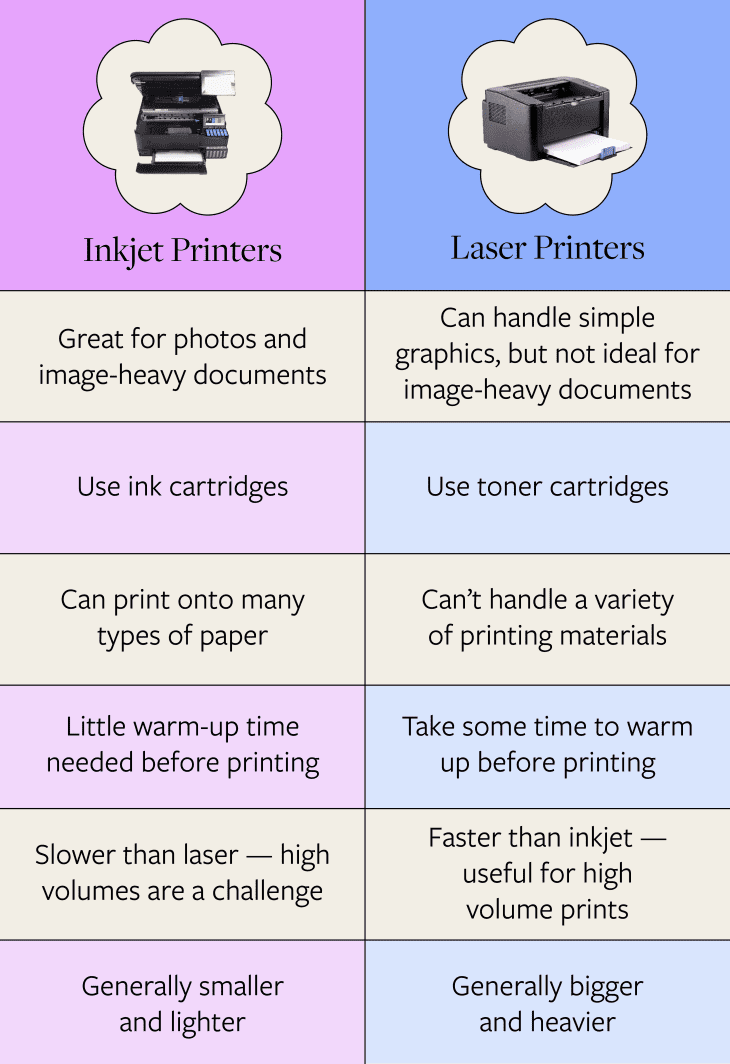
Inkjet and laser printers cater to different demands. Inkjets are ideal for low volume, high-quality print jobs. Laser printers shine in high-volume scenarios.
- Inkjet printers work well for home use.
- Laser printers are a go-to for offices.
Heat Up Time And Continuous Printing
Laser printers need to warm up. Once they do, they print non-stop. Inkjets can slow down to avoid overheating.
| Printer Type | Heat Up Time | Continuous Printing |
|---|---|---|
| Inkjet | Minimal | Intermediate |
| Laser | Longer | Extended |
Advancements And Improvements
Inkjet and laser printers differ in their printing processes. Understanding these differences reveals why inkjet printers typically lag behind in speed. But times are changing. Recent breakthroughs in inkjet technology are closing the speed gap between inkjet and laser devices.
Evolving Inkjet Technologies
Several improvements have emerged in the world of inkjet printing. Notably, precision printhead engineering and advanced ink formulas are pushing boundaries.
- Piezoelectric droplets: More accurate and efficient.
- Continuous inkjet: Higher speed with non-contact printing.
- High-viscosity inks: Dry faster, crisp prints.
These innovations mean faster printing times and improved printer performance.
Future Prospects For High-speed Inkjet Printing
The future looks bright for high-speed inkjet printing. Innovations such as Page Wide technology by HP show significant speed boosts. Technology Impact Page Wide Prints entire page in a single pass. Streamlined Print heads Reduces time between pages. Eco-friendly Cartridges Supports rapid ink delivery.
Rapid technological advancements mean that high-speed inkjet printers could soon rival or even surpass their laser counterparts.
Frequently Asked Questions For Why Are Inkjet Printers Slower Than Laser Printers?
Are Inkjet Printers Slower Than Laser Printers?
Generally, inkjet printers print more slowly than laser printers. Laser printers are designed for faster output, making them ideal for high-volume printing tasks.
Why Are Inkjet Printers So Slow?
Inkjet printers are often slower due to their intricate process of spraying tiny ink droplets onto paper to create detailed images and text.
Are Laser Printers Usually Faster At Printing?
Yes, laser printers typically print faster than inkjet printers, making them suitable for high-volume printing tasks.
Which Printer Is Fast Laser Or Inkjet?
Laser printers are generally faster than inkjet printers, offering quicker print speeds for high-volume tasks.
Conclusion
Understanding the disparity in speed between inkjet and laser printers helps inform your purchasing decisions. While inkjets are adept for photo quality and affordability, laser printers excel in speed and volume efficiency. Embrace each type’s strengths for your specific printing needs.
Choose wisely to optimize your home or office setup!