

The Hugging Face Reachy Mini is a groundbreaking entry in the world of AI-powered desktop robots, combining interactive capabilities, real-time learning, and open-source accessibility. Designed for developers, educators, and robotics enthusiasts, Reachy Mini is a compact yet powerful humanoid robot built to democratize artificial intelligence and robotics research. Developed in collaboration with Pollen Robotics and powered by Hugging Face’s open-source models, Reachy Mini introduces a new era of accessible, customizable desktop robots that seamlessly integrate machine learning and natural human-robot interaction.
Hugging Face, a powerhouse in the artificial intelligence (AI) community, is renowned for its platform hosting over 1 million AI models and hundreds of thousands of datasets. On July 9, 2025, the company made a bold leap into the robotics industry by opening orders for its Reachy Mini desktop robots. This launch represents a significant step toward democratizing robotics, making AI-powered robot development accessible to developers, educators, researchers, and enthusiasts worldwide. By combining affordability, open-source design, and integration with Hugging Face’s vast AI ecosystem, Reachy Mini is poised to transform how we interact with and learn about robotics.
What Is Reachy Mini?
Reachy Mini is a modular, humanoid desktop robot equipped with an expressive head, articulated arms, and camera-based vision. It’s built to mimic human behavior and gestures, learn from its surroundings, and engage in natural dialogue using Hugging Face’s transformer-based AI models like Transformers, Whisper, and DINO.
This robot is specifically designed to be developer-friendly—from AI research to educational demos, it offers a hands-on interface to experiment with cutting-edge models in speech recognition, vision, and interaction.
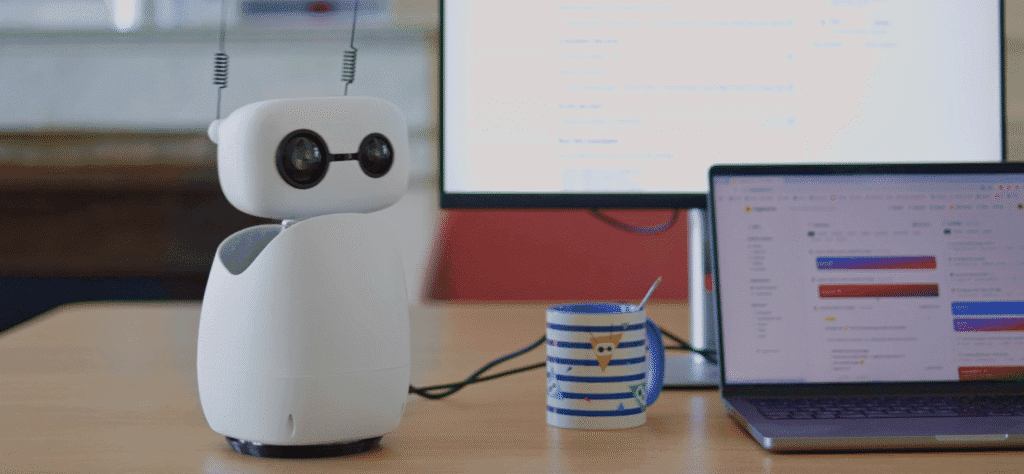
Standing at roughly the size of a standard stuffed animal, these robots are both functional and endearing, featuring dual screens for eyes and twin antennas that give them a friendly, approachable appearance. Hugging Face offers two versions of Reachy Mini to cater to diverse needs and budgets:
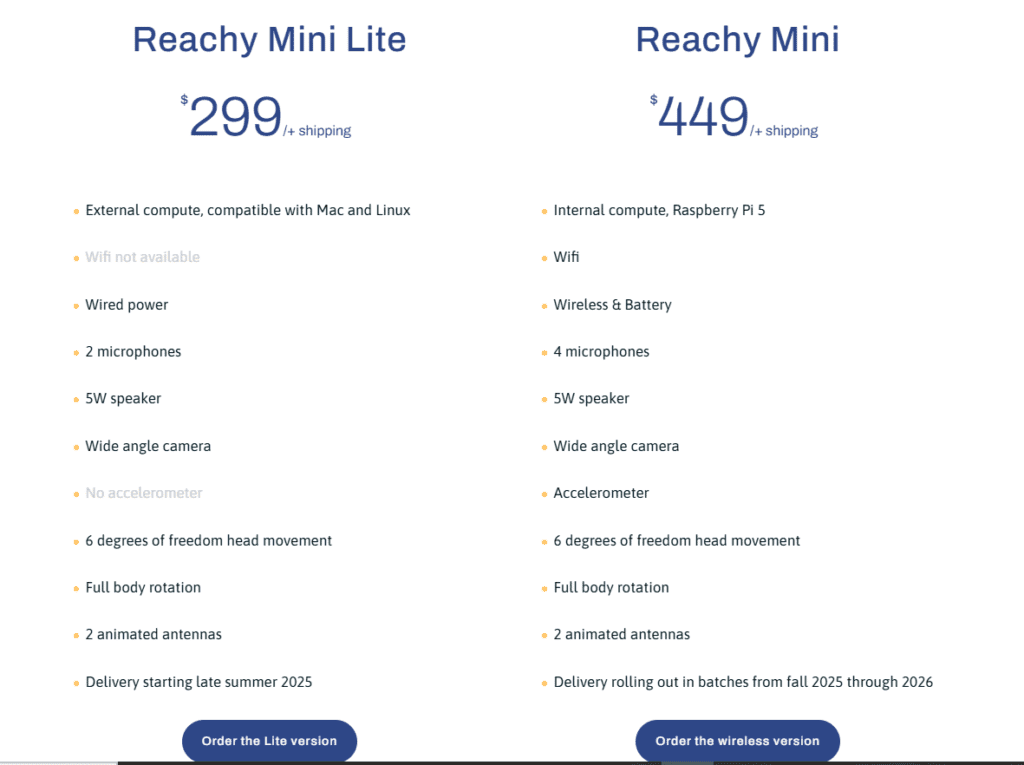
- Reachy Mini Wireless: Priced at $449, this model operates independently using a Raspberry Pi 5 mini computer, offering flexibility for standalone projects.
- Reachy Mini Lite: Available for $299, this version requires connection to an external computing source, making it a more budget-friendly option for those with existing hardware.
Both models are open-source and delivered as build-it-yourself kits, allowing users to assemble and customize their robots. This hands-on approach aligns with Hugging Face’s mission to foster collaboration and innovation within the AI and robotics communities, as highlighted by CEO Clément Delangue’s emphasis on preventing robotics from being dominated by a few closed-source giants.
Features and Specifications: Reachy Mini Desktop Robot
Reachy Mini robots are packed with features that make them an ideal platform for AI and robotics development. Below is a detailed overview of their capabilities:
| Feature | Description |
|---|---|
| Programmable in Python | Users can control and program the robots using Python, a widely-used language in the AI community, ensuring accessibility for developers. |
| Pre-installed Demos | Comes with 15+ pre-installed behaviors available on the Hugging Face Hub, enabling immediate experimentation upon assembly. |
| Community-Driven Development | Users can upload, share, and download new robot behaviors via the Hugging Face Hub, fostering a collaborative ecosystem. |
| Simulation SDK | Allows developers to test code in a virtual environment before receiving the physical robot, facilitating rapid prototyping. |
| Expressive Movement | Features motorized head and body rotation, plus animated antennas, for engaging human-robot interactions. |
These features make Reachy Mini a versatile tool for a range of applications, from creative prototyping and educational projects to advanced research in AI-driven robotics.
How to Use Reachy Mini Desktop Robot?
Reachy Mini is designed to be user-friendly for those with basic Python programming skills. The open-source Python SDK provides an intuitive interface for coding, with plans to support additional programming languages in the future. Integration with the Hugging Face Hub grants access to over 1.7 million AI models and more than 400,000 datasets, offering a wealth of resources for developing sophisticated AI applications.
For instance, a developer could use Reachy Mini to test facial recognition algorithms, create interactive educational tools, or build personalized robotic assistants. The simulation SDK further enhances usability by allowing users to experiment with their code in a virtual environment before receiving the physical robot, reducing barriers to entry and enabling rapid prototyping. The robots’ compact size and affordability make them suitable for classrooms, research labs, or even home setups, broadening their appeal to a diverse audience.
Why Reachy Mini Desktop Robot Game-Changer?
The Reachy Mini stands out because it bridges the gap between AI theory and real-world application. While most people interact with AI only through screens, this robot enables direct, physical engagement with AI models. Its affordability, open design, and Hugging Face ecosystem make it a valuable tool for developers looking to bring LLMs and multimodal AI to life.
Impact and Future
The launch of Reachy Mini is a pivotal moment in the democratization of robotics. By offering an affordable, open-source platform, Hugging Face is lowering the barriers to entry for individuals and institutions interested in robotics and AI. This initiative builds on the company’s acquisition of Pollen Robotics, which provided the technical expertise needed to develop these robots, and the launch of LeRobot, a dedicated robotics section on the Hugging Face platform. As noted by CEO Clément Delangue, the open-source nature of Reachy Mini ensures transparency and accessibility, preventing the robotics field from being dominated by a few large players with proprietary systems.
The potential impact of Reachy Mini is significant. It could inspire a new wave of AI-driven robotics applications, from educational tools that teach coding to advanced research prototypes that push the boundaries of human-robot interaction. The collaborative environment fostered by the Hugging Face Hub means that as more users contribute behaviors and models, the capabilities of Reachy Mini will continue to grow. However, as the robots are in an early development phase, users should expect some limitations and be prepared to provide feedback to help refine future iterations.
A $299 Robot? Hugging Face’s Latest Launch Might Redefine the Robotics Game
Conclusion
Hugging Face’s Reachy Mini desktop robots are a game-changer for the AI and robotics communities. Imagine having a small, friendly robot on your desk that can learn your name, recognize your face, and assist with tasks—all while you hone your coding skills and explore AI. That’s the promise of Reachy Mini. Whether you’re a student learning the basics of programming, a teacher looking to inspire the next generation, or a researcher pushing the boundaries of AI, this robot offers an accessible and exciting platform to bring your ideas to life. With orders now open, there’s no better time to dive into the world of robotics with Hugging Face. Visit Hugging Face’s blog to learn more or place your order today.
Frequently Asked Questions
What is the cost of an AI robot?
A typical AI robot’s cost varies based on size and capability. For example, the Reachy Mini, a compact open-source desktop humanoid robot by Hugging Face, is priced between $250 (Lite) and $449 (Wireless), offering head movement, speech, camera, and mic features—ideal for developers and educators. Larger AI robots, like Hugging Face’s full-size HopeJR humanoid, are around $3,000, while high-end commercial robots can cost tens of thousands of dollars, depending on complexity and use case.
What are mini robots used for?
Mini robots are used for education, research, and hobbyist development, offering a compact way to explore robotics and AI. For example, Reachy Mini by Hugging Face is an affordable, open-source desktop robot designed to teach programming, machine learning, and human-robot interaction. It can move its head, recognize speech, and respond using AI models, making it ideal for students, developers, and makers experimenting with conversational AI and robotics in a hands-on way.
Who is the most expensive robot?
The most expensive robot ever built is likely NASA’s Curiosity Rover, with a total mission cost of around $2.5 billion, including development, launch, and operations. In the commercial sector, humanoid robots like Honda’s ASIMO reportedly cost about $2.5 million, while advanced systems such as Boston Dynamics’ Atlas are valued at around $2 million. These cutting-edge machines illustrate the staggering expense behind groundbreaking robotics technology.
Can you buy an AI robot?
Yes, you can now purchase AI-powered robots for personal or educational use. For example, the Reachy Mini by Hugging Face and Pollen Robotics—a compact, open-source desktop humanoid—is available for pre-order at $299 for the wired Lite version, and $449 for the wireless model. Designed for developers and enthusiasts, Reachy Mini can move its head, listen, speak, and integrate with AI apps, making it a user-friendly gateway into robotics and embodied AI experimentation.