

You use the internet every single day. But do you know who decides what websites can exist, which country gets which domain, and how the whole system doesn’t collapse into chaos?
Let’s settle this once and for all: no single person, company, or government owns the internet. But that doesn’t mean it’s a free-for-all. There’s a surprisingly organised system running quietly behind the scenes — and at the centre of it sits a non-profit organisation most people have never heard of.
So who’s really in charge? Buckle up. This is one of the most fascinating rabbit holes in the history of technology.
First Things First: What Does “Owning the Internet” Even Mean?
The internet isn’t one thing you can own. It’s a network of networks — millions of cables, servers, routers, and wireless signals, owned by thousands of different entities around the world.
Think of it like the global road system. No one “owns” all the roads. Governments own some. Private companies own others. And there are agreed-upon rules about how they all connect.
The internet works the same way:
- Internet Service Providers (ISPs) like Comcast, BT, and Airtel own the physical cables and infrastructure in their regions.
- Tech giants like Google, Meta, and Amazon own massive private networks and data centres.
- Governments own and control parts of the internet within their borders.
- You own your own devices, your own home network — you’re part of it too.
But here’s the magic question: if nobody owns it, how does typing google.com take you to the same place every single time, anywhere in the world?
That’s where ICANN comes in.
Meet ICANN: The Quiet Architect of the Internet
ICANN stands for the Internet Corporation for Assigned Names and Numbers. It’s a non-profit organisation based in Los Angeles, California, founded in 1998.
ICANN doesn’t own the internet. But it coordinates the systems that make the internet work. Without it, the whole naming system would break down into complete anarchy.
Simple analogy: ICANN is like the global postal authority for the internet. It doesn’t own the post offices or the mail vans — but it decides the rules for how addresses work, so that a letter from Bangladesh always reaches the right destination in Brazil.
What Exactly Does ICANN Do?
This is where things get genuinely interesting. ICANN’s job is to manage the internet’s unique identifiers — the things that ensure the internet is consistent, secure, and stable for everyone on the planet.
1. The Domain Name System (DNS)
Every website has an IP address — a string of numbers like 142.250.74.46. But nobody types that into a browser. Instead, you type google.com.
The Domain Name System is the internet’s phonebook — it translates human-friendly names into machine-readable numbers. ICANN oversees the policies that govern this system globally.
2. Top-Level Domains (TLDs)
ICANN decides what domain extensions can exist. Those endings on website addresses? ICANN controls all of them.
- Generic TLDs (gTLDs): .com, .org, .net, .info, .biz — and newer ones like .app, .blog, .shop
- Country Code TLDs (ccTLDs): .uk (United Kingdom), .bd (Bangladesh), .de (Germany), .jp (Japan)
- Sponsored TLDs: .edu (education), .gov (US government), .mil (US military)
- New gTLD Programme: Since 2012, ICANN opened the floodgates — .amazon, .google, .nike, and thousands more were introduced
3. IP Address Allocation
Every device connected to the internet needs a unique IP address. ICANN works with five regional bodies (called RIRs — Regional Internet Registries) to allocate IP address blocks fairly around the world.
- ARIN — North America
- RIPE NCC — Europe, Middle East, Central Asia
- APNIC — Asia-Pacific (including Bangladesh)
- LACNIC — Latin America & Caribbean
- AFRINIC — Africa
4. Root Server Coordination
There are 13 root server clusters (labelled A through M) that form the backbone of the entire DNS. These are the authoritative sources for all domain name lookups on Earth. ICANN coordinates their operation — though the physical servers are operated by different organisations including NASA, ICANN itself, and Verisign.
5. Protocol Parameters
In coordination with the Internet Assigned Numbers Authority (IANA) — which ICANN operates — the organisation maintains registries for internet protocols. These are the agreed technical standards that allow your phone, laptop, and smart fridge to all speak the same language online.
“The internet is not one network. ICANN is the reason all those networks act like one.”
ICANN’s Organisational Structure — How Decisions Are Made
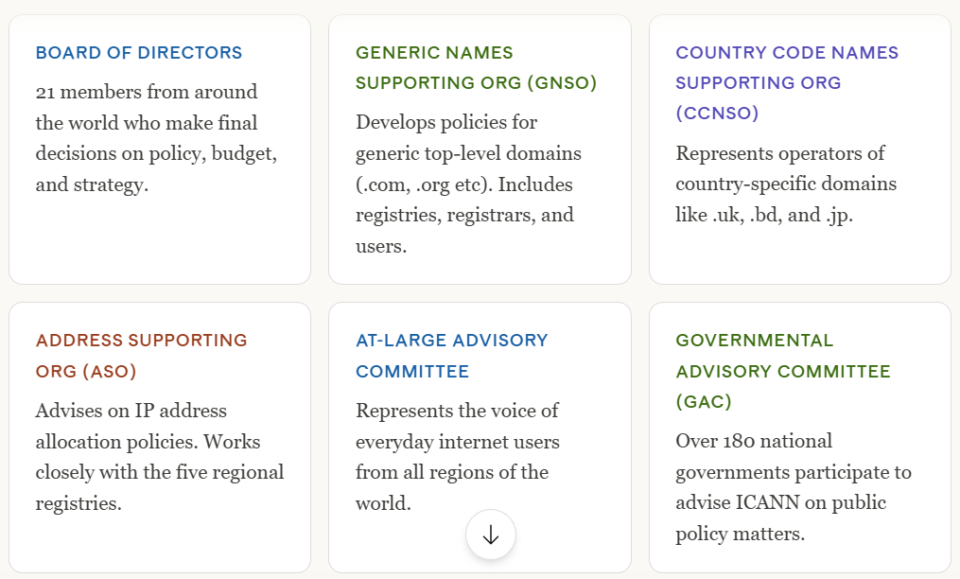
Here’s one of the most remarkable things about ICANN: it’s designed to be run by the global internet community, not by any single government or corporation. Its governance model is called the multistakeholder model.
A Brief History of ICANN — How We Got Here
1969
ARPANET is born — the early US military network that would become the internet. Jon Postel, known as the “God of the Internet,” manually maintained the first list of domain names.
1983
The Domain Name System (DNS) is formally created, replacing the single hand-maintained hosts file with a distributed hierarchy.
1998
ICANN is founded by the US Department of Commerce to take over coordination duties from the US government and Jon Postel. It launches as a non-profit in California.
2012
ICANN launches the New gTLD Programme, dramatically expanding the number of domain endings available. Over 1,900 applications are received.
2016
A historic shift: ICANN formally severs its contractual relationship with the US government and transitions to full multistakeholder governance — a massive moment for internet freedom globally.
At Present
ICANN operates as a fully independent international organisation, managing a domain ecosystem worth billions of dollars and serving 5+ billion internet users worldwide.
Controversies and Criticisms — It’s Not All Perfect
ICANN has been at the centre of some serious debates over the years. Here are the most prominent ones:
- US Government bias: For years, critics argued that having a US-based non-profit with a US government contract gave America disproportionate control over the global internet.
- Domain name speculation: When ICANN releases new TLDs, wealthy individuals and corporations often buy up thousands of names to resell them — pricing out small businesses and non-profits.
- Lack of transparency: Many stakeholders argue that ICANN’s complex structure and consensus-based process makes real accountability difficult.
- WHOIS privacy debate: ICANN’s WHOIS database (which lists domain ownership) has long been in tension with global privacy regulations like Europe’s GDPR.
- Content moderation pressure: Governments occasionally pressure ICANN to revoke domains hosting illegal content — raising hard questions about censorship vs. safety.
So Who Really “Controls” the Internet?
If you’re looking for one villain or one hero to pin internet control on — you won’t find one. The power is genuinely distributed. Here’s a quick map of who controls what:
The Power Map of the Internet
- ICANN — controls domain names and IP address coordination
- Internet Engineering Task Force (IETF) — sets the technical standards and protocols (TCP/IP, HTTP, etc.)
- Internet Society (ISOC) — promotes open internet development globally
- National Governments — regulate internet use within their own borders
- ISPs & Telecoms — control physical access to the internet
- Big Tech (Google, Meta, Amazon) — control enormous swathes of online activity and infrastructure
- You — control your own data, devices, and online behaviour
Why This Matters for You — Even If You’re Not a Tech Person
Understanding internet governance isn’t just for engineers and policy wonks. Here’s why it matters to every person who goes online:
- Domain security: ICANN’s DNSSEC protocols help protect you from being redirected to fake websites by hackers.
- Access and equity: How IP addresses are allocated affects whether developing countries get fair access to internet resources.
- Free speech vs censorship: Debates about who controls domains directly shape what content can exist online.
- Your business online: If you run a website, ICANN’s policies directly affect your domain registration costs, rights, and options.
- Internet fragmentation: Without coordination bodies like ICANN, we risk a “splinternet” — multiple incompatible national internets that can’t talk to each other.
The internet as a single, universal, interoperable network is not guaranteed. It requires constant coordination, negotiation, and governance. ICANN is a key part of that fragile architecture.
Quick Summary: ICANN Fast Facts
- Full name: Internet Corporation for Assigned Names and Numbers
- Founded: 18 September 1998, Marina del Rey, California, USA
- Type: Non-profit, multi-stakeholder organisation
- Headquarters: Los Angeles, California (with offices in Brussels, Singapore, Istanbul, and Washington DC)
- CEO/President: Changes periodically; appointed by the Board
- Primary function: Coordinate unique identifiers for the global internet
- Revenue model: Funded primarily by domain name registration fees paid by registrars
- Languages: Operates across all UN official languages and many others
- Key partner: Operates IANA (Internet Assigned Numbers Authority)
- Member participation: Open to anyone — businesses, civil society, governments, individuals
Now You Know the Truth — What Will You Do With It?
The internet belongs to all of us. But it only stays open, free, and interoperable if people like you stay curious, informed, and engaged with how it’s governed.Explore More About Internet Governance ↗
Share this post with someone who thinks “nobody runs the internet“.
Related posts:
 The Internet Has No President — So Who Actually Makes the Rules? Inside the Multistakeholder Model
 What is DNSSEC and Why Is It Important for Internet Security? Here’s What DNSSEC Actually Does
 If a Government Decides to Pull the Plug on the Internet — Can ICANN Actually Stop Them?
 How ICANN and IGF Are Trying to Keep the Internet Open in Conflict Zones?