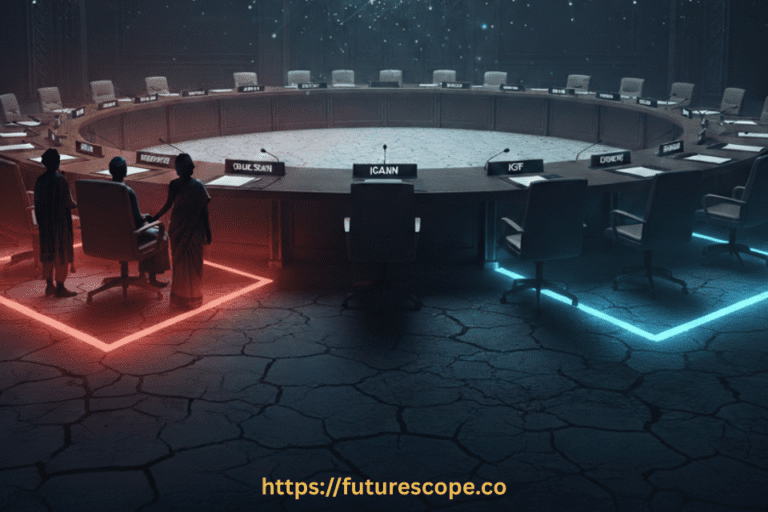

No government runs the internet. No CEO calls the shots. Yet it works — for five billion people, every single day. The secret? A radical governance experiment called the multistakeholder model. Here’s everything you need to know.
Imagine building a system used by over five billion people, spanning 190+ countries, with no president, no parliament, and no central authority — and having it work seamlessly. That’s not a fantasy. That’s the internet. And it runs on a governance philosophy called the multistakeholder model.
It sounds academic. It sounds dry. But this model is one of the most important and quietly radical ideas in modern politics — and it directly affects whether the internet you use stays open, free, and globally connected.
Let’s break it down, plain and simple.
What Is the Multistakeholder Model of Internet Governance?
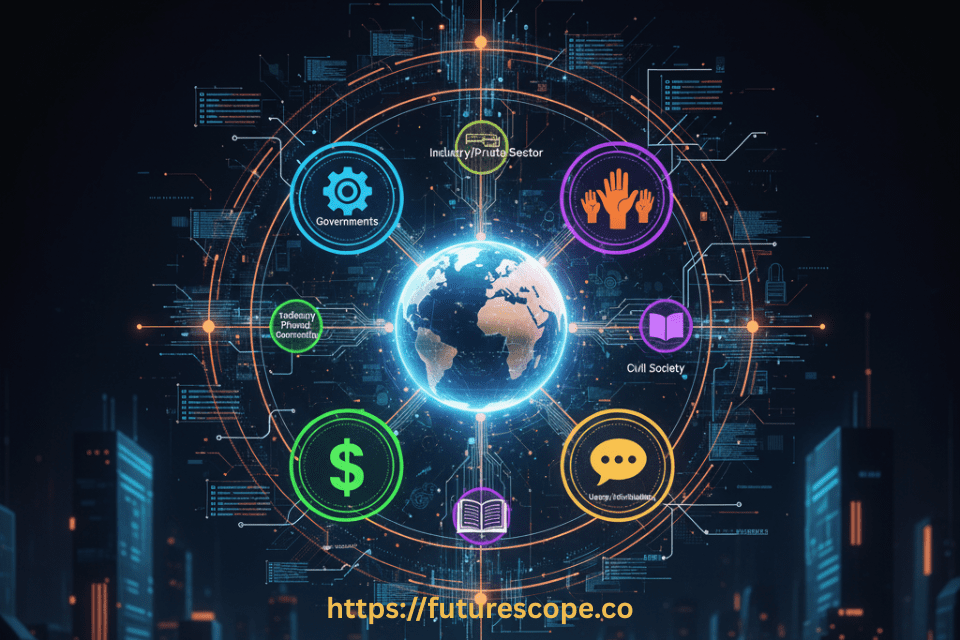
At its core, the multistakeholder model of internet governance is a framework where decisions about the internet are made collaboratively — not by one government or one organisation, but by multiple groups representing different interests.
These groups — or “stakeholders” — include:
Governments
National governments and intergovernmental bodies advise on public policy and national interests.
Private Sector
Corporations, tech companies, ISPs, and domain registrars who build and run internet infrastructure.
Civil Society
NGOs, human rights organisations, digital rights advocates, and community groups.
Technical Community
Engineers, researchers, and standards bodies like IETF, ICANN, and IEEE who maintain protocols.
End Users
Everyday people — you and me — represented through advisory bodies and user groups.
The key word is collaborative. Each group has a seat at the table. No single stakeholder can unilaterally decide the rules for everyone else.
One-line definition: The multistakeholder model of internet governance is the principle that all groups affected by internet policy should have a meaningful voice in shaping it — not just governments.
Why Did We Need This Model in the First Place?
The internet was born inside a US government research project (ARPANET) in the late 1960s. For decades, it was technically managed by a handful of American academics — most famously Jon Postel, who literally kept a hand-typed list of every domain name.
As the internet went global in the 1990s, it became obvious that one country’s government managing a resource used by the entire planet was not going to work long-term.
The options on the table were:
- Give control to the United Nations — a government-heavy body, which critics feared would let authoritarian states censor the internet.
- Let the US government keep running it — giving one country veto power over a global resource.
- Create a purely private, corporate-led model — handing enormous power to tech giants with commercial interests.
- Build a new kind of governance — one that included everyone.
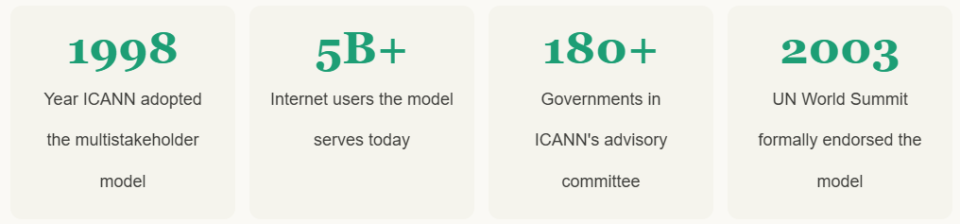
The fourth option won. And in 1998, ICANN was born as the first major institution built on the multistakeholder model of internet governance.
How Does It Actually Work in Practice?
Great question. The model isn’t just a philosophy — it’s a functioning system with real processes. Here’s how it operates across different internet governance bodies:
At ICANN
ICANN manages domain names and IP addresses. Its policy decisions are made through a bottom-up, consensus-based process. Anyone — including you — can participate in public comment periods. Working groups include representatives from governments, business, civil society, and the technical community simultaneously. No single group has veto power.
At the Internet Governance Forum (IGF)
The IGF is a United Nations body — but with a twist. Unlike typical UN forums, governments don’t get special status. Business leaders, activists, engineers, and citizens all participate on equal footing. It’s a discussion platform, not a decision-making body — which is both its strength and its most common criticism.
At the IETF
The Internet Engineering Task Force develops the technical protocols that make the internet work. Its process is radically open — anyone can propose a standard. Decisions are made by “rough consensus and running code,” not by voting or government mandate.
At National Level
Many countries have adopted multistakeholder advisory councils for national internet policy — bringing together government ministries, ISPs, civil society, and user groups before passing legislation.
“The internet is too important to be governed by any one group — and too technical to be governed by none.”
The Multistakeholder Model vs. the Multilateral Model
Here’s where it gets political. There are two competing visions for how the internet should be governed — and the tension between them is one of the defining geopolitical debates of our era.
| Multistakeholder Model | Multilateral Model |
| All groups have a voice | Only governments decide |
| Bottom-up, consensus-driven | Top-down, treaty-based |
| Decentralised by design | Centralised through the UN/ITU |
| Resists censorship and overreach | Easier for states to enforce control |
| Favoured by the US, EU, civil society | Favoured by Russia, China, some others |
| Can be slow and complex | Risks enabling state censorship |
The battle lines are real. At the 2012 World Conference on International Telecommunications (WCIT), Russia, China, and several other nations pushed for moving internet governance control to the International Telecommunication Union (ITU) — a UN body where only governments vote.
The multistakeholder model survived. But the debate never truly ended.
Why this matters right now: The risk of "internet fragmentation" — where different countries operate incompatible, isolated versions of the internet — is directly tied to who wins this governance debate. A world of splintered internets is a world where the global, open web we know today no longer exists.
Real-World Examples of the Multistakeholder Model in Action
This isn’t just theory. Here are moments when the multistakeholder model shaped the internet you use every day:
ICANN 2016 Transition
The US government handed stewardship of the internet’s core naming functions to the global multistakeholder community — a historic moment years in the making.
GDPR & WHOIS
Civil society groups and EU regulators successfully pushed ICANN to reform its public domain ownership database to comply with privacy rights — a win for user advocates.
New gTLD Programme
Community groups, businesses, and individuals participated in years of public consultations before ICANN launched 1,200+ new domain extensions like .shop, .app, and .africa.
IETF & Encryption
Technical experts and civil society groups pushed through stronger default encryption standards (TLS 1.3) against resistance from some governments who wanted surveillance access.
Strengths of the Multistakeholder Model
- Legitimacy through inclusion: When everyone has a voice, outcomes have broader acceptance and trust.
- Expertise at the table: Technical decisions benefit from engineers in the room; rights decisions benefit from civil society advocates.
- Resilience against capture: Harder for any one government or corporation to seize control when power is distributed.
- Transparency: Most multistakeholder processes are open to public comment and scrutiny.
- Flexibility: The model can adapt quickly to new technologies without waiting for international treaties to be ratified.
- Global in spirit: Participation is open to anyone from any country, not just those with powerful delegations.
Criticisms and Challenges
No governance model is perfect. The multistakeholder model has real weaknesses that its supporters openly acknowledge:
- Power imbalances: Not all stakeholders are truly equal. Well-funded corporations and wealthy-country governments often have far more capacity to participate than grassroots groups from the Global South.
- Slow decision-making: Building consensus among diverse, competing interests takes time — sometimes years. The internet moves faster than the governance process.
- Accountability gaps: Who do multistakeholder bodies answer to? There’s no election, no democratic mandate in the traditional sense.
- Complexity: The ecosystem of bodies — ICANN, IGF, IETF, RIRs, ccTLDs — is genuinely difficult for ordinary people to navigate and participate in.
- Corporate capture risk: If civil society and users are weak participants, large tech companies can dominate outcomes under the guise of “multistakeholder” processes.
The honest truth: The multistakeholder model is not a perfect democracy. But its supporters argue it is far better than the realistic alternatives — either government-dominated control or pure corporate governance. It is, in the words of many internet scholars, "the least bad option."
Why Should You Care About This?
Here’s the thing most people miss: internet governance isn’t just for techies and diplomats. Every time you:
- Access a website that hasn’t been blocked by your government
- Use HTTPS encryption to protect your banking details
- Register a domain name in your own country’s language
- Complain about a data privacy violation and get action
- Connect to the same internet as someone on the other side of the world
…you are benefiting from the multistakeholder model of internet governance working as intended.
And every time a government blocks a website, throttles an app, or proposes moving internet control to the UN, the multistakeholder model is what stands in the way.
This isn’t abstract policy. It’s the architecture of your digital rights.
Quick Recap: Everything You Need to Know
- The multistakeholder model of internet governance means decisions are shared across governments, business, civil society, technical experts, and users
- It was formalised through ICANN in 1998 and endorsed by the UN World Summit in 2003 and 2005
- It stands in contrast to the multilateral (governments-only) model favoured by Russia, China, and others
- Key institutions that operate under this model include ICANN, IGF, IETF, and regional internet registries
- Its biggest strengths: inclusion, legitimacy, resistance to censorship
- Its biggest weaknesses: slow processes, power imbalances, accountability gaps
- The future of the open internet depends on this model surviving geopolitical pressure
Your Voice Belongs in This Conversation
Internet governance isn’t just for experts. The multistakeholder model only works when more people — including everyday users — show up, speak up, and hold power to account. Don’t let governments and corporations decide the internet’s future without you.Learn How to Get Involved.
Share this with someone who thinks internet governance doesn’t affect them.
Related posts:
 Nobody Owns the Internet — But Someone Does Run It. The Surprising Truth About ICANN
 What is DNSSEC and Why Is It Important for Internet Security? Here’s What DNSSEC Actually Does
 If a Government Decides to Pull the Plug on the Internet — Can ICANN Actually Stop Them?
 How ICANN and IGF Are Trying to Keep the Internet Open in Conflict Zones?