


If you use proxies for data scraping, social media management, or online privacy, you’ve probably come across the terms static proxy and rotating proxy. Both types serve the same basic purpose — hiding your real IP address and replacing it with another — but they work in very different ways.
Choosing the right type of proxy can make or break your online project. Pick the wrong one, and you might face blocked connections, failed requests, or wasted money. But pick wisely, and you’ll get smoother browsing, faster automation, and more reliable anonymity.
In this article, we’ll break down everything you need to know about static vs rotating proxies, including how they work, their pros and cons, and the best situations to use each.
What Are Proxies and Why Do They Matter?
A proxy server acts as a gateway between your device and the internet. Instead of connecting directly to websites, your requests are routed through the proxy, which assigns a different IP address. This helps bypass geo-restrictions, avoid IP bans, and maintain anonymity.
Proxies are essential for:
- Web scraping and data mining
- Managing multiple social media or eCommerce accounts
- Bypassing geo-blocks
- Enhancing online privacy
- Automating tasks and bots
But not all proxies are created equal. The choice between static and rotating proxies depends on your specific goals.
What Are Static Proxies?
A static proxy (also known as a dedicated proxy) provides you with a single IP address that remains the same every time you connect. This IP doesn’t change — it stays consistent throughout your session, day after day, unless you manually switch it.
Static proxies are typically hosted on data center servers or provided by internet service providers (ISP proxies). Since they maintain one stable IP, websites see you as a consistent visitor — which is useful when you want long-term access without being flagged as suspicious.
For example, if you log into multiple social media accounts, you don’t want your IP to change every few minutes. A static proxy lets each account stick to one unique IP, maintaining trust and avoiding detection.
Pros
- Stable IP: You maintain a fixed identity online.
- Fast Speed: Less IP rotation means lower latency.
- Consistent Sessions: Ideal for long-term logins or applications that require the same connection. /li>
- Easy Setup: Usually plug-and-play with minimal configuration.
Cons
- Easier to Detect: Since the IP doesn’t change, websites can recognize patterns.
- Limited Anonymity: Not ideal for scraping or stealth tasks.
- Higher Ban Risk: If one IP gets blocked, you need to replace it manually.
What Are Rotating Proxies?
A rotating proxy automatically switches your IP address at set intervals or after each connection request. Instead of one permanent IP, you get access to an entire pool of proxy IPs that rotate in the background.
Rotating proxies are mostly residential or mobile proxies, which use real-user connections. Every time you send a new request — for example, when scraping data or accessing multiple pages quickly — the system assigns a different IP.
This makes rotating proxies ideal for web scraping, SEO monitoring, ad verification, and any activity where you need to avoid being blocked or rate-limited. Because each request looks like it’s coming from a new user, websites have a harder time detecting automation.
Pros
- High Anonymity: Each IP change helps you stay undetected.
- Automated Rotation: No manual IP switching required.
- Bypass Restrictions: Easily avoid IP bans, rate limits, or blocks.
- Scalability: Perfect for handling thousands of requests simultaneously.
Cons
- Speed Variation: Frequent switching can slow down connection speed.
- Session Instability: May cause logouts or captcha challenges on some sites.
- More Expensive: Often costs more due to the size of IP pools.
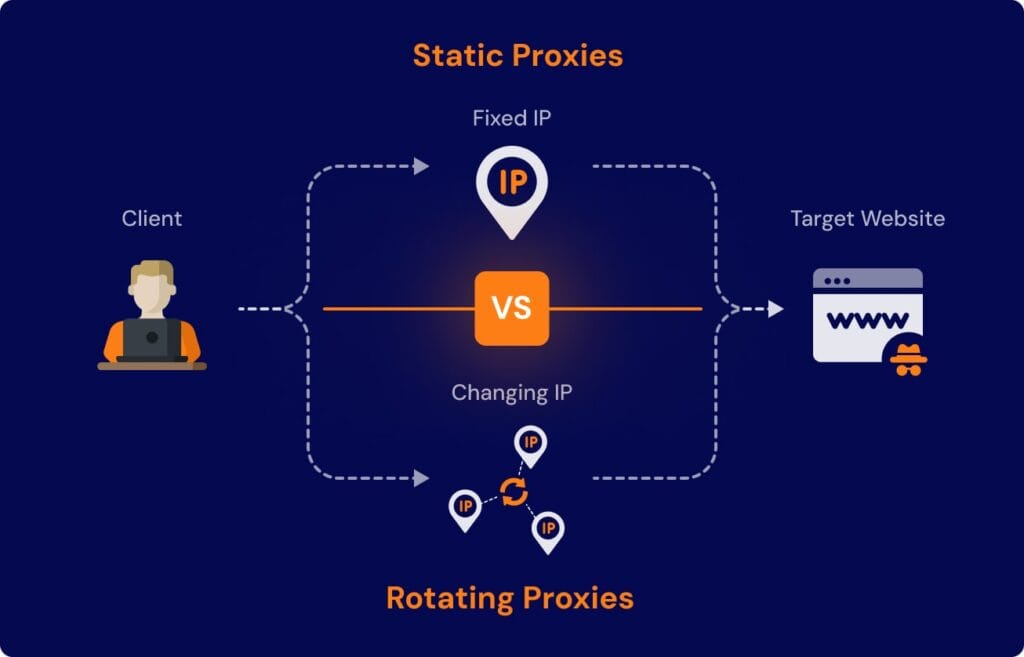
Static vs Rotating Proxies: Head-to-Head Comparison
| Feature | Static Proxy | Rotating Proxy |
|---|---|---|
| IP Consistency | Fixed | Changes per request/session |
| Anonymity | Moderate | High |
| Speed | Fast | Variable |
| Detection Risk | Higher | Lower |
| Setup Complexity | Simple | Moderate |
| Best For | Account management, login sessions | Scraping, automation, bypassing blocks |
| Cost | Often cheaper | Typically more expensive |
Technical Considerations
1. IP Reputation: Static proxies can build a reputation over time, which is beneficial for trusted interactions. Rotating proxies, while anonymous, may use IPs with unknown or poor reputations, especially if sourced from free or low-quality providers.
2. Session Management: Static proxies are ideal for maintaining session continuity. Rotating proxies can disrupt sessions if the IP changes mid-request, which may lead to errors or failed logins.
3. Scalability: Rotating proxies are better suited for scaling operations. If you need to send thousands of requests per minute, rotating proxies distribute the load across multiple IPs, reducing the chance of bans.
4. Geo-targeting: Both types can offer geo-targeting, but rotating proxies often provide more granular control over location diversity.
Now, let’s dive deeper into each one to understand when and why you should use them.
When to Use Static Proxies?
Static proxies shine in scenarios where consistency, reliability, and identity trust matter most. Because your IP doesn’t change, you appear as a stable and legitimate user to websites and online platforms.
Here are some of the most common use cases:
1. Social Media Management
If you handle multiple social accounts for clients or brands, using the same IP each time is essential. Platforms like Facebook, Instagram, and Twitter flag accounts that log in from different IPs frequently. Static proxies let you assign one unique IP per account to build a trusted online identity.
2. E-Commerce and Online Shopping
When monitoring product listings or checking prices on specific platforms, a static proxy helps you avoid session interruptions. You can stay logged in for hours without your connection resetting.
3. Gaming and Streaming
For online gaming, streaming, or account-based apps, a stable IP ensures consistent latency and avoids login challenges. It also helps bypass geo-restrictions for services limited to the UK, US, or other regions.
4. Business and Remote Work
Companies that need secure access to internal systems often rely on static IPs to whitelist trusted devices. It adds a layer of security and simplifies permission management.
In short:
Use static proxies when you value connection stability, identity consistency, and faster performance over constant anonymity.
When to Use Rotating Proxies?
Rotating proxies are the opposite — they excel in situations that require high anonymity, large-scale automation, or data collection.
Each new request gets a new IP, which makes it almost impossible for websites to detect patterns or block your activity.
Here are the top scenarios where rotating proxies are the best choice:
1. Web Scraping and Data Mining
If you collect data from websites, rotating proxies are your best friend. With each request coming from a new IP, you can scrape thousands of pages without being blocked. This is especially useful for price comparison, SEO data, and e-commerce analytics.
2. SEO Monitoring
SEO professionals use rotating proxies to track keyword rankings, analyze competitors, and monitor backlinks across multiple regions. Using the same IP for these tasks can lead to CAPTCHAs or bans, but rotating proxies keep the process smooth.
3. Ad Verification
Ad verification companies use rotating proxies to check how ads appear to users in different regions. By switching IPs, they can test ad placement across multiple UK or global locations.
4. Sneaker Bots and Ticketing
Rotating proxies are a must for sneaker copping, ticket purchasing, and similar automation tools. Since multiple IPs are used simultaneously, you can avoid being flagged for suspicious activity.
In short:
Use rotating proxies when you need maximum anonymity, large-scale automation, and data flexibility.
Which One Should You Choose?
The right choice depends entirely on your goal. Let’s simplify it:
| Your Goal | Best Choice | Why |
|---|---|---|
| Manage multiple accounts | Static Proxy | Stable IP ensures each account remains trusted |
| Scrape large datasets | Rotating Proxy | Multiple IPs prevent blocking |
| Access region-locked content | Static Proxy | Steady connection works better for streaming |
| Perform SEO or ad testing | Rotating Proxy | You can view results from various locations |
| Run bots or automation tools | Rotating Proxy | High anonymity and flexibility |
| Maintain online privacy for daily use | Static or Rotating | Both protect your real IP; rotating adds extra anonymity |
How to Combine Both for Best Results?
In many cases, the smartest approach is to use both static and rotating proxies together.
For example, a digital marketer might:
- Use static proxies to manage client accounts safely.
- Use rotating proxies for web scraping and keyword tracking.
By combining both, you get the speed and reliability of static IPs and the anonymity and flexibility of rotating ones. Some proxy providers even allow you to switch modes within the same account — giving you the best of both worlds.
Top Proxy Providers Offering Both Static and Rotating Options
If you’re ready to get started, here are a few trusted proxy providers that offer both types of proxies with strong UK and global coverage:
- Bright Data (Luminati) – Advanced residential, mobile, and data center proxies with static and rotating modes.
- Smartproxy – Affordable and beginner-friendly with a mix of static and rotating IPs.
- Oxylabs – Enterprise-grade proxies suitable for large-scale automation.
- Soax – Clean, reliable residential and mobile proxies with flexible rotation settings.
- ProxyEmpire – Trusted provider with automatic IP rotation and customizable plans.
Final Thoughts
When comparing static vs rotating proxies, the key is understanding your specific goal.
- If you need stability and trust, go with static proxies.
- If you need anonymity and flexibility, choose rotating proxies.
Both have powerful advantages, and in many modern use cases, the best solution is a combination of both.
Whether you’re scraping data, running social media accounts, or testing ads, using the right proxy type will make your work faster, safer, and more efficient.
Frequently Asked Questions
Are rotating proxies better than static proxies?
Not always. Rotating proxies are better for web scraping and automation, while static proxies are better for account management and stability.
Can I switch from a static to a rotating proxy easily?
Yes. Many providers allow users to toggle between both options depending on their task.
Do rotating proxies slow down your internet?
Slightly — IP rotation adds a small delay, but it’s usually unnoticeable for most use cases.
Are static proxies more secure?
They’re secure but less anonymous. Rotating proxies offer higher anonymity levels.
Which is cheaper — static or rotating proxies?
Static proxies are generally cheaper, while rotating proxies cost more due to large IP pools and rotation features.