
| Most people think they understand AI — until they realize they’ve been mistaking a parrot for a pilot. Chatbots answer questions. AI Agents take action. Here’s the difference, and why it matters more than ever. |
Let’s be honest. When ChatGPT exploded onto the scene, everyone called everything “AI.” But lumping chatbots and AI Agents into the same category is like comparing a calculator to a CFO. They share some DNA, sure — but they operate in entirely different leagues.
If you’re building a business, automating workflows, or just trying to understand where this technology is heading, you need to know the real distinction between an AI Agent vs chatbot.
So, what exactly is a chatbot?
A chatbot is a reactive system. It waits for your message, processes it, and fires back a response. That’s it. Even the most sophisticated large-language-model-powered chatbots operate on this loop:
- You send a prompt
- The model generates a text response
- The conversation resets (or continues with memory, in better systems)
- It does nothing without your explicit input
Chatbots are brilliant at Q&A, drafting, summarizing, and explaining. But they’re fundamentally passive. They don’t browse the web unprompted, book your meetings, or trigger a refund in your CRM — not on their own.
Common Uses of Chatbots
Businesses typically use chatbots for:
- Answering frequently asked questions
- Providing basic customer support
- Booking appointments
- Guiding users through simple workflows
- Collecting customer information
Platforms such as Dialogflow and ManyChat have made chatbot development accessible to businesses without heavy programming knowledge.
However, traditional chatbots have limitations.
So, What Is an AI Agent?
An AI agent is a far more advanced system designed to understand goals, reason through tasks, and take actions autonomously.
Instead of just responding to questions, AI agents can:
- Plan steps
- Use tools
- gather information
- perform actions
- adapt to changing contexts
Many modern AI agents are powered by large language models (LLMs) and advanced orchestration frameworks.
For example, platforms built around technologies from OpenAI and Microsoft are enabling AI agents that can complete complex workflows instead of simply chatting.
Now, what makes an AI Agent different?
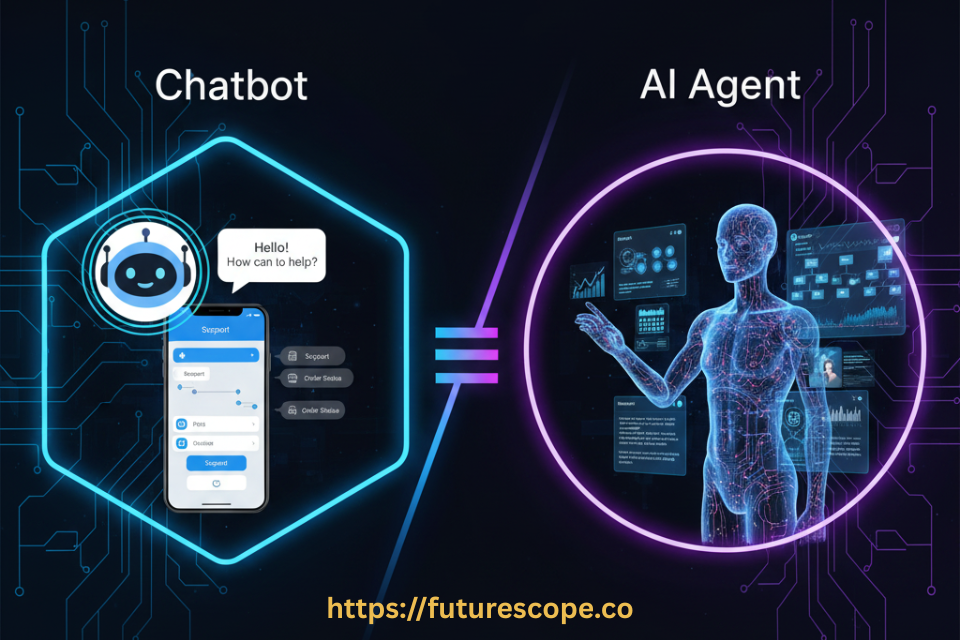
An AI Agent is proactive, goal-directed, and autonomous. Instead of just answering your question, it plans, executes, and adapts — often with minimal human hand-holding.
| Chatbot | AI Agent |
| → Reactive to your prompt → Single-turn or simple memory → Text output only → No tool access by default → Waits for instructions → No environment awareness | → Goal-driven & proactive → Persistent memory & context → Actions: browse, code, call APIs → Uses tools autonomously → Pursues multi-step tasks → Perceives & responds to environment |
Think of it this way: a chatbot is your brilliant friend who gives you great advice over text. An AI Agent is that same friend — except they also make the phone calls, send the emails, and actually do the thing.
The four pillars that separate agents from chatbots
- Autonomy: autonomy: Agents don’t need you to hold their hand through every step. Give them a goal; they figure out the path.
- Tool use: Tool use: Agents can call APIs, run code, search the web, read files, send emails — all in service of a task.
- Planning & reasoning: Planning & reasoning: They break complex goals into sub-tasks, evaluate options, and course-correct when something fails.
- Persistent memory: Persistent memory: Unlike a stateless chatbot, agents remember past context, user preferences, and ongoing task state across sessions.
A real-world example that makes it click
Say you ask: “Research the top 5 competitors in my market, compile a summary, and email it to my team.”
A chatbot gives you a list — maybe a good one — and stops. You copy it, paste it into an email, and send it yourself.
An AI Agent? It searches the web for current competitor data, cross-references sources, formats a polished summary, drafts a professional email, and hits send — while you get coffee.
| 72% of enterprises plan to deploy AI Agents by 2026 | 10× faster task completion vs. manual workflows | $45B projected AI Agent market value by 2030 |
When should you use a chatbot vs. an AI Agent?
- Use a chatbot: Use a chatbot for customer support FAQs, content drafting, quick lookups, and single-turn conversations.
- Use an AI Agent: Use an AI Agent for multi-step workflows, research pipelines, automated scheduling, code generation & execution, and complex data tasks.
- Chatbots shine when: Chatbots shine when the task is bounded and the output is text.
- AI Agents win when: AI Agents win when the task is open-ended and success means something actually happening in the world.
The distinction isn’t about intelligence — it’s about agency. The clue is right there in the name.
Quick Comparison: AI Agent vs Chatbot
| Feature | Chatbot | AI Agent |
|---|---|---|
| Primary Role | Conversation | Task completion |
| Decision Making | Rule-based | Reasoning-based |
| Automation Level | Limited | Advanced |
| Workflow Complexity | Simple | Multi-step |
| Learning Ability | Minimal | Adaptive |
Why Businesses Are Moving Toward AI Agents
The shift from chatbots to AI agents is happening because companies want automation that actually performs work—not just conversations.
Benefits include:
- Higher productivity
- Reduced operational costs
- smarter automation
- better customer experiences
- faster decision-making
Instead of replacing chatbots entirely, many organizations now use AI agents as the brain behind chatbot interfaces.
This combination allows businesses to deliver conversational experiences that also execute real-world tasks.
The bottom line
Chatbots changed how we interact with software. AI Agents vs chatbots isn’t just a technical debate — it’s the difference between a tool that talks and a tool that acts. And as AI Agents become cheaper, faster, and more capable, the question isn’t whether they’ll transform your industry. It’s whether you’ll be ready when they do.
| Ready to go beyond the chatbot? Explore how AI Agents can automate your workflows, save hours every week, and handle the tasks holding your team back. The future isn’t a smarter chatbot — it’s an agent that works while you sleep. → Build Your First AI Agent Today |
Frequently Asked Questions (FAQ)
1. What is the main difference between an AI agent and a chatbot?
The main difference in AI Agent vs chatbot is functionality. A chatbot primarily focuses on conversation and answering questions, while an AI agent can reason, make decisions, and perform actions such as scheduling meetings, analyzing data, or automating workflows.
2. Can an AI agent replace a chatbot?
In many cases, yes. AI agents can perform all the tasks of a chatbot while also executing complex actions. However, many businesses still use chatbots as the front-end interface, while AI agents operate in the background to complete tasks.
3. Are AI agents more advanced than chatbots?
Yes. AI agents are generally more advanced because they can:
- plan multi-step tasks
- integrate with software tools
- analyze data
- make autonomous decisions
Chatbots are usually limited to scripted responses or predefined conversation flows.
4. What are some examples of AI agents?
Modern AI agents include systems powered by platforms from OpenAI and Microsoft. These agents can automate workflows, assist with research, generate content, and perform complex digital tasks.
5. Are chatbots still useful for businesses?
Yes. Chatbots are still valuable for handling simple customer interactions, such as FAQs, order tracking, and appointment booking. They are cost-effective and easy to deploy for customer service automation.
6. Which is better for businesses: AI agents or chatbots?
It depends on the use case. Chatbots are suitable for simple conversational tasks, while AI agents are better for complex automation and decision-making. Many organizations combine both technologies to create smarter AI-driven customer experiences.