
Artificial intelligence is evolving faster than most people imagined. From voice assistants to advanced AI models that can write, code, and analyze data, we are already witnessing a technological revolution.
But when experts discuss the future of AI, two powerful terms often appear:
Artificial General Intelligence (AGI) and Artificial Superintelligence (ASI).
Many people use these terms interchangeably—but they are not the same thing.
Understanding the difference between AGI vs Superintelligence is crucial because these technologies could reshape industries, economies, and even human civilization.
Let’s break it down in simple terms.
What Is Artificial General Intelligence (AGI)?
Artificial General Intelligence (AGI) refers to a type of AI that can think, learn, and perform intellectual tasks at the same level as a human being.
Unlike current AI systems that specialize in one task, AGI would be capable of handling a wide range of activities across different domains.
Think of AGI as a machine that can:
- learn new skills quickly
- reason and solve unfamiliar problems
- understand complex ideas
- transfer knowledge between different tasks
In short, AGI would possess human-level intelligence.
Organizations such as OpenAI and Google are actively researching technologies that could eventually lead to AGI.
However, true AGI does not yet exist.
What Is Artificial Superintelligence (ASI)?
Artificial Superintelligence (ASI) goes far beyond human intelligence.
It refers to an AI system that would be significantly smarter than the best human minds in every field.
This includes areas such as:
- scientific discovery
- strategic decision-making
- creativity
- emotional intelligence
- social reasoning
The concept of superintelligence was popularized by philosopher Nick Bostrom in his influential book Superintelligence: Paths, Dangers, Strategies.
If ASI were ever developed, it could potentially:
- solve global challenges like climate change
- accelerate scientific breakthroughs
- revolutionize medicine and technology
But it also raises serious ethical and safety concerns.
AGI vs Superintelligence: The Core Difference
The simplest way to understand AGI vs Superintelligence is this:
AGI equals human-level intelligence.
Superintelligence exceeds human intelligence.
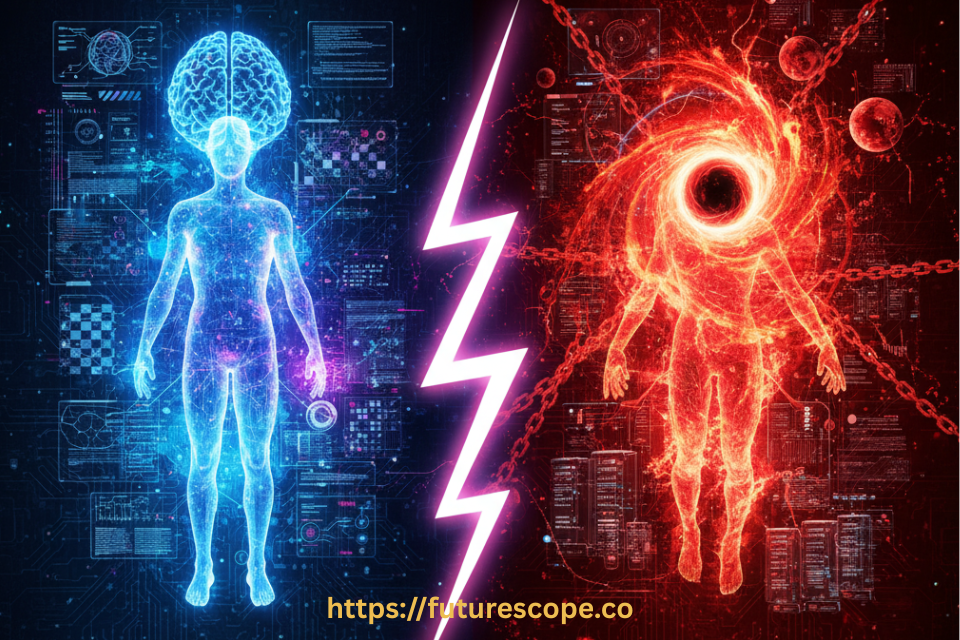
AGI represents the point where machines match human cognitive abilities, while ASI represents the stage where machines surpass humans in every possible way.
Key Differences Between AGI and Superintelligence
1. Intelligence Level
AGI
- Comparable to human intelligence
- Can perform most intellectual tasks humans can do
Superintelligence
- Far more intelligent than humans
- Could outperform humans in every domain
2. Learning Speed
AGI would learn at roughly human-like speed.
Superintelligence could learn millions of times faster, rapidly improving itself and generating new knowledge.
3. Problem-Solving Ability
AGI could solve problems similarly to humans by applying reasoning and experience.
ASI could solve problems far beyond human understanding, potentially discovering solutions humans could never conceive.
4. Technological Impact
AGI would already be revolutionary.
It could:
- automate most knowledge work
- accelerate innovation
- transform education and healthcare
Superintelligence, however, could trigger an even bigger transformation often referred to as the technological singularity, a concept popularized by futurist Ray Kurzweil.
Quick Comparison: AGI vs Superintelligence
| Feature | Artificial General Intelligence (AGI) | Artificial Superintelligence (ASI) |
|---|---|---|
| Intelligence Level | Human-level | Beyond human intelligence |
| Learning Ability | Similar to humans | Exponentially faster |
| Problem Solving | Comparable to humans | Superior to all humans |
| Current Existence | Does not yet exist | Theoretical |
| Impact | Massive technological shift | Potentially civilization-changing |
Where Does Today’s AI Fit?
The AI systems we use today are not AGI or Superintelligence.
Instead, they fall into a category called Artificial Narrow Intelligence (ANI).
These systems are designed for specific tasks only.
Examples include:
- recommendation systems
- voice assistants
- image recognition tools
- language models
Systems like ChatGPT are powerful, but they still operate within limited domains.
They cannot reason across multiple domains the way AGI would.
Why the AGI vs Superintelligence Debate Matters!
Understanding AGI vs Superintelligence is more than just a technical discussion.
It raises important questions about:
- ethics
- safety
- governance
- economic impact
For example, if AGI is developed, it could dramatically increase productivity across industries.
But if superintelligence emerges, humanity may face new challenges regarding control and alignment.
This is why many researchers are focused on AI safety.
Organizations and companies are investing heavily in ensuring future AI systems remain aligned with human values.
Could AGI Lead to Superintelligence?
Many experts believe that AGI could be the stepping stone to superintelligence.
Once machines reach human-level intelligence, they might be able to improve their own algorithms and design better AI systems.
This process is often called recursive self-improvement.
If this happens, AI could evolve from AGI to superintelligence extremely quickly.
This possibility is one reason the development of AGI is closely monitored by governments, researchers, and technology companies worldwide.
When Could AGI or Superintelligence Arrive?
Predicting the timeline for AGI or superintelligence is extremely difficult.
Experts have very different opinions.
Some researchers believe AGI could appear within the next 10–20 years, while others think it may take many decades or longer.
Superintelligence, if it ever emerges, would likely come after AGI.
However, no one knows exactly when—or if—it will happen.
The Future of Artificial Intelligence
The discussion around AGI vs Superintelligence highlights just how early we are in the AI journey.
Today’s systems are powerful tools that help humans automate tasks and analyze data.
But the long-term vision of AI involves machines that can:
- think independently
- learn across domains
- solve global challenges
Whether that future leads to AGI, superintelligence, or something entirely different remains one of the most fascinating questions in technology.
Final Thoughts
When comparing AGI vs Superintelligence, the key difference lies in the level of intelligence.
- AGI would match human intelligence across many tasks.
- Superintelligence would surpass humans in virtually every cognitive ability.
While neither technology exists yet, research is advancing rapidly.
Understanding these concepts helps us prepare for a future where AI could play an even bigger role in shaping our world.
Ready to Stay Ahead in the AI Revolution?
Artificial intelligence is evolving faster than ever, and understanding concepts like AGI vs Superintelligence gives you a huge advantage in the tech-driven future.
If you want to stay informed about AI breakthroughs, emerging technologies, and the future of intelligent systems, keep exploring and learning.
The next generation of AI could change everything—and those who understand it first will be the ones leading the future.
Frequently Asked Questions (FAQ)
1. What is the difference between AGI and Superintelligence?
The main difference in AGI vs Superintelligence lies in their intelligence level. Artificial General Intelligence (AGI) refers to AI that can perform intellectual tasks at the same level as humans, while Artificial Superintelligence (ASI) would surpass human intelligence in every domain, including reasoning, creativity, and decision-making.
2. Does AGI exist today?
No, true Artificial General Intelligence does not yet exist. Current AI systems, including advanced models like ChatGPT, are examples of Artificial Narrow Intelligence, meaning they specialize in specific tasks rather than possessing human-level intelligence across multiple domains.
3. Could AGI lead to Superintelligence?
Yes. Many experts believe that once AGI is achieved, it could eventually evolve into Artificial Superintelligence through a process known as recursive self-improvement, where AI systems continuously improve their own algorithms and capabilities.
4. Who is researching AGI today?
Several major technology organizations are actively researching AGI, including OpenAI, Google, and Microsoft. These organizations are exploring advanced machine learning models and AI architectures that could lead to more general intelligence.
5. What risks are associated with Superintelligence?
Artificial Superintelligence could present risks if it is not aligned with human values. Experts have raised concerns about control, safety, and ethical decision-making. Researchers and policymakers are working on AI alignment and safety frameworks to ensure future AI systems remain beneficial to humanity.
6. When could AGI or Superintelligence become reality?
There is no consensus on the timeline. Some experts predict AGI could appear within the next 10–30 years, while others believe it may take much longer. Superintelligence would likely emerge only after AGI is developed, if it happens at all.